As of reporting published on 10 November 2026, Ethereum researchers and the Ethereum Foundation were running two clocks for a post-quantum transition. The question in that account is not whether a hash-based replacement for ECDSA can be written down. It is whether the protocol can land the required hard forks on something close to an eight-month cadence without breaking contracts that already depend on observable behavior.
Two deadlines, one year apart
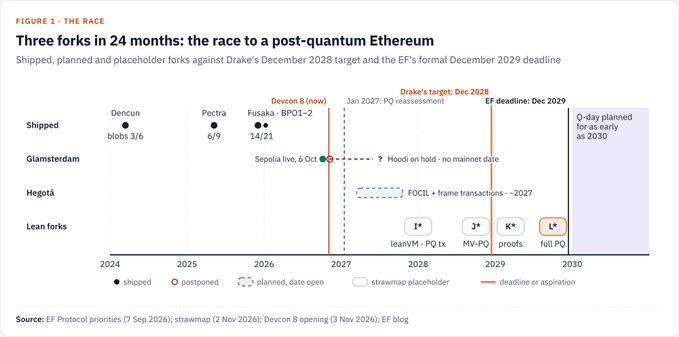
Devcon 8 ran from 3 to 6 November 2026 at the Jio World Centre in Mumbai, the first Devcon held in India. On the opening morning, Ethereum Foundation researcher Justin Drake said he hoped the quantum-resistant and “post-AI” transition would be finished by December 2028. As the roadmap was described, that means three hard forks in the 24 months after Glamsterdam.
That is a year ahead of the Foundation’s formal commitment. In a priorities article published the previous September, the Foundation pledged three-layer quantum resistance by December 2029 and said that date would not move before an external expert review in January 2027. The report’s reading is that researchers were already working toward 2028, while 2029 remained the preset deadline. The September article is not quoted as defining what the three layers are; this account does not fill that gap.
The same week supplied a reason to treat the gap as operational. On 22 October 2026, Glamsterdam, the next hard fork, was withdrawn from its second testnet. On Devcon’s last day the Foundation’s explanation was that a gas repricing had broken assumptions deployed contracts rely on. The report’s claim is that cryptography for a quantum-resistant Ethereum was close to ready, and that the constraint was shipping it one fork at a time without breaking what already runs.
A smaller Devcon, pointed at CROPS
The Mumbai program was deliberately smaller: 370 talks and 399 speakers over four days, about 43 percent fewer sessions than Devcon 7 in Bangkok. The Foundation had cut 54 roles in 2026, about one fifth of staff. Two thirds of main-venue talks carried the charter label CROPS — censorship resistance, open source, privacy, and security. Security sessions were the largest set, at 70, followed by privacy at 65 and AI at 57. According to media reports cited in the article, not a transcript reproduced there, Vitalik Buterin’s opening talk argued that technology leads people to trust too much and verify too little, ranging across operating systems and chips, health technology, communications, and AI. Devcon IX was scheduled for 11–13 October 2027 in Lisbon.
The fork ladder
The Foundation’s draft roadmap orders work by fork. Later forks are letter placeholders: H* is Hegotá, then I*, J*, K*, and L*. Quantum-resistant Ethereum, on this draft, is assembled along that sequence rather than in one replacement fork.
Hegotá, placed in 2027, is not itself the quantum-resistant fork. It introduces frame transactions so an account can choose its own signature scheme — the stated path off ECDSA. I* introduces leanVM, a minimal proving virtual machine, and quantum-resistant “lean” transactions. J* introduces hash-based validator signatures and quantum-resistant data sampling; the Foundation calls J* the “minimum viable quantum resistance” milestone. K* and L* carry mandatory execution proofs and the rest of the Lean architectural refactor.
Three forks in 24 months is one every eight months. Recent intervals cited in the report were 11 months, 14 months, and 7 months, and Glamsterdam had already run 11 months without shipping. By the arithmetic given there, reaching L* by December 2029 would require a fork every 7.2 months. At a 12-month pace, only J* would arrive on time. That comparison is a schedule argument from those intervals, not a measurement of future core-dev throughput.
Why the account treats the clock as short
The report traces urgency to two threat lines, both used to argue for hash functions as the primitive with the fewest assumptions and the hardest to break. Neither line is presented as a completed break of Ethereum.
In March 2026, researchers from Google Quantum AI, UC Berkeley, the Ethereum Foundation, and Stanford jointly published an estimate that breaking Ethereum’s elliptic-curve signatures would take fewer than 1,200 logical qubits and fewer than 500,000 physical qubits, with a runtime measured in minutes — fast enough, on that estimate, to attack a transaction while it was still queued in the mempool.
In July 2026, Anthropic reported that one of its models had found an attack lowering key-recovery cost for the lattice signature scheme HAWK-256 from about 2^64 operations to about 2^38. In October 2026, Drake urged the industry to “calmly start planning bunker mode”: preparation for a case in which AI-assisted mathematics breaks ECDSA before any quantum computer does. These are a published estimate, a reported attack on a different scheme, and a stated planning posture.
Where Glamsterdam actually stuck
Glamsterdam had been running on the Sepolia testnet since 6 October 2026. The report describes two core changes as sound in design. Enshrined proposer-builder separation brings builder bids into the protocol and moves execution off the slot’s critical path. Block-level access lists declare a block’s read and write sets in advance so clients can execute in parallel.
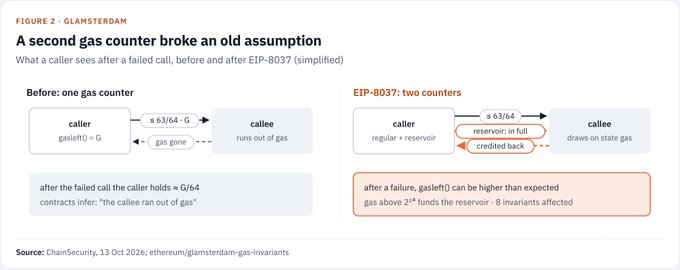
The break was repricing. EIP-8037 prices new state at 1,530 gas per byte in order to slow state growth. Writing a new storage slot rises from 22,100 gas to 110,020 gas, and deploying a 24 kB contract costs about eight times more. Costs of that size do not fit the per-transaction gas cap as the source prints it — 224 — which the same report flags as a likely slip for 2^24. This account does not resolve that figure. Gas above the cap enters a separate state-gas reserve, is passed in full to the called contract, and is refunded if the call reverts.
ChainSecurity’s observation, as relayed, is that error handlers which used to stop on out-of-gas can now run to completion and bypass common griefing checks. The Foundation listed eight broken invariants: rules the protocol is supposed to uphold at all times. An All Core Devs summary counted 13 affected DeFi projects. The Hoodi testnet was postponed, with no Hoodi or mainnet date given. All Core Devs coordinator Nixo wrote that this “very likely pushes Glamsterdam mainnet into 2027.”
The lesson drawn is wider than one EIP, and it is an argument rather than a new measurement. A chain’s real interface is every observable behavior — gas costs, the 63/64 forwarding rule, whether an account can run code — and each is a migration risk. The dependency named in the report is concrete: Hegotá’s frame transactions list EIP-8037 as a requirement.
Hegotá: inclusion lists and account-chosen signatures
Two mechanisms are specified for Hegotá.
FOCIL (EIP-7805) has 16 validators per slot each publish an inclusion list of up to 8 KiB of mempool transactions. The next block must include those transactions unless they are invalid or the block is full, and attesters enforce that through fork choice. Censoring a transaction would then require every includer who saw it to cooperate, rather than capturing a single builder.
Frame transactions (EIP-8141) let an account define how it authorizes a transaction, so a later move to a quantum-resistant signature need not wait on a fork for each scheme. Rejected proposals are offered as evidence of design choices, not as a formal philosophy statement: optional execution proofs, enshrined privacy pools, and block-in-blobs were turned down, the last because it would deepen dependence on KZG commitments. The LUCID encrypted mempool was deferred to a later fork. The pattern the underlying author draws — interpretation, not a recorded decision rule — is that Ethereum keeps choosing mechanisms that make the protocol a better platform, rather than mechanisms that build a particular application into it.
Longer consensus signatures, with aggregation asked to pay
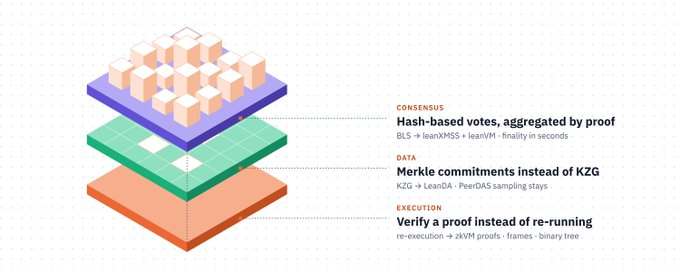
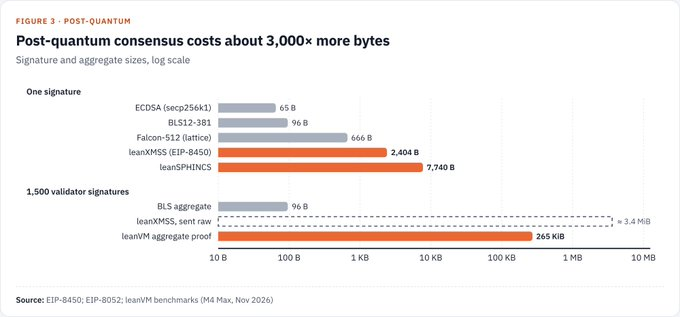
Under draft EIP-8450, a validator would register a dormant hash-based key in addition to its existing key. A leanXMSS signature is 2,404 bytes, against 96 bytes for BLS. BLS signatures can be added together; hash-based signatures cannot, so an aggregator instead proves that it checked every signature. On the leanVM figures given, a laptop aggregates about 965 signatures per second, and 1,500 signatures become a 265 KiB proof verified in 7.4 milliseconds.
On the data layer, KZG commitments are to give way to LeanDA: Merkle commitments plus a leanVM proof that the data was encoded correctly. On the user side, wallets would use leanSPHINCS. Those signatures are 7,740 bytes. After in-mempool aggregation under EIP-8288, the report puts the cost near 33,000 gas each, against 150,000 to 200,000 gas to verify one directly. Those are design figures attached to drafts, not mainnet measurements.
What “formal verification” covered
Drake announced end-to-end formal verification of leanVM. The report qualifies that immediately. Lean 4 work on the project proved soundness of the instruction semantics and of the constraints. The Rust implementation had only differential testing. Soundness of the recursive proofs remained an open problem, and the code was not production-ready. On this account, the announcement does not mean a production verifier with a closed proof.
EIP-8288 keeps the heavy objects out of the block
The proposal singled out as closest to the direction Buterin has argued for is EIP-8288, in-mempool signature and proof aggregation. He co-wrote the draft with Thomas Coratger in June 2026. Posts on 19 October 2026 state the claim directly: precompiles and the EVM are both poor homes for most of Ethereum’s cryptographic support, because data that either path handles must go on-chain. A September 2026 article had already listed parallel in-mempool handling of signatures and proofs as part of a 2030 design. That is a stated design intent.
The size problem is specific. A hash-based signature is 2 to 3 KB and costs 150,000 to 200,000 gas to verify in the EVM. STARKs used by privacy protocols are 128 to 512 KB. Posted one by one, quantum-resistant accounts become extremely expensive, privacy transactions stay impractical, and both objects are too large for FOCIL inclusion lists.
EIP-8288 keeps that payload out of the block. A transaction declares dependencies rather than carrying them. Frame transactions gain a frame mode that lists each dependency as a 96-byte reference: scheme, data hash, and key hash. One transaction may declare at most 16 leanSPHINCS signatures and one STARK. When the transaction arrives, nodes check the real signatures and proofs and fold them, each second, into a recursive STARK. Builders and FOCIL includers do the same for what they pack. The block header adds one recursive STARK covering every dependency in the block, and validators check only that proof.
On the report’s arithmetic, one aggregated leanSPHINCS signature costs about 33,000 gas: 3,000 from the frame and 30,000 as its share of the block STARK, against 150,000 to 200,000 for direct verification. If STARK dependencies are switched on — they are only reserved in the draft — a privacy proof that would cost millions of gas on-chain falls to about 60,000 gas. A new signature scheme could be wrapped in a proof without a dedicated precompile and without waiting for a fork. Core developers had already moved that way in one decision: in October 2026 they rejected an ML-DSA precompile for Hegotá and preferred hash-based schemes. The specification caps builder overhead at about 256 KB per aggregation interval, however many signatures are inside.
Draft status is part of the evidence. EIP-8288 was a draft. STARK dependencies were reserved only. Aggregation keys and dependency hashes were still marked to be determined. Reverted transactions are charged; the authors acknowledge a higher risk of mempool denial of service, and describe recursive-proof soundness as widely believed but not proved. Coverage cited in the report places the EIP on a fork after Hegotá, with no schedule. It also depends on Hegotá shipping frame transactions, which depend on the Glamsterdam repricing then under review. A written mechanism and a shippable dependency chain are not the same thing.
Finality and proofs: speed reported, assurance not
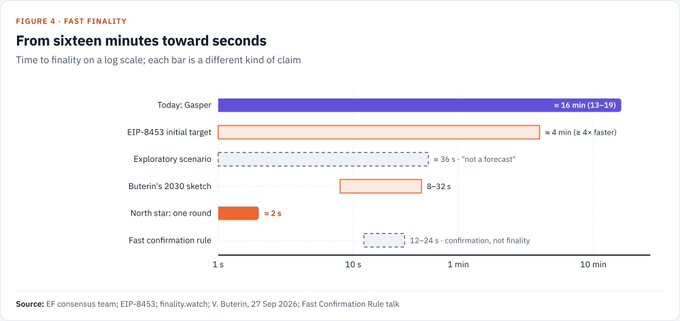
Finality was about 16 minutes. Draft EIP-8453, “decoupled consensus,” splits the path in two: a fast availability chain confirmed by a committee of about 512 validators, and a separate finality component run by the full validator set. The stated first goal is to make finality at least four times faster. A longer-range sketch on finality.watch runs from an exploratory 36 seconds — the site labels that figure “not a prediction” — toward a north star of one-second blocks and two-second finality. Separately, a Fast Confirmation Rule is described as letting exchanges and bridges shorten deposit confirmation to 12–24 seconds. Targets and a labeled non-prediction are not measured mainnet finality.
Replacing re-execution with proofs had, on the report, already changed the speed picture. On 8 November 2026, three provers met the Ethproofs real-time standard on 4 to 16 consumer-grade GPUs, at about $0.003 to $0.007 per block. The bottleneck named next is the security claim. The Foundation’s following milestone, set for early December 2026, was 128-bit provable security. As quoted from Devcon, Cody Gunton said that no team had yet produced a formally verified verifier implementation. Proof integration was paused: Hegotá did not include optional proofs, and the draft roadmap puts mandatory proofs at K*. A higher gas limit was also waiting on a later fork. Mainnet was still 60 million gas per block and Sepolia about 200 million, against a gigagas aim of 200 times the throughput at the time of the report.
Items the report treats as secondary
Blob parameters since January 2026 were a target of 14 and a cap of 21. From June through September the average was about 4.4 blobs per block, each priced far below one cent. Capacity was ahead of demand on those figures.
On rollups, the data platform L2BEAT had been renamed ETHBEAT. Most rollup value was still at Stage 1. Base was about $14 billion and Arbitrum about $9 billion. The report says “value,” not a separately defined metric, and does not state a measurement date beyond that snapshot.
On interop, the Ethereum Economic Zone had demonstrated atomic calls between L1 and L2 on a devnet. Gnosis Chain planned to join in spring 2027.
On privacy, the Foundation’s Kohaku wallet stack had demonstrated private transfers through Privacy Pools and Tornado Cash. The code had not been audited.
On security, the report states that on 29 October 2026 about $6.36 billion was stolen from Binance, attributed to North Korea’s TraderTraitor. The attack used 50 pre-signed EIP-7702 authorizations to drain a hot wallet. TRM Labs, as cited, said the upgrade amplified the attack but was not the cause. The report lists this as a security event, not as a finding about the quantum roadmap.
What was still open on 10 November 2026
The report left the following unresolved. Dates below are as scheduled at publication, not later outcomes.
- ACDC #191 on 12 November 2026 and ACDE #249 on 19 November 2026 were to discuss fixes for EIP-8037 and EIP-8038 and to give a new Hoodi testnet date. The contents of EIP-8038 are not described.
- January 2027 would show whether December 2028 was formally adopted as the quantum-resistance deadline.
- It was unsettled whether a Hegotá devnet could run FOCIL and frame transactions together.
- Which quantum-resistant key registry would be chosen, and in which fork, was open.
- leanVM’s hash function and finite field were not final, and a soundness proof for its proof system was still missing.
- The early-December 2026 milestone of 128-bit zkEVM security had not yet come due.
The article’s conclusion, which this account does not strengthen, stays narrow. By 10 November 2026 the shape of a quantum-resistant Ethereum — hash-based signatures, account-chosen authorization, mempool aggregation, and a later proving layer — had been specified across drafts. Whether that design could advance while hard forks actually shipped about every eight months was the question left open in Mumbai. The Glamsterdam slip, the stated fork intervals, and the draft status of EIP-8288 do not settle it.
Source: panewslab.com (originally published 2026-11-10 10:59 UTC+8)