Originally reported November 10, 2026, at 12:52 p.m. UTC+8. This is a historical summary of Four Pillars’ weekly report, translated by TechFlow.
Four Pillars’ November 10 report separates two questions that are easy to conflate: whether Congress will pass a comprehensive U.S. crypto law, and whether regulators can permit specific products under existing authority. It also examines what Hyperliquid’s first-half figures say—and do not yet say—about revenue from markets beyond crypto.
Legislation slows; agency proposals remain in motion
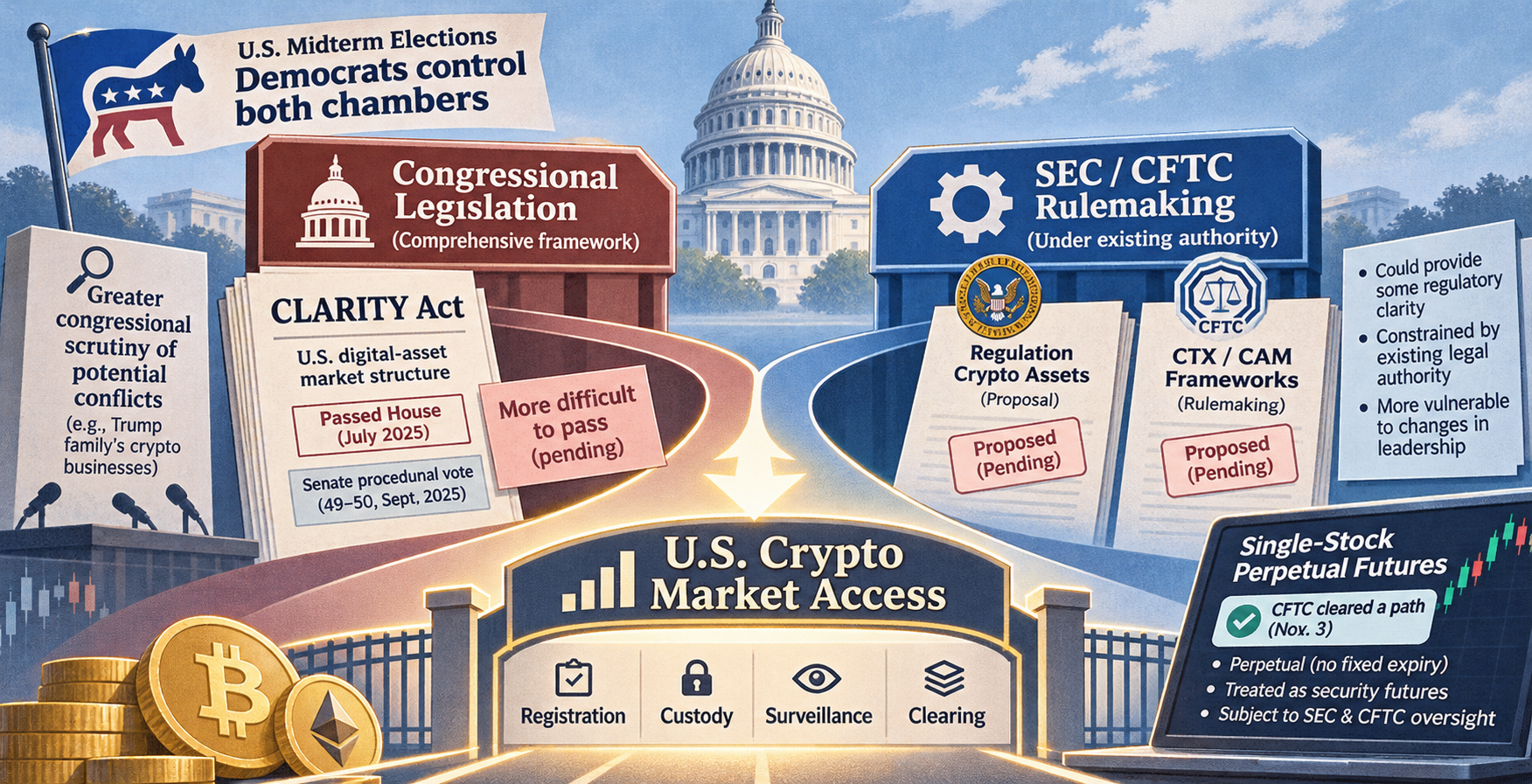
The report says Democrats won control of both chambers in the November 3 U.S. midterm elections, flipping at least seven Senate seats and gaining more than 20 House seats. The new Congress was due to take office in January 2027. Four Pillars expects that result to make passage of the CLARITY Act, a proposed federal digital-asset market-structure framework, more difficult. The bill passed the House in July 2025 but failed to advance in a 49–50 Senate procedural vote that September.

Four Pillars also expects greater congressional scrutiny of potential conflicts involving the Trump family’s crypto businesses. Those concerns are attributed in the report to Democratic lawmakers; they are not findings that a conflict influenced policy.
Agency action is a separate track. According to the report, the SEC proposed Regulation Crypto Assets in August 2026, while the CFTC began rulemaking on its proposed CTX and CAM frameworks in October. These were proposals, not final rules. Four Pillars argues that agency action could offer some regulatory clarity without a comprehensive statute, while noting that it remains constrained by existing legal authority and could be more vulnerable to changes in leadership.

A regulated route for single-stock perpetuals faces a challenge
The report says the CFTC cleared a path on November 3 for single-stock perpetual futures on U.S.-regulated exchanges that also complete SEC securities-futures registration. Perpetual contracts have no fixed expiry and can provide price exposure without ownership of the underlying stock. Under the framework described by Four Pillars, these products are treated as security futures subject to both agencies’ oversight.
Four Pillars reports that Kalshi launched contracts covering more than 50 companies on November 5 and recorded over $300 million in early trading volume. It also describes proposed offerings from other exchange operators. An announced partnership between Intercontinental Exchange and Trade[XYZ] aims to build regulated trading and clearing infrastructure using Hyperliquid technology; the report says that plan and Hyperliquid Strategies’ application for futures commission merchant registration still required regulatory approval. An industry coalition including Cboe and Citadel Securities had sued to challenge the CFTC’s authority, leaving the legal path contested.
Regulatory acceptance of a contract type would not, by itself, authorize an offshore or decentralized platform to serve U.S. customers. Four Pillars identifies registration, custody, surveillance and clearing as separate requirements.
Hyperliquid: volume growth is not yet equivalent to revenue growth
In the 2026 H1 Hyperliquid Half-Year Report, prepared by the Hyperliquid Research Collective formed by GLC Research and Four Pillars, protocol revenue was $351 million: up 6.4% year over year, but down 38% from the record second half of 2025. June revenue reached $71 million, its best monthly result since the preceding November. The report records $288 million spent on HYPE buybacks during the half-year.
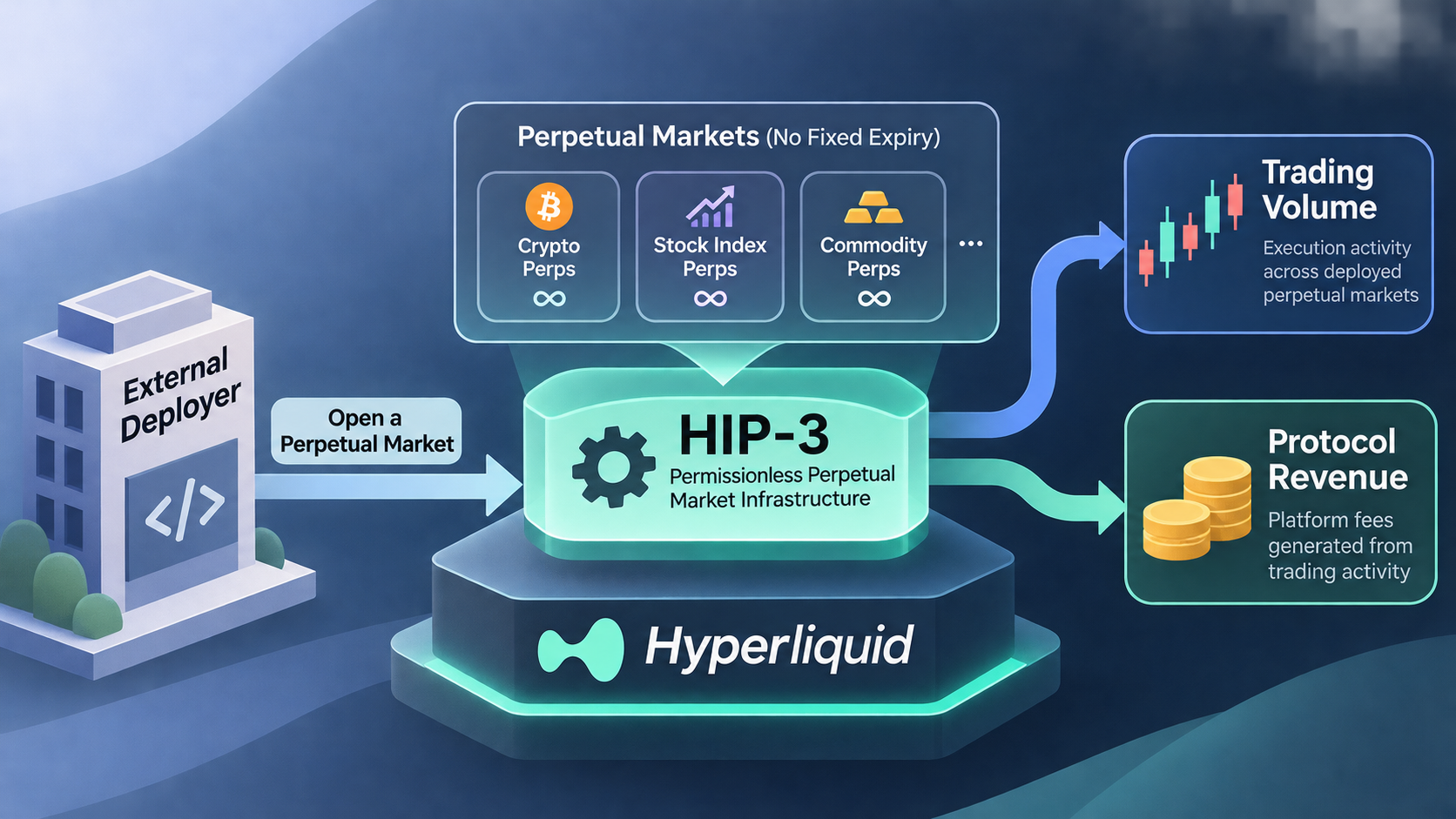
HIP-3, which allows external deployers to open perpetual markets on Hyperliquid infrastructure, accounted for $324 billion in first-half volume, or 25.1% of platform volume. Its share rose to 32.0% in the second quarter. Yet HIP-3 generated only 7.4% of protocol revenue under subsidized fee pricing, versus 85.6% from native crypto perpetuals. Concentration is another limitation: the report says Trade[XYZ] represented 97% of HIP-3 volume in June. The evidence supports broader trading activity, but not an assumption that this activity already produces proportionate revenue.
The report estimates that an arrangement directing roughly 90% of cost-adjusted USDC reserve interest to the Assistance Fund could contribute $135 million–$200 million annualized, based on then-current rates and balances. It explicitly says this income was not recognized in first-half results and that actual distribution benefits had not been established. At June 30, the report counted $309 million in cumulative net inflows to three U.S. spot HYPE ETFs, while flagging $4.3 billion in vested but unclaimed tokens as potential supply pressure. These estimates and holdings are report-specific measurements, not independently verified valuation inputs here.
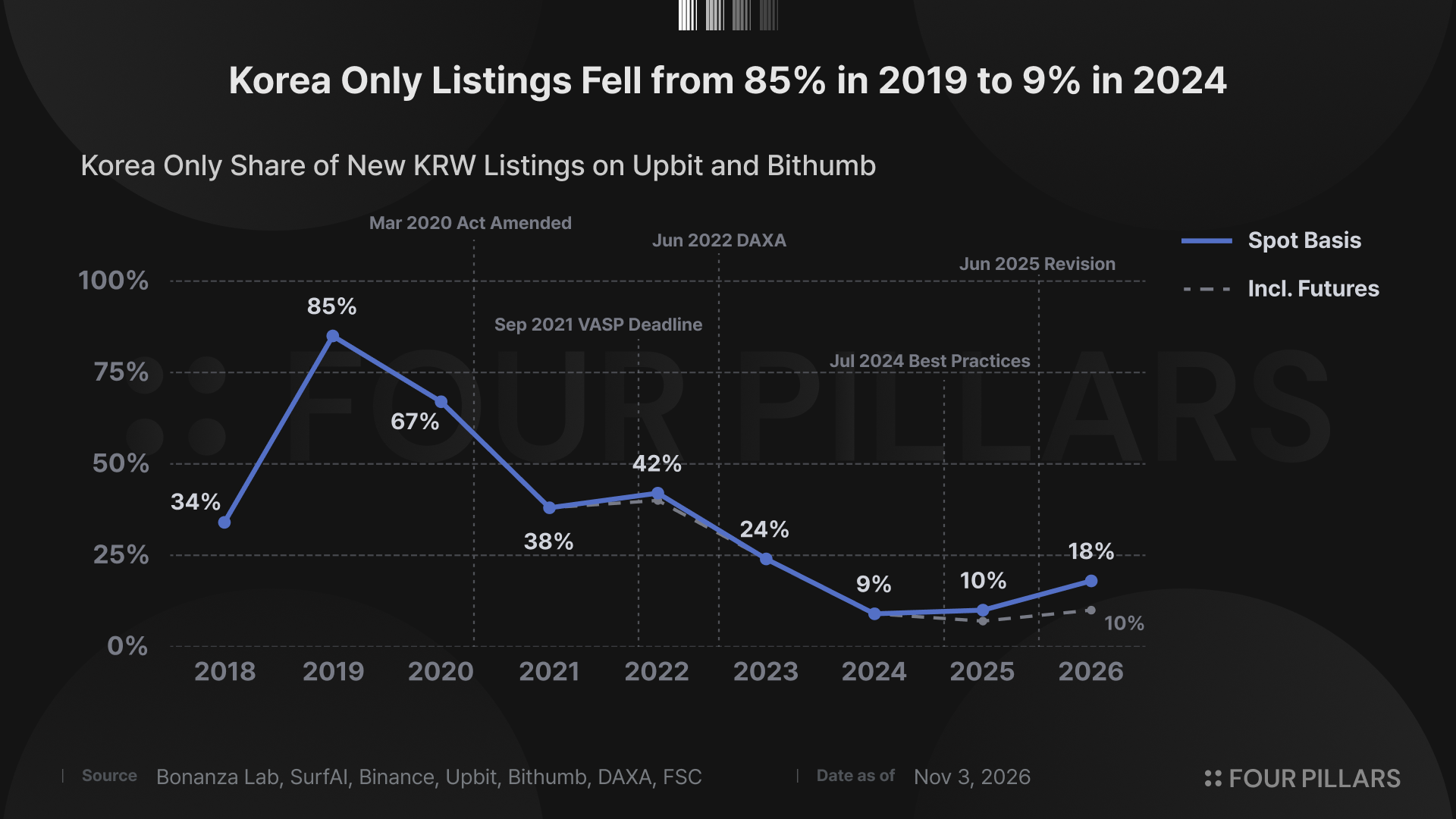
The weekly report also cites Korean exchange-listing data from Bonanza Lab, SurfAI, Binance, Upbit, Bithumb, DAXA and the FSC: the share of new KRW-pair listings exclusive to Korea fell from 85% in 2019 to 9% in 2024, then stood at 18% in 2026. Its separate account of an October 30 Binance theft attributes the $6.36 billion loss figure to Four Pillars and the attribution to TraderTraitor to the FBI; the summary does not establish those findings independently.
Source: techflowpost.com (originally published 2026-11-10 12:52 UTC+8)