
In a report dated November 17, 2026, Kaiko data showed that the stablecoin market had lost about $12 billion in value over the preceding 30 days. The report described it as the sector’s fastest contraction since the 2022 Terra-Luna collapse. USDT and USDC accounted for roughly 90% of the decline.
The distinction for market liquidity is whether traders are moving between stablecoins or reducing their stablecoin holdings altogether. Kaiko research head Anastasia Melachrinos said USDT and USDC had each contracted by about 4%, without either losing its dollar peg during the period. She interpreted their parallel declines as evidence of holders cashing out to dollars rather than fleeing one issuer for another. The supply figures support the observation that both tokens shrank; they do not, on their own, establish every holder’s destination for the funds.
Glassnode researcher Sean Rose said USDT and USDC balances on centralized exchanges had fallen by a combined $26.7 billion since April 2026. Exchange balances measure stablecoins held at trading venues, not the total stablecoin supply, so the two declines should not be treated as interchangeable. Rose also said Glassnode had recorded a peak in total stablecoin market value of $312.6 billion on April 17, 2026, compared with approximately $284 billion at the time of the report.
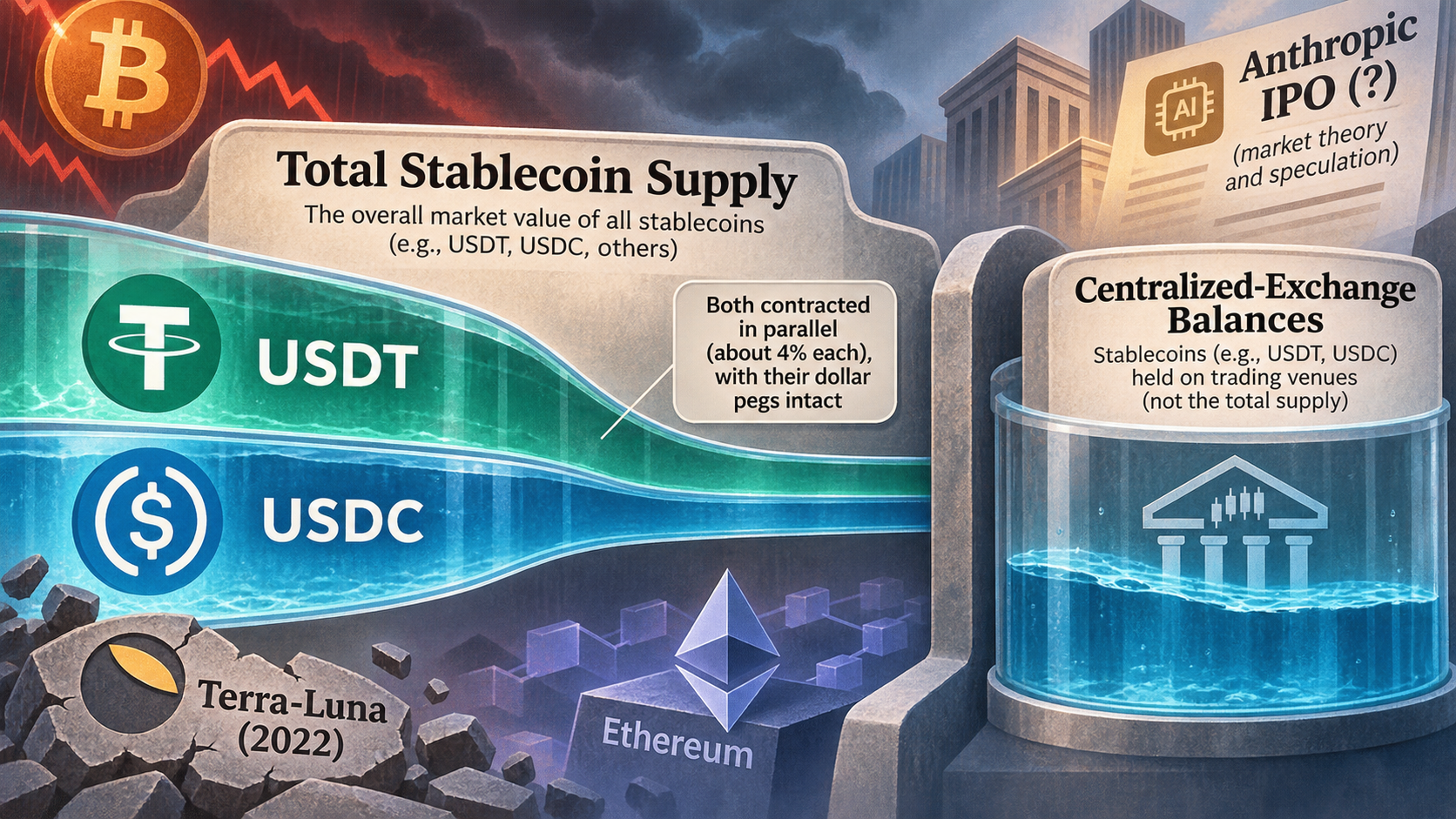
Kaiko’s data placed much of the contraction on Ethereum. The report linked thinner liquidity to a sharp Bitcoin sell-off on Saturday, November 14, when Bitcoin fell as much as 8% within hours during New York trading. That sequence does not establish how much of the price move was caused by stablecoin outflows.
The report also relayed a theory from Tagus Capital that institutions might be selling crypto assets to raise cash for a potential Anthropic IPO. Tagus compared Bitcoin ETF flows with a previous fundraising pattern and cited an approximately $1.8 trillion valuation on Hyperliquid’s perpetual-contract market, a $1.4 trillion upper end of a purported filing range, and possible fundraising of $100 billion. Those were Tagus’s claims and speculation, not evidence that such an IPO was scheduled or that it caused the stablecoin contraction.
Rose contrasted the simultaneous declines in USDT and USDC with the 2022–2023 downturn, when, he said, total stablecoin market value fell about 35% while USDT expanded. The comparison identifies a difference in the reported supply pattern, not a forecast of what follows.