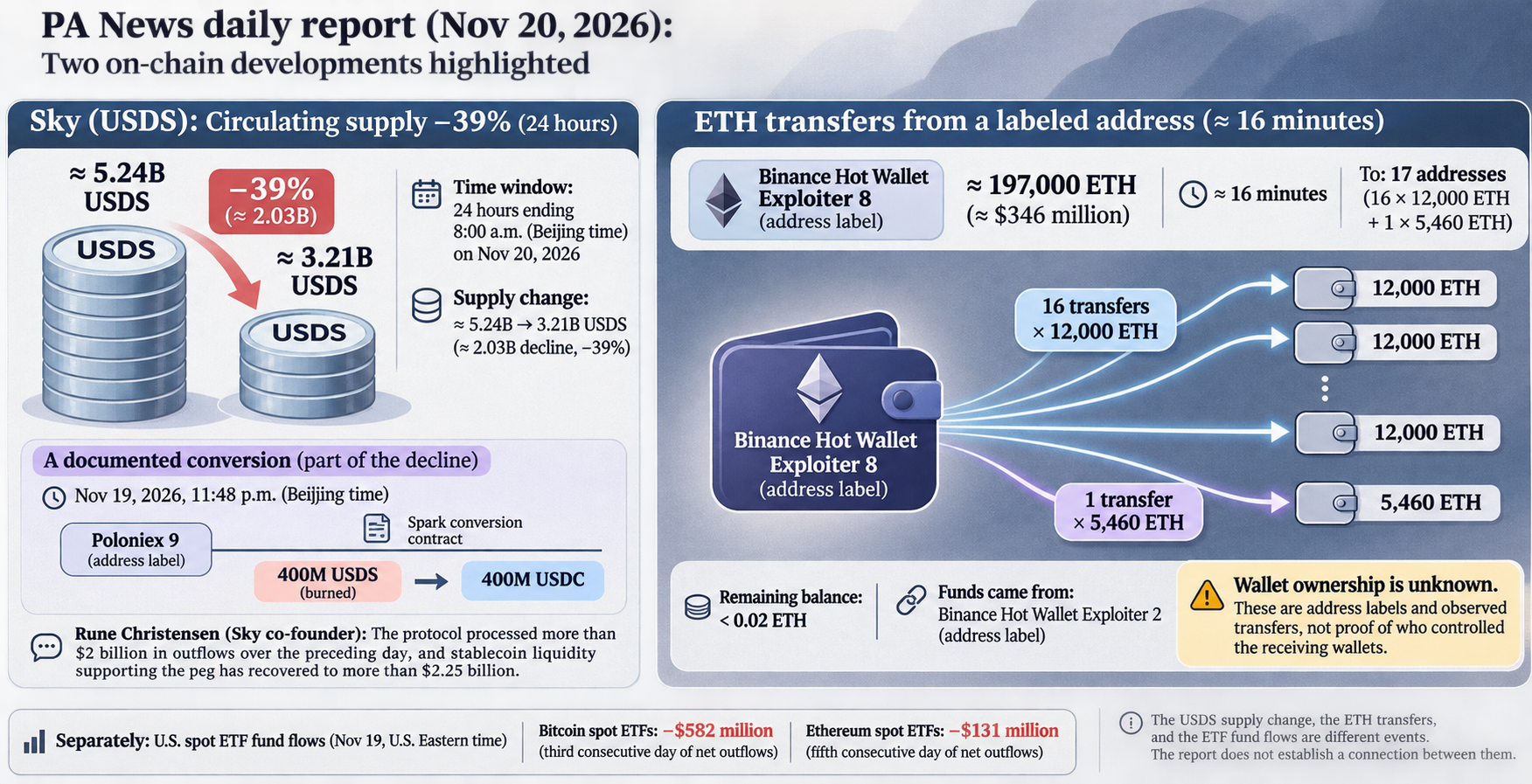
In its November 20, 2026 daily report, PA News highlighted two on-chain developments: a sharp decline in Sky’s USDS circulating supply and a series of ETH transfers from an address labeled as connected to the October Binance theft. The figures describe different events; the source does not establish a connection between them.
USDS supply and a documented conversion
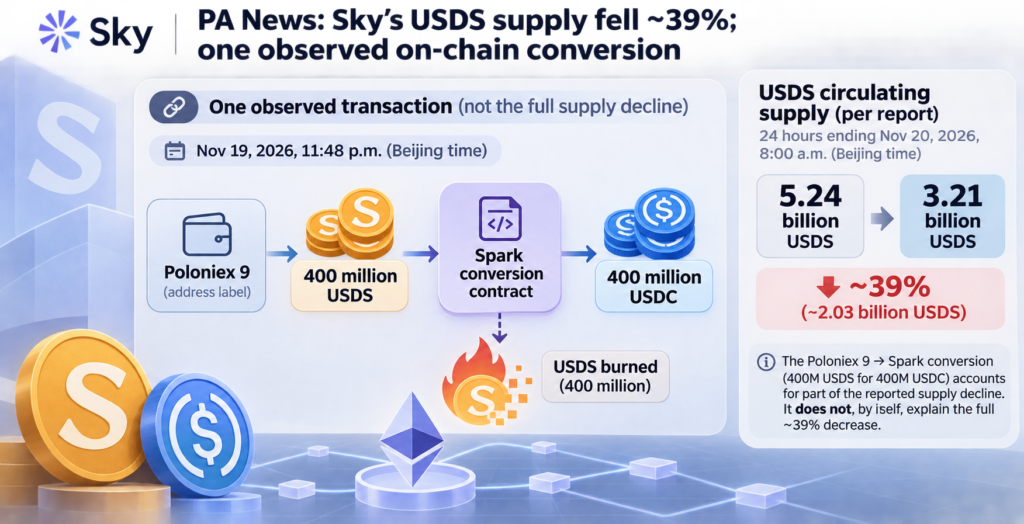
Citing DefiLlama data reported by The Defiant, PA News said USDS circulating supply fell about 39% in the 24 hours ending at 8:00 a.m. Beijing time on November 20. Supply declined from roughly 5.24 billion to 3.21 billion USDS, a reduction of about 2.03 billion.
One identifiable transaction accounts for part of that change. Ethereum records showed that at 11:48 p.m. Beijing time on November 19, an address labeled “Poloniex 9” exchanged 400 million USDS for 400 million USDC through a Spark conversion contract; the USDS was burned. That transaction does not, by itself, explain the full reported supply decline. Sky co-founder Rune Christensen said the protocol had processed more than $2 billion in outflows over the preceding day and that stablecoin liquidity supporting the peg had recovered to more than $2.25 billion.
ETH transfers from a labeled address
Etherscan data cited in the report showed that an address labeled “Binance Hot Wallet Exploiter 8” sent about 197,000 ETH, valued at approximately $346 million at the price used in the report, to 17 addresses over roughly 16 minutes. The transfers comprised 16 transactions of 12,000 ETH each and a final transfer of 5,460 ETH. Its remaining balance was below 0.02 ETH. The report said its funds came from an address labeled “Binance Hot Wallet Exploiter 2.” These are address labels and observed transfers, not proof in the report of who controlled the receiving wallets.
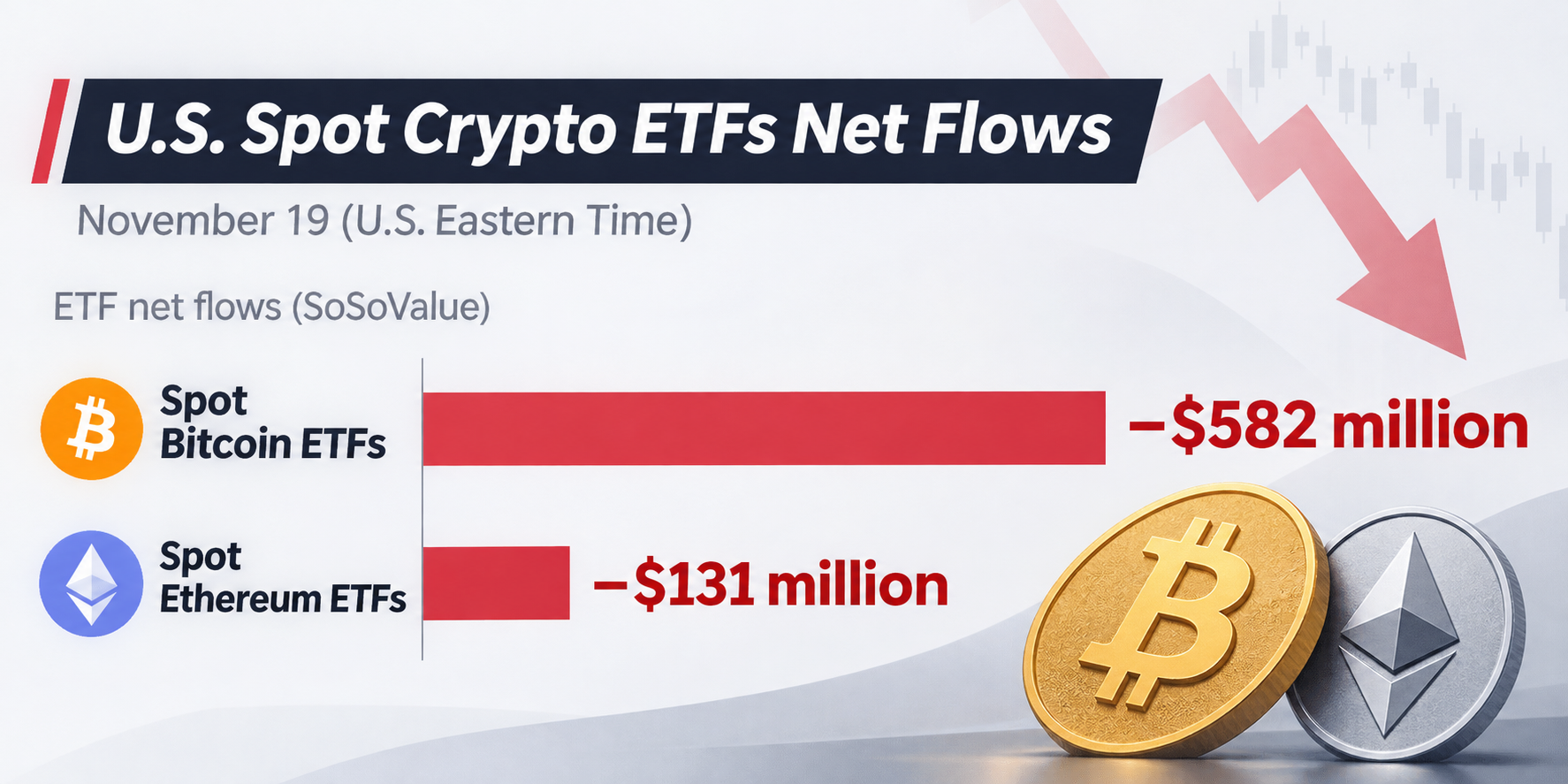
Separately, SoSoValue data for November 19, U.S. Eastern time, showed net outflows of $582 million from U.S. spot Bitcoin ETFs and $131 million from U.S. spot Ethereum ETFs—their third and fifth consecutive days of net outflows, respectively. Those fund-flow figures measure a different market activity from the on-chain transfers and USDS supply change.