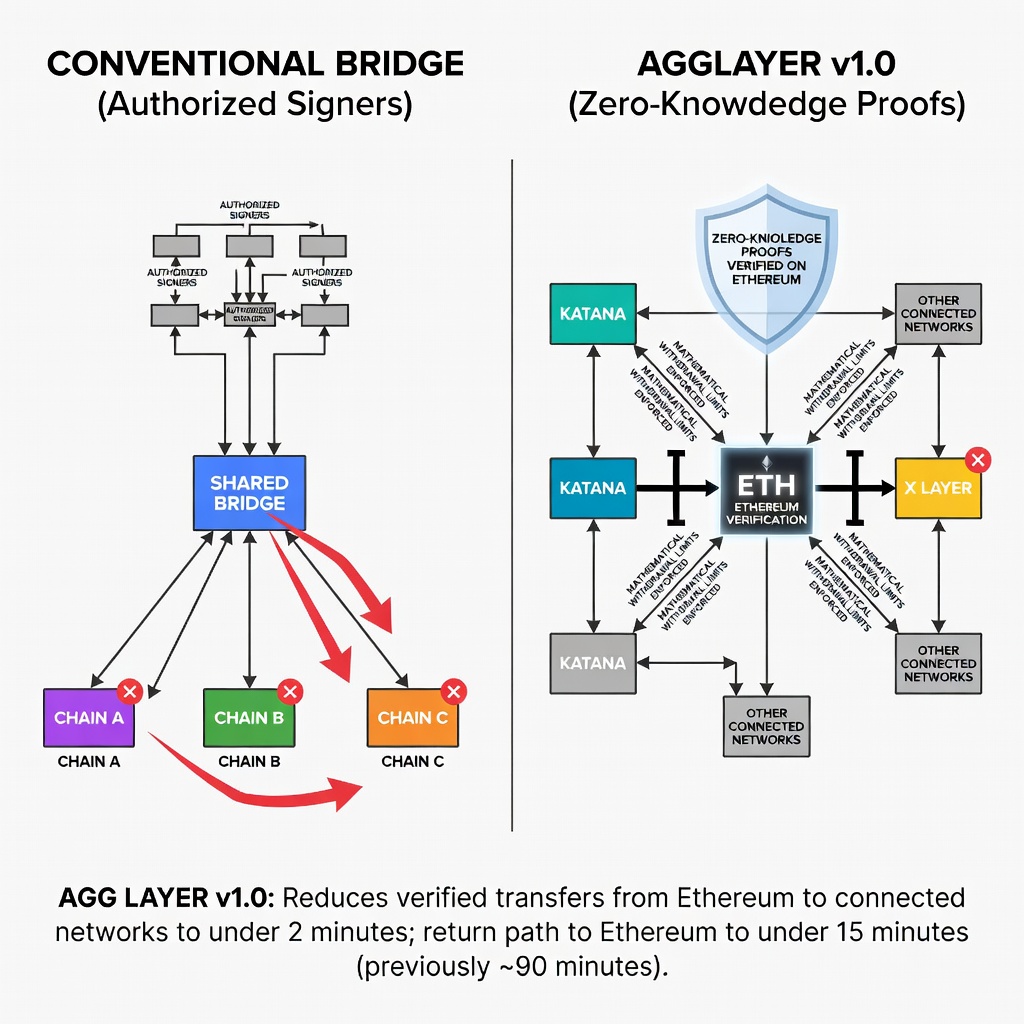
On November 23, 2026, Polygon Labs said it had released Agglayer v1.0, reducing verified transfers from Ethereum to connected networks to under two minutes and cutting the return path to Ethereum to under 15 minutes, from roughly 90 minutes. Those figures come from a November 23 announcement the company shared with crypto.news. The account below stays inside that report. It is not a later operational update, and it does not treat company descriptions as independent measurements.
What the latency claim covers
Polygon Labs said a transfer from Ethereum to a connected network—Katana was the example it gave—can complete in less than two minutes. The reverse transfer takes under 15 minutes, with each settlement verified through Ethereum. The company framed v1.0 as shorter settlement time without dropping Ethereum verification, and it described the release as the fastest zero-knowledge-verified settlement infrastructure then operating in production. That “fastest” wording is Polygon Labs’ characterization. The report does not name a benchmark, a comparison set, or a measurement date for it.
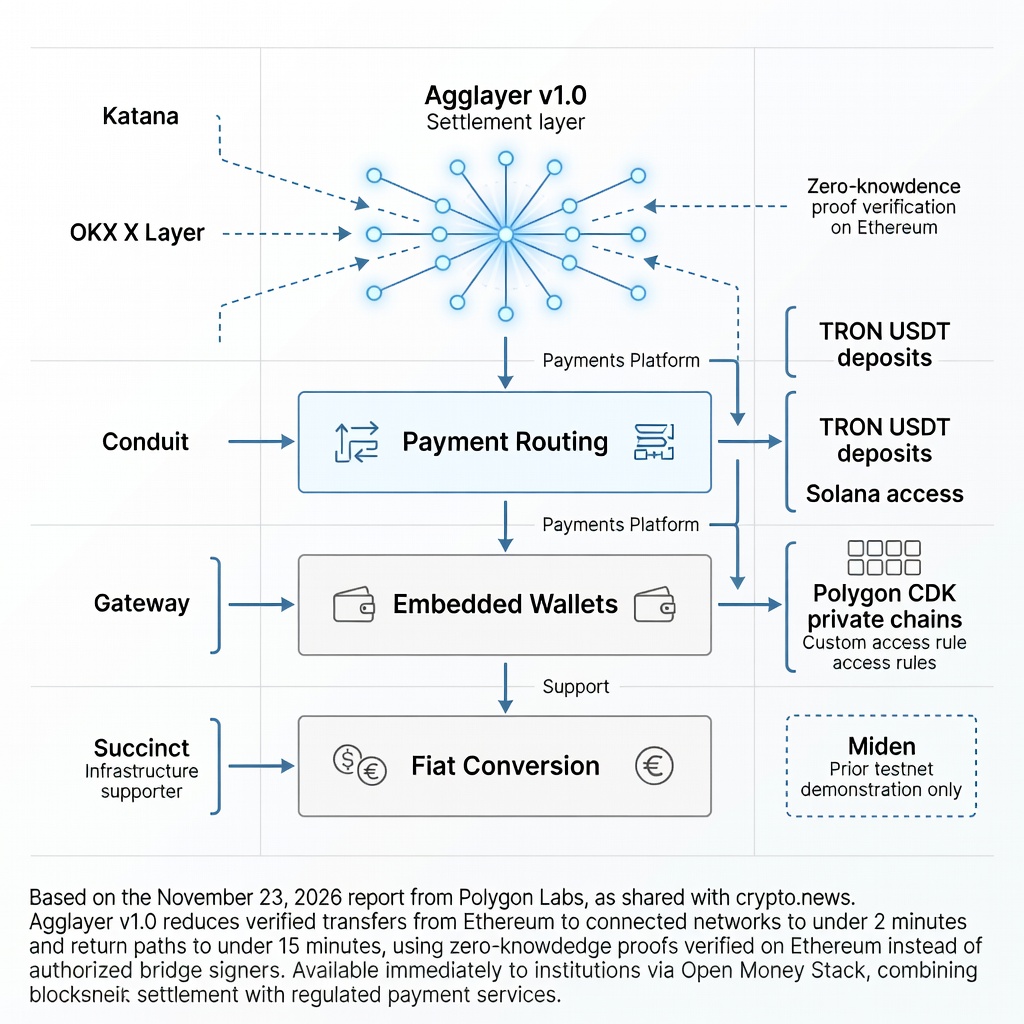
Availability was stated in institutional terms. As of the announcement, Polygon Labs said v1.0 was immediately available to institutions developing payment and settlement services through its Open Money Stack. That stack combines blockchain settlement with regulated payment services, embedded wallets, and fiat conversion. The report does not present the upgrade as a permissionless interface for arbitrary users. It also does not publish proof-system parameters, batch intervals, or a full list of chains covered by the sub-two-minute bound. Katana is an example, not evidence that every connected chain was measured.
Proofs in place of authorized signers
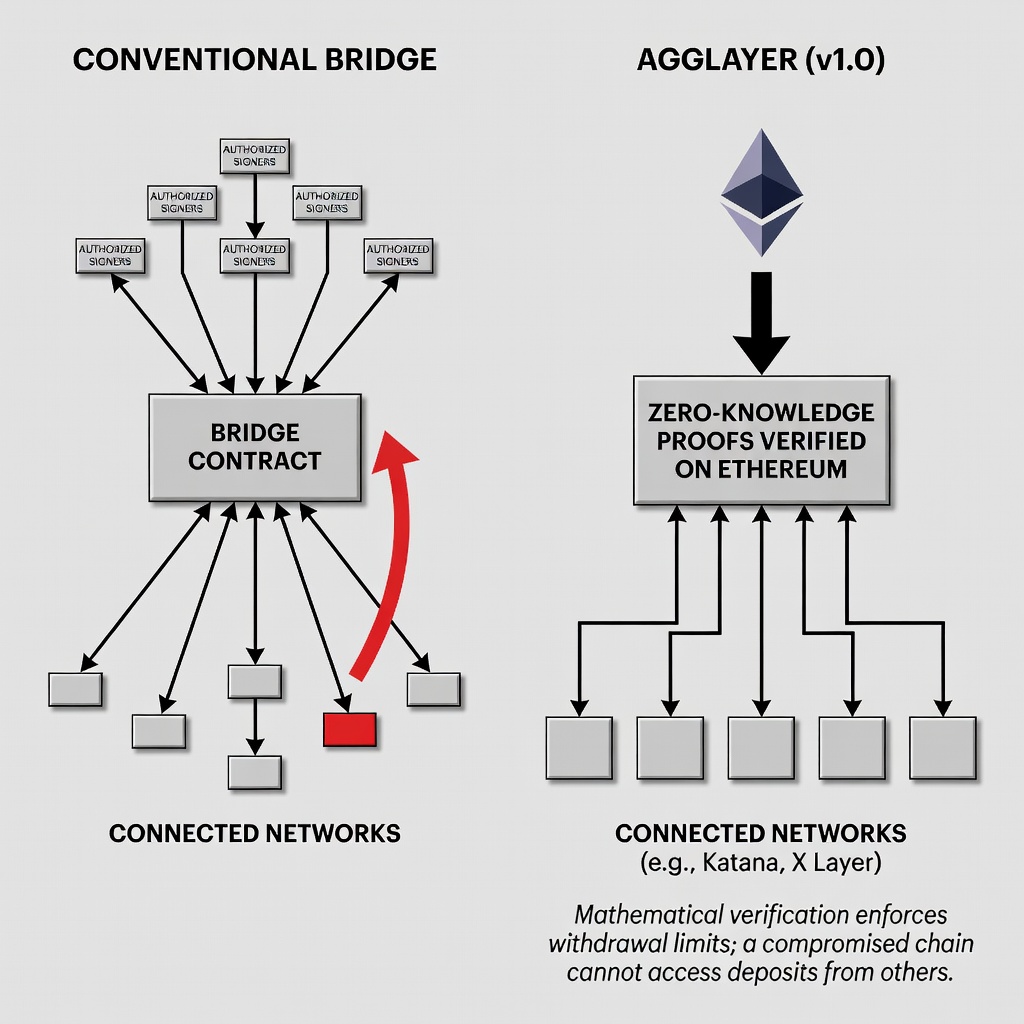
The architecture Polygon described secures transfers with zero-knowledge proofs verified on Ethereum, rather than with groups of authorized bridge signers. The proofs are meant to show that funds withdrawn from a connected chain are backed by deposits. Polygon said mathematical verification enforces withdrawal limits so that a compromised connected network cannot reach deposits belonging to other chains on the shared bridge.
That is a fault-isolation claim. If the accounting rules and the Ethereum checks work as described, a failure on one connected chain should not become a drain on deposits from the others. The November 23 report does not include the circuit constraints, the rule that sets withdrawal limits, or an external audit of v1.0. The mechanism is documented only at the level Polygon Labs stated.
Polygon Labs said this approach had already been tested during a separate $292 million cross-chain exploit, and that Agglayer continued operating without an incident affecting its settlement infrastructure. Both the amount and the “no incident” outcome are the company’s account. The report does not name the exploit, the chains involved, or an independent post-mortem.
A company volume figure, not a published dataset
Polygon Labs said Agglayer had operated since entering production in 2024 and had processed nearly $10 billion in settlements. The report gives no public dataset, query, or as-of timestamp for that total, so it is not used here as an on-chain measurement. It records the company’s stated production history.
The same announcement ties the faster path to institutional payments. Marc Boiron, CEO of Polygon Labs, said: “People sending money expect it to arrive fast and arrive safely, and moving money between blockchains has meant picking one of the two.” He added that v1.0 provides the settlement speed and security needed for stablecoin payments to operate at banking scale. Those statements are an executive argument about fit. The report does not pair them with a payment-volume series, a count of bank integrations, or a latency distribution under load.
Settlement inside Open Money Stack
In Polygon’s description, Agglayer is the settlement infrastructure for connected networks. Other Open Money Stack components handle payment routing, wallets, and banking connections. Institutions can receive stablecoins, move assets between supported networks, and convert funds to traditional currencies for customer payouts.
The November 23, 2026 report said Polygon had spent the preceding months extending that service through partnerships, an acquisition, and further chain integrations. Earlier in October 2026, the company introduced TRON support for USDT deposits, cross-chain transfers, and fiat payouts through the payments platform. In October 2026 it completed the Coinme acquisition, which it said secured access to 37 state money transmitter licenses and 11 exemptions covering 48 US states and brought regulated payment infrastructure into Open Money Stack. Tazapay, Mesh, Toku, and Kira were named among businesses adopting the services. The report then places a subsequent expansion of Open Money Stack to Solana, so companies on that network could use banking connections, digital wallets, and international payouts. It does not give a separate calendar date for the Solana step beyond that sequence.
Polygon Labs said Open Money Stack had completed a SOC 2 Type 1 examination covering the design of its relevant security controls. On the wording in the report, the examination addresses control design. The report does not describe a Type 2 review of whether those controls operated effectively over a period.
Attaching a chain, and on what terms
Beyond the payments product, Polygon said financial institutions can connect their own networks to external liquidity without giving up control of their infrastructure. Banks can use Polygon CDK to build private blockchains with customized access rules and connect them to Agglayer. Existing networks on other technology stacks can participate through compatible integrations. The company said institutions can connect without paying protocol fees and can retain control of network operations. The report does not quote a fee schedule.
Networks named as connected include Katana and OKX’s X Layer, with infrastructure support from Conduit, Gateway, and Succinct. Those three are described as infrastructure supporters, not as the settled chains. Separately, Polygon had previously demonstrated interoperability with Miden, a privacy-focused blockchain, in a testnet environment, which the company presented as evidence that Agglayer can support architectures different from Ethereum. That Miden result is a testnet demonstration, not a production connection listed with Katana and X Layer.
What remains unresolved
The activated change, as stated on November 23, 2026, is directional and specific: under two minutes from Ethereum to a connected network, and under 15 minutes back to Ethereum, compared with roughly 90 minutes on that return path before. v1.0 was described as available then to institutions on Open Money Stack, not as a proposal awaiting activation.
The report does not explain why the two directions differ, which chains inherit the new bounds, or how withdrawal limits are calculated. The claim that one chain’s compromise cannot spend another chain’s deposits depends on those proof rules and on Ethereum verification actually binding withdrawals. Neither the rules, nor an independent check of the nearly $10 billion total, nor an independent account of the $292 million incident, is in the source. Production connectivity should not be read as including the Miden testnet demonstration, and the SOC 2 Type 1 result should not be read as evidence of ongoing control effectiveness.