
November 26, 2026, 21:21:45 UTC+08:00 — Zcash infrastructure team Zakura recommended a network upgrade to stop new payments into Sapling, the network’s legacy shielded pool, and urged users to move their remaining ZEC to Ironwood. The team set no deadline. Its recommendation was precautionary: Zakura described a practical break of Sapling’s pairing-based cryptography as “highly speculative.”
How much ZEC remains in Sapling?
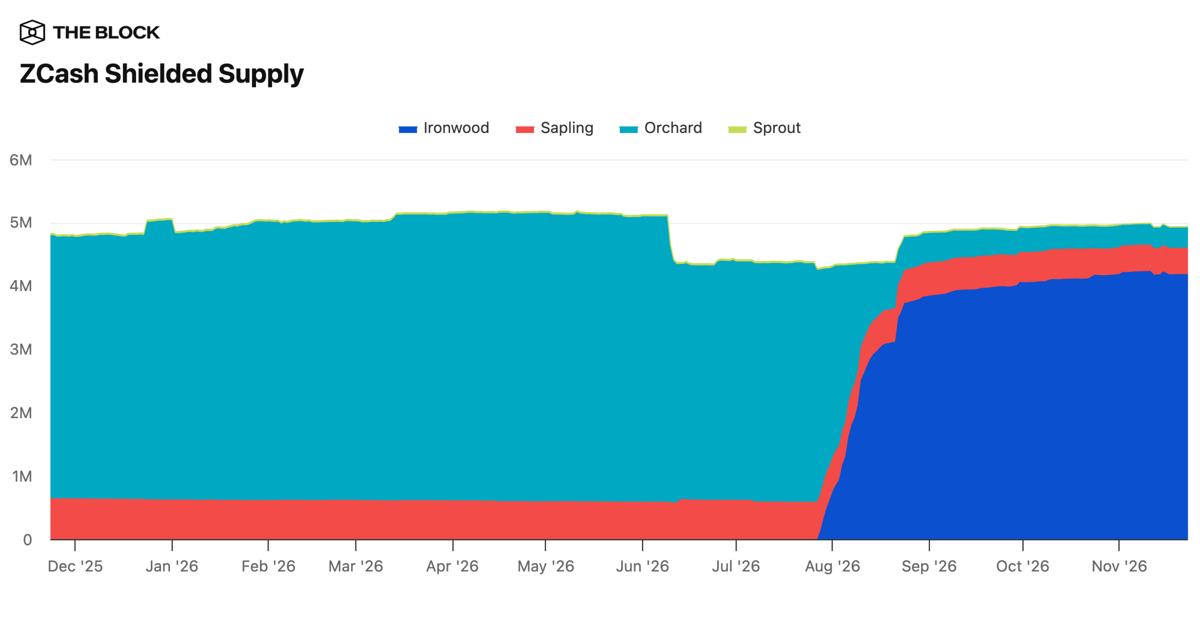
Sapling and Ironwood let users hold and transfer ZEC without publicly revealing amounts or the addresses of senders and recipients. According to Zakura’s November 26 post, Sapling still held roughly 400,000 ZEC, about 2% of supply and worth approximately $291 million at prices then prevailing. An April Zcash forum proposal had put the balance at 600,000 ZEC, down from 1.1 million at the start of 2024. That proposal suggested waiting a year after a community decision before making Sapling withdrawal-only.
Zakura expects stopping deposits to cause little disruption because most wallets support both pools. The team said fewer than 2.6% of all transactions in the 30 days preceding its post used Sapling. Of those Sapling transactions, 66% were known miner flows. Zakura believed miners likely accounted for most of the rest, but did not identify those flows as confirmed mining activity.
Why a freeze would have to precede a compromise
Zakura cited a reported proof of the Riemann hypothesis, which concerns the distribution of prime numbers, and separate, unsubstantiated rumors that AI labs had made progress on factoring large integers into primes. The difficulty of factoring underpins RSA encryption, which the team said cryptocurrencies rarely use. Some mathematical techniques apply to attacks on both RSA and pairing-based cryptography, but neither the reported proof nor the rumors demonstrate a practical break of either system. According to Zakura, Ironwood and Zcash transparent transactions rely on neither factoring nor pairings.
Closing Sapling to deposits is distinct from freezing the pool. Zakura said a break of Sapling’s proof system could allow forged proofs, putting its funds at risk. The same pairing-based cryptography does not secure users’ private keys or their records of shielded funds, however. Developers could therefore replace the proof system without replacing those records.
The critical condition, according to Zakura, is that the network freeze Sapling before an attack compromises the pool’s state. If it did, users could later recover funds using a replacement proof system: a SNARK based on the elliptic-curve discrete logarithm problem (ECDLP) or on hash functions. The team described a possible recovery path, not an activated freeze or an implemented replacement.
Separately, Zakura said it was developing a proposal for hash-based, post-quantum signatures for Zcash transparent transactions using SPHINCS+ with 192-bit security. On Ethereum, the Ethereum Foundation had doubled its protocol security team, described AI as a “more urgent risk” than quantum computing, and recommended Keccak-256 over four alternatives for Ethereum’s planned shift to hash-based cryptography.