Originally reported by Liu Jiaolian on November 10, 2026, at 14:04 (UTC+8). In the original article, Liu reported that assets had been taken from thousands of Keplr social-login wallet accounts and that Keplr attributed the incident to a Web3Auth infrastructure vulnerability. The article said the technical cause had not been disclosed in detail. Its account of the incident, and the competing positions of the providers, should not be mistaken for a completed root-cause analysis.
Where does recovery place trust?
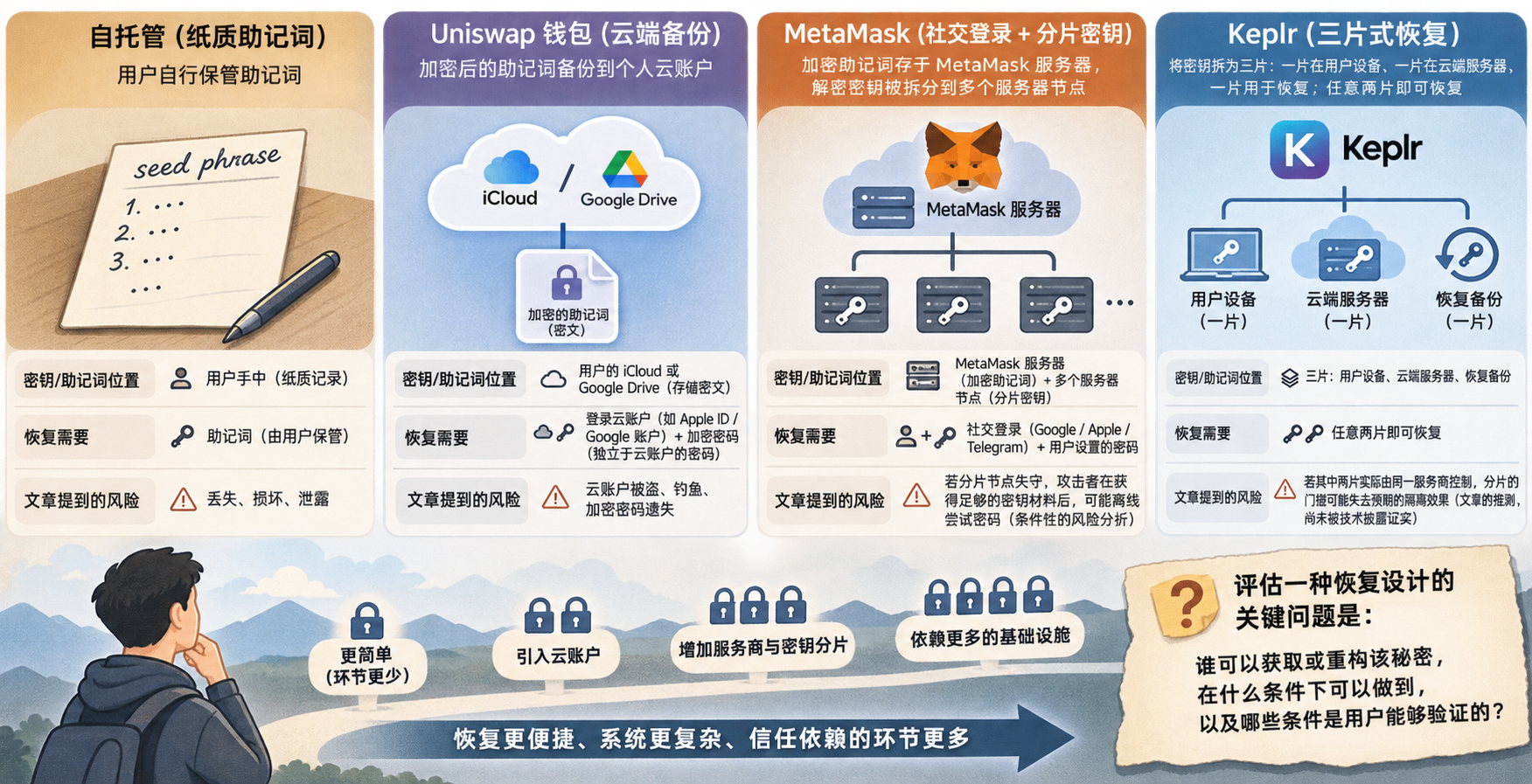
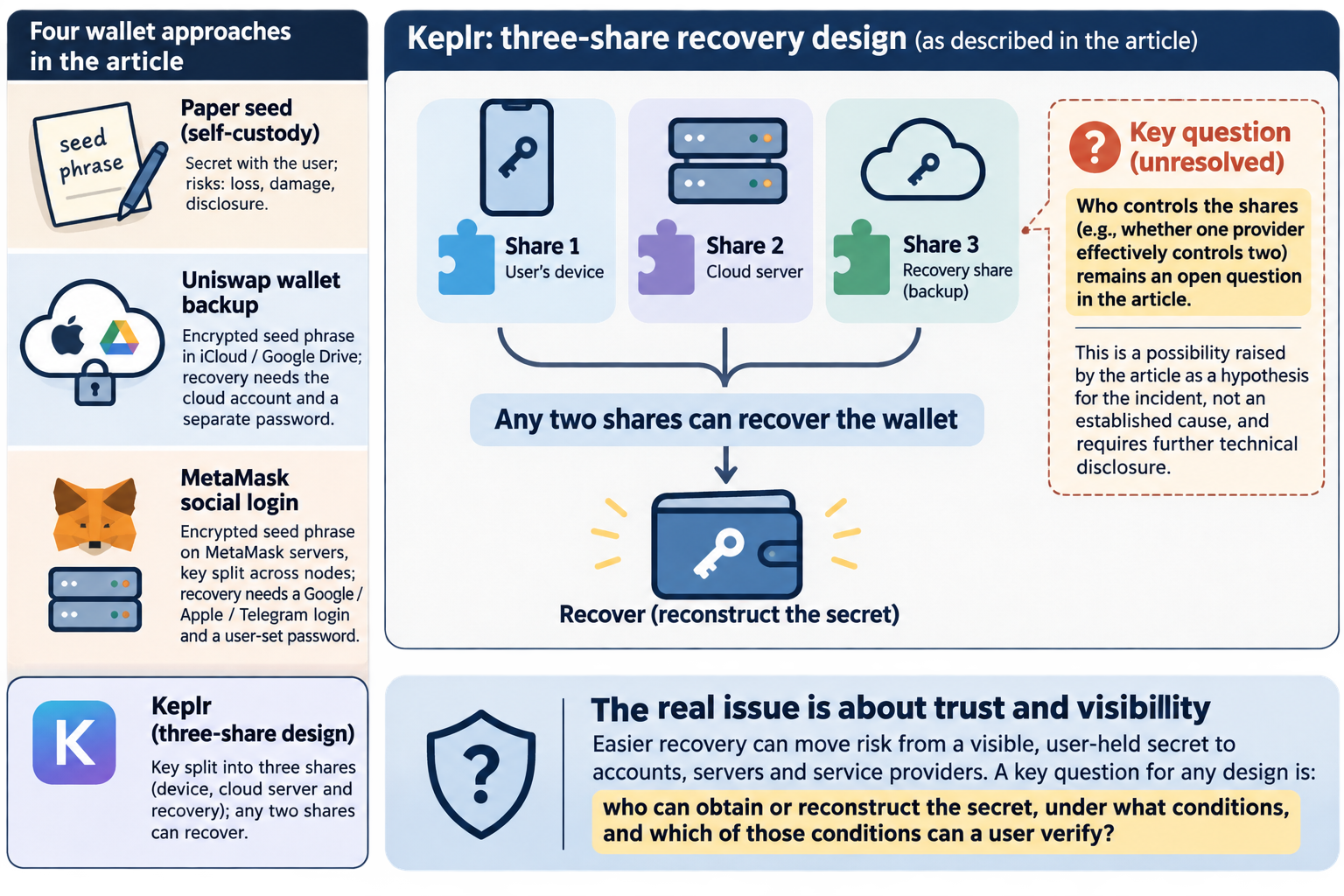
Liu compared four approaches to storing or recovering wallet credentials. A paper copy of a self-custodied seed phrase keeps the relevant secret with the user, but creates risks of loss, damage and disclosure.
For the Uniswap wallet backup described in the article, an encrypted seed phrase is stored in the user’s iCloud or Google Drive account. Recovery requires access to that cloud account and the separate password used to encrypt the phrase. The cloud provider holds ciphertext rather than the password, according to Liu’s description; cloud-account compromise, phishing and loss of the encryption password remain relevant risks.
Liu described MetaMask’s social-login approach as storing an encrypted seed phrase on MetaMask servers while splitting the decryption key across server nodes. Recovery requires both a Google, Apple or Telegram login and a user-set password. The article’s security distinction is between an online recovery attempt, where login checks and server rate limits apply, and a scenario in which an attacker obtains sufficient key material to try passwords offline. That scenario is a conditional risk analysis, not a reported MetaMask breach.
For the Keplr arrangement discussed in the article, Liu described three key shares: one on the user’s device, one on a cloud server and one used for recovery. The stated design permits recovery with any two shares. Liu suggested that the threshold could fail to provide the intended separation if one provider effectively controlled two shares, and speculated that this might explain the incident. The article did not establish that this happened; it said further technical disclosure was needed.
What the comparison can—and cannot—show
Liu’s central argument is that easier recovery can move risk from a visible, user-held secret into accounts, servers and service providers whose controls are harder for users to assess. More components do not, by themselves, prove that a wallet is less secure: the comparison provides no measured failure rates for the four approaches. It does identify a concrete question for evaluating a recovery design: who can obtain or reconstruct the secret, under what conditions, and which of those conditions can a user verify?
Source: techflowpost.com (originally published 2026-11-10 14:04 UTC+8)