As reported on November 10, 2026, the New York Stock Exchange was planning to use Avalanche technology to settle trades on its proposed 24/7 tokenized-securities platform. The platform was targeting a fourth-quarter launch but still required regulatory approval. The distinction for protocol analysis is that the planned settlement ledger is a custom, permissioned chain, not Avalanche’s public C-Chain—and its transaction volume would not necessarily translate into AVAX demand.
One ledger for settlement, multiple routes for issuance
On November 9, The Wall Street Journal reported that the forthcoming NYSE-affiliated platform would use only Avalanche for settlement. Ava Labs said it would provide core ledger technology to the platform’s clearing company, a role also confirmed in NYSE premarket information that day.
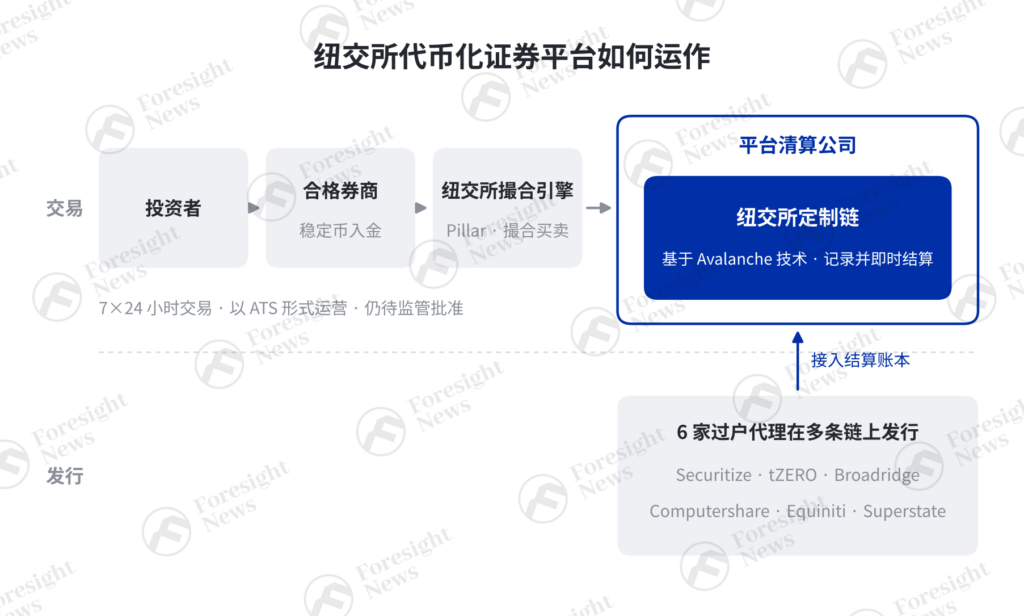
Under the disclosed design, NYSE’s existing Pillar engine would match trades; the clearing company would then settle them on an Avalanche-based ledger. Investors could fund accounts with stablecoins. Ava Labs chief business officer John Nahas said this would be a blockchain customized for regulatory requirements rather than settlement on Avalanche’s public chain.
The platform is planned as an alternative trading system. NYSE had announced on November 2 that Broadridge, Computershare, Equiniti and Superstate would join Securitize and tZERO as transfer-agent partners, bringing the total to six. The proposed securities include tokens issued by custodians and by issuers themselves; both types are intended to be interchangeable with conventional shares and carry the same dividend and voting rights. According to NYSE digital issuance head Dennis Lee, shares could be issued across multiple chains while trades would be recorded and settled on the platform’s chosen ledger.
NYSE had announced development of the platform and its pursuit of regulatory approval on January 19. Its parent, Intercontinental Exchange, signed a memorandum of understanding with tZERO on August 31. At September’s Avalanche Summit, Ava Labs president Charley Cooper said NYSE had tested Avalanche for about a year, without saying it had been selected. On November 9, Cooper described the planned deployment as production-oriented rather than another pilot. That description does not mean the platform had launched.
Why a custom L1—and what remains unproven
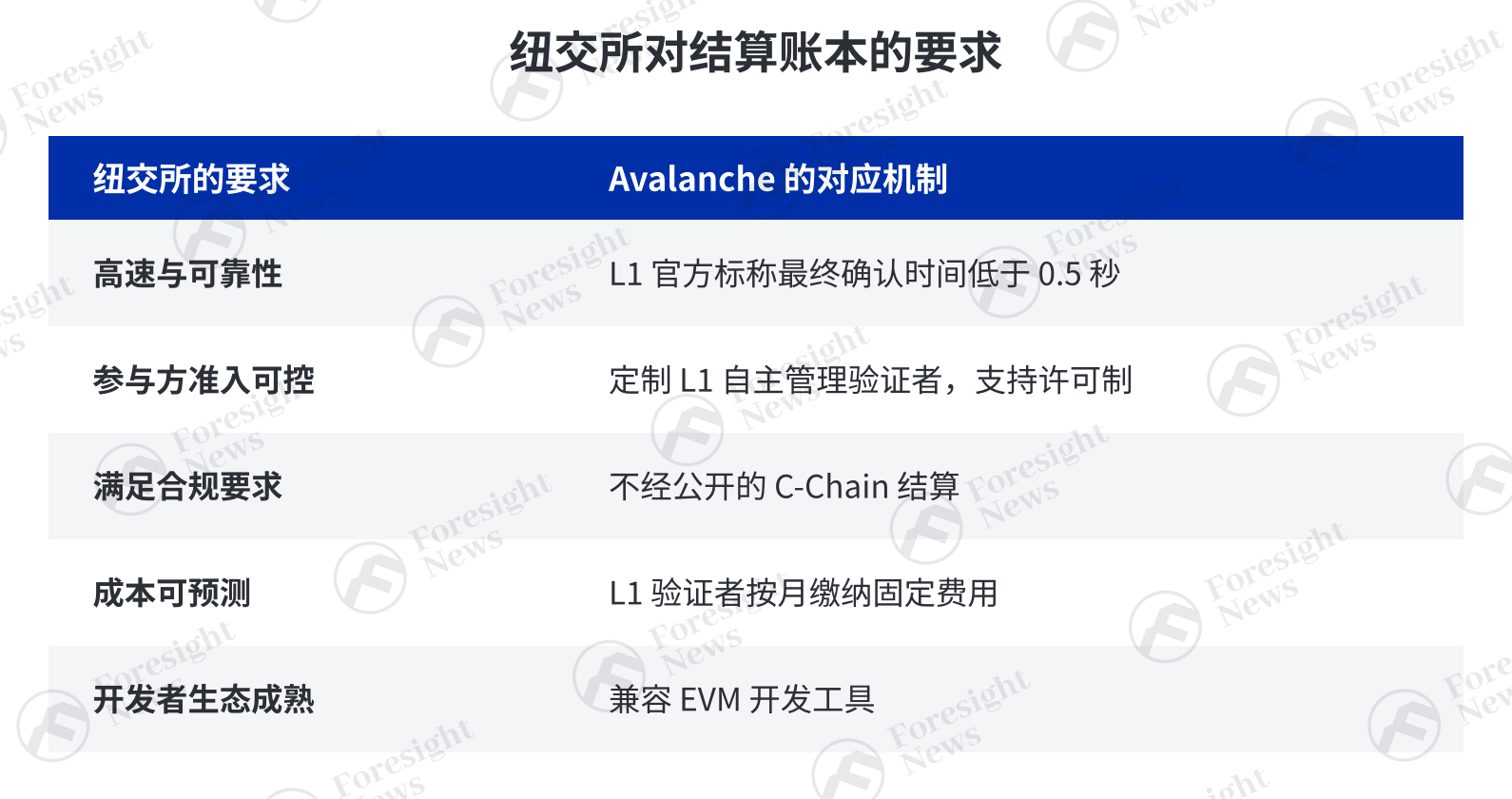
NYSE’s January announcement had described the ability to support multiple chains for settlement and custody; the November plan narrowed settlement to Avalanche. NYSE chief product officer Kevin Tyrrell said the exchange tested multiple vendors and prioritized speed, throughput, controlled-network support and compliance capabilities. Nahas said technical, commercial and ecosystem reviews took more than a year.
Avalanche’s post-Etna, ACP-77 custom-L1 model allows an operator to manage its own validator set and restrict participation. Unlike the public C-Chain, this can meet the platform’s stated need to control settlement participants. Custom-L1 validators do not first have to stake 2,000 AVAX as mainnet validators; instead, they pay an ongoing fee. Ava Labs CEO Emin Gün Sirer said the dedicated infrastructure could still connect to a broader asset and liquidity ecosystem, including through native messaging between Avalanche L1s. The source does not establish how the NYSE platform would use those connections in practice.
For ecosystem context—not a measure of expected platform activity—rwa.xyz reported $1.43 billion in distributed real-world assets, $11.4 billion in represented real-world assets and $795 million in stablecoin market capitalization on Avalanche as of November 9. “Distributed” refers to assets transferable between wallets; “represented” refers to ownership recorded on-chain.
Settlement activity is not the same as AVAX revenue
Neither the Ava Labs announcement nor NYSE’s statement specified a role for AVAX in the platform’s settlement, transaction fees or staking. Under the existing custom-L1 mechanism, the direct AVAX-linked charge is the validator fee, not a share of settlement value or volume. Avalanche documentation puts that fee at approximately 1.33 AVAX per validator per month when there are fewer than 10,000 L1 validators; the AVAX is burned. Fees within an L1 can instead be denominated in a token chosen by its operator.
The Avalanche Foundation had already identified this value-capture gap in its July 30 economic research agenda. Its chief investment officer, Matias Antonio, said value created across the ecosystem does not automatically accrue to AVAX. In an August 12 estimate, the foundation put cumulative C-Chain fee burns since early 2024 at about $23.5 million, excluding L1 validator fees. Its latest monthly figures in that estimate, for June, listed $3.1 million in nominal on-chain gross chain product, $2.7 million in returns to holders of assets such as tokenized funds, and $6.9 million in issuer income from reserve assets. The foundation said the latter two categories contributed little to AVAX value capture.
Ideas under research included validator voting on gas prices under ACP-283, a protocol-owned stablecoin under ACP-67, and revenue sharing from applications and L1s. None was an established mechanism for capturing the proposed NYSE platform’s settlement activity. For scale, DefiLlama recorded approximately $26,500 in Avalanche C-Chain fees on November 9. The foundation said that day it would track the platform’s activity and its role in the Avalanche economy. Until the platform receives approval and its operating details are established, both its activity and any resulting AVAX impact remain uncertain.