
Injective’s mainnet stopped producing blocks on November 9, 2026, days after the staking-focused INJ fund INJC began trading on Nasdaq. In reporting published on November 10, Odaily described an outage lasting approximately four hours and 24 minutes. The immediate question for a network positioning itself as institutional financial infrastructure was not just why block production stopped, but why the explanations differed.
What was observed
According to the Injective node monitoring cited by Odaily, the last block was 191,016,661, produced at 21:04 Beijing time on November 9. Upbit, Coinone and Kraken subsequently announced pauses to INJ deposits and withdrawals because block production had stopped. Their notices said spot trading was unaffected and that deposit and withdrawal services would resume after stability was confirmed.
The halt followed several closely spaced developments. Injective introduced Institutional Rail on November 2, describing it as a direct route to block validators for banks, trading firms and institutional applications. The project claimed the design could make transaction inclusion more predictable and provide receipts before block production. INJC began trading on November 5; Injective Labs CEO Eric Chen and Canary Capital founder and CEO Steven McClurg rang Nasdaq’s opening bell on November 6. The fund planned to incorporate staking returns into its net asset value. These are descriptions of the intended product and mechanism, not evidence in the supplied reporting that they had been tested during the outage.
Two accounts of the halt
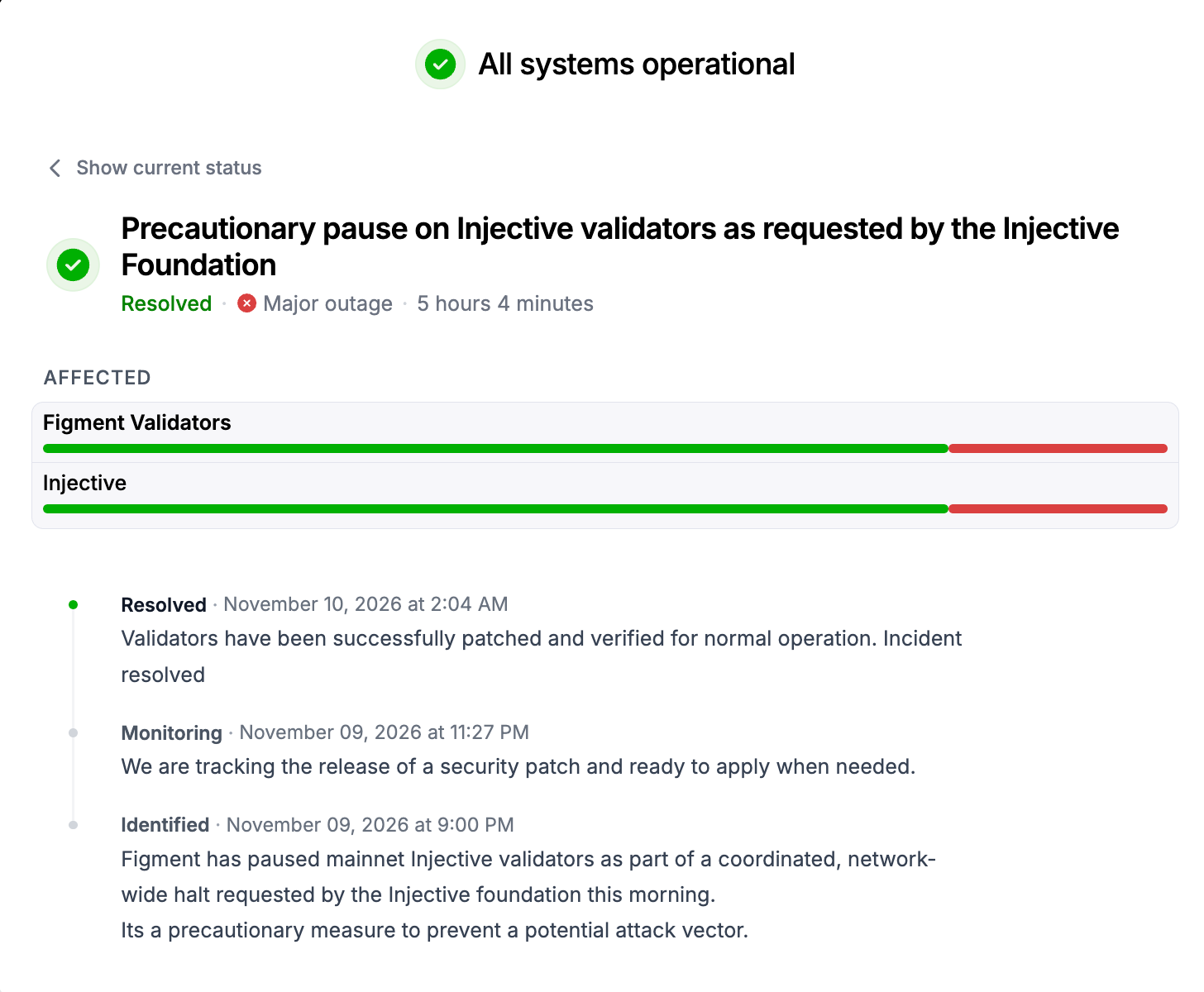
Odaily reported that validator Figment’s incident page initially described a coordinated pause of mainnet validators at the Injective Foundation’s request, as a precaution against a potential attack path. A subsequent update said validators were tracking and preparing to apply a security patch. At 02:04 Beijing time on November 10, Figment said validators had completed the patch and normal operations had resumed.
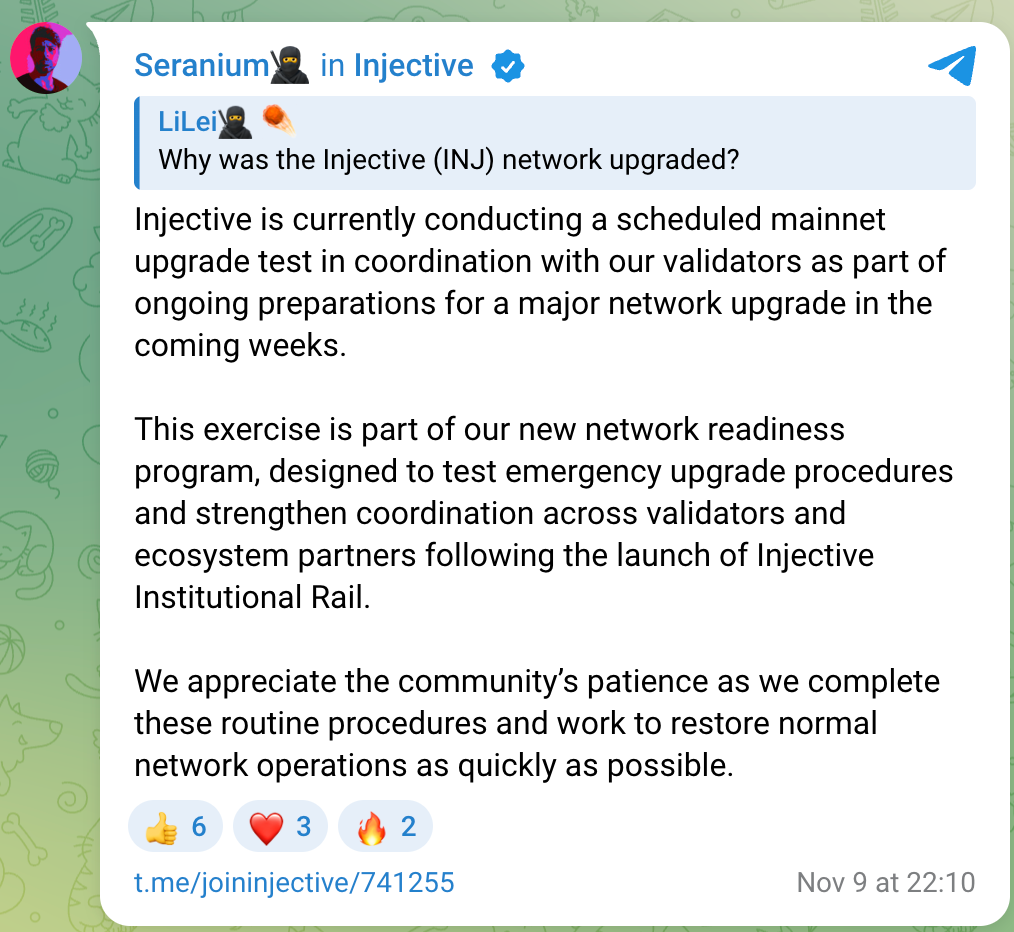
An Injective Telegram community administrator gave a different account: validators were conducting a scheduled mainnet upgrade test as part of preparations for a major network upgrade in the following weeks. The administrator characterized it as an exercise in emergency-upgrade procedures and coordination following the launch of Institutional Rail.
The supplied reporting does not establish whether a potential attack path was found, whether the halt was planned in advance, or how the two accounts fit together. It also does not provide a technical postmortem. Figment’s status update supports that validators applied a patch and resumed operation; the administrator’s statement describes the exercise’s stated purpose. Neither, on its own, resolves the discrepancy.
Odaily reported that INJ traded around $7.90–$8.10 before and after the halt, without identifying a price dataset or exact observation times. That limited price observation does not measure the outage’s operational impact. For an infrastructure project seeking institutional use, the unresolved issue in this account is the documented sequence of the halt and the lack of a consistent public explanation for it.