
As reported on November 12, 2026, Aave V3.8 had gone live across 15 Aave V3 markets following Aave DAO approval. The release, developed by Aave Labs, adds a reentrancy guard around external callbacks from pool operations. Its key design choice is that flash-loan entry points check the guard without setting it.
What the guard changes
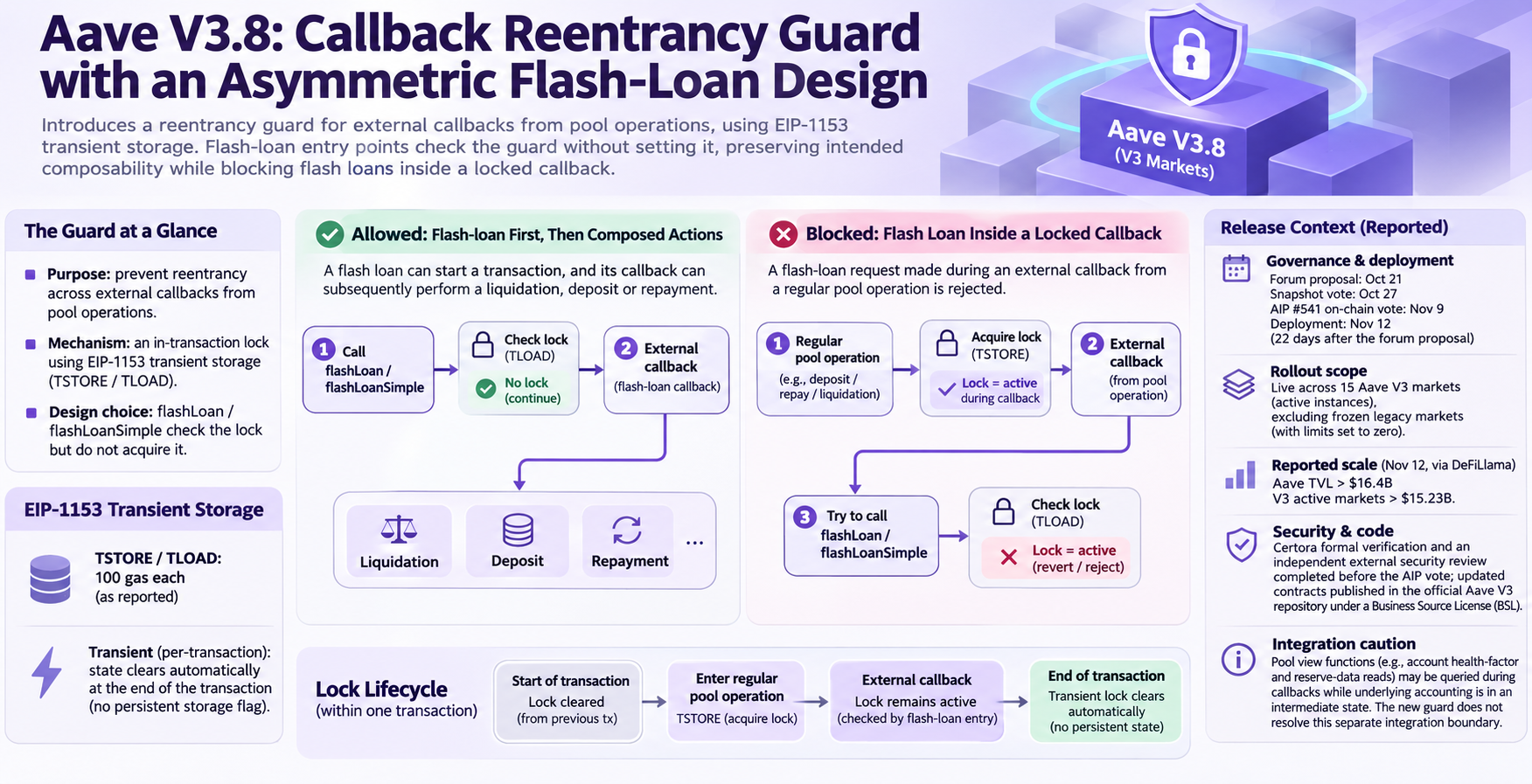
Aave V3.8 uses EIP-1153 transient storage for its lock. Unlike persistent contract storage, transient storage clears at the end of a transaction. The report says TSTORE and TLOAD each cost 100 gas, allowing the pool to track the lock without maintaining a persistent storage flag. That is the reported rationale for the design, not a measured transaction-level gas saving.
Aave Labs said flashLoan and flashLoanSimple check whether a lock is active but do not acquire one themselves. Under that design, a flash loan can begin a transaction whose callback subsequently performs a liquidation, deposit or repayment. Conversely, a flash-loan request made during an external callback from a regular pool operation is rejected. The distinction matters because a blanket lock could also block intended flash-loan compositions.
Deployment and evidence boundaries
The report says Aave Labs posted the governance-forum proposal on October 21, submitted a Snapshot vote on October 27, and opened the AIP #541 on-chain vote on November 9. Deployment followed on November 12, 22 days after the forum proposal. The rollout covered active instances across 15 chains, including Ethereum’s Core and Lido markets; frozen legacy markets with limits set to zero were excluded.
DeFiLlama figures cited for November 12 put Aave’s total value locked above $16.4 billion, with more than $15.23 billion in active V3 markets. Those figures describe the reported scale of the protocol, not the amount of risk eliminated by this change.
The report states that Certora formal verification and an independent external security review were completed before the AIP vote, and that the updated contracts were published in the official Aave V3 repository under a Business Source License. It does not provide findings from those reviews. Community developers also cautioned integrators that pool view functions—including account health-factor and reserve-data reads—may be queried during callbacks while underlying accounting is in an intermediate state. The new guard should not be read as resolving that separate integration boundary.