As reported on November 11, 2026, Zodl was rolling out version 3.20.0 of its Zcash wallet with Oblivious HTTP (OHTTP) enabled by default. The change addresses a privacy gap that shielding transactions on-chain does not close: a light wallet’s server may otherwise see both the wallet’s requests and the IP address that sent them.
How the request path changes
Zcash light wallets use remote lightwalletd servers to retrieve chain data and broadcast transactions. Under Zodl’s reported OHTTP design, the wallet instead encrypts each request for a Zodl gateway and sends it through a relay operated by Cloudflare or Fastly. The relay can see the user’s IP address but cannot read the encrypted request. The gateway decrypts the request and forwards it to lightwalletd, but sees the relay’s address rather than the user’s.
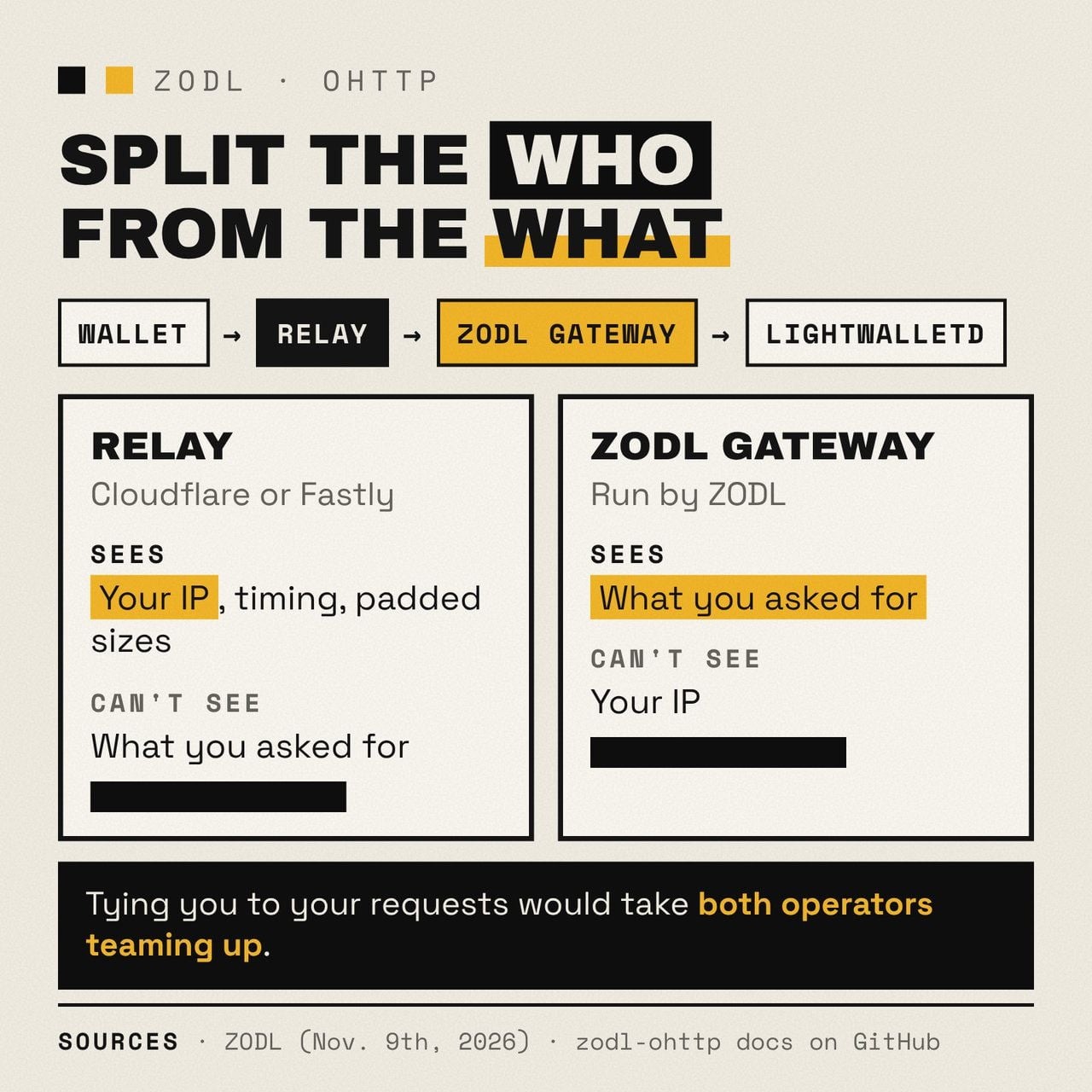
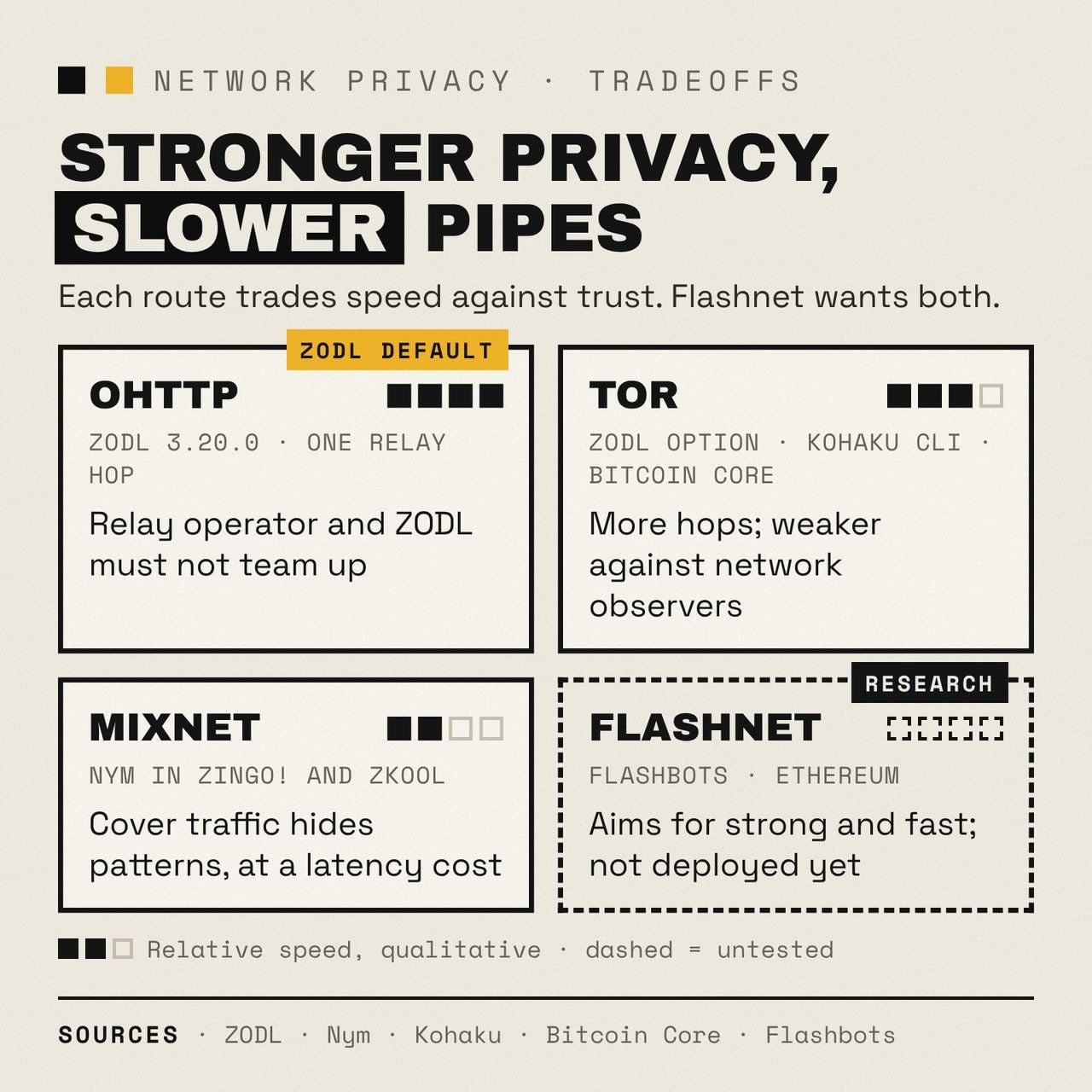
That separation is the security property—not anonymity from every observer. It depends on the relay and gateway operators not colluding. A relay can still observe connection times and approximate traffic volume. Zodl core contributor y4ss described OHTTP as a better default, not a replacement for Tor or Nym against a state-level adversary. Users concerned about pressure on cloud providers can, according to y4ss, enable Zodl’s Tor option alongside OHTTP so that the relay sees a Tor exit address instead of their IP address.
The report also describes two measures in Zodl’s published code. Requests are padded in size bands of roughly 4 KB; transaction broadcasts are padded to at least 16 KB, and sensitive responses receive padding too. For logging, relay request IDs are stored at the gateway as HMAC-derived fingerprints using a key held only in gateway memory and destroyed on restart. These measures are intended to make traffic classification and later log matching harder; they do not remove the design’s operator-trust assumption. At the November 11 reporting date, Zodl said it would roll the upgrade out to all users over the following days.
Other approaches, different trade-offs
The network-layer problem extends beyond Zcash. Developer b10c documented in 2023 an entity called LinkingLion that monitored which Bitcoin nodes first broadcast transactions; the report says signs of its activity dated back to 2018 and that IP ranges associated with it also connected to Monero nodes. Those observations illustrate a potential route from transaction propagation to network identity, not proof that any particular wallet user was identified.
The report places Zodl’s approach alongside several alternatives:
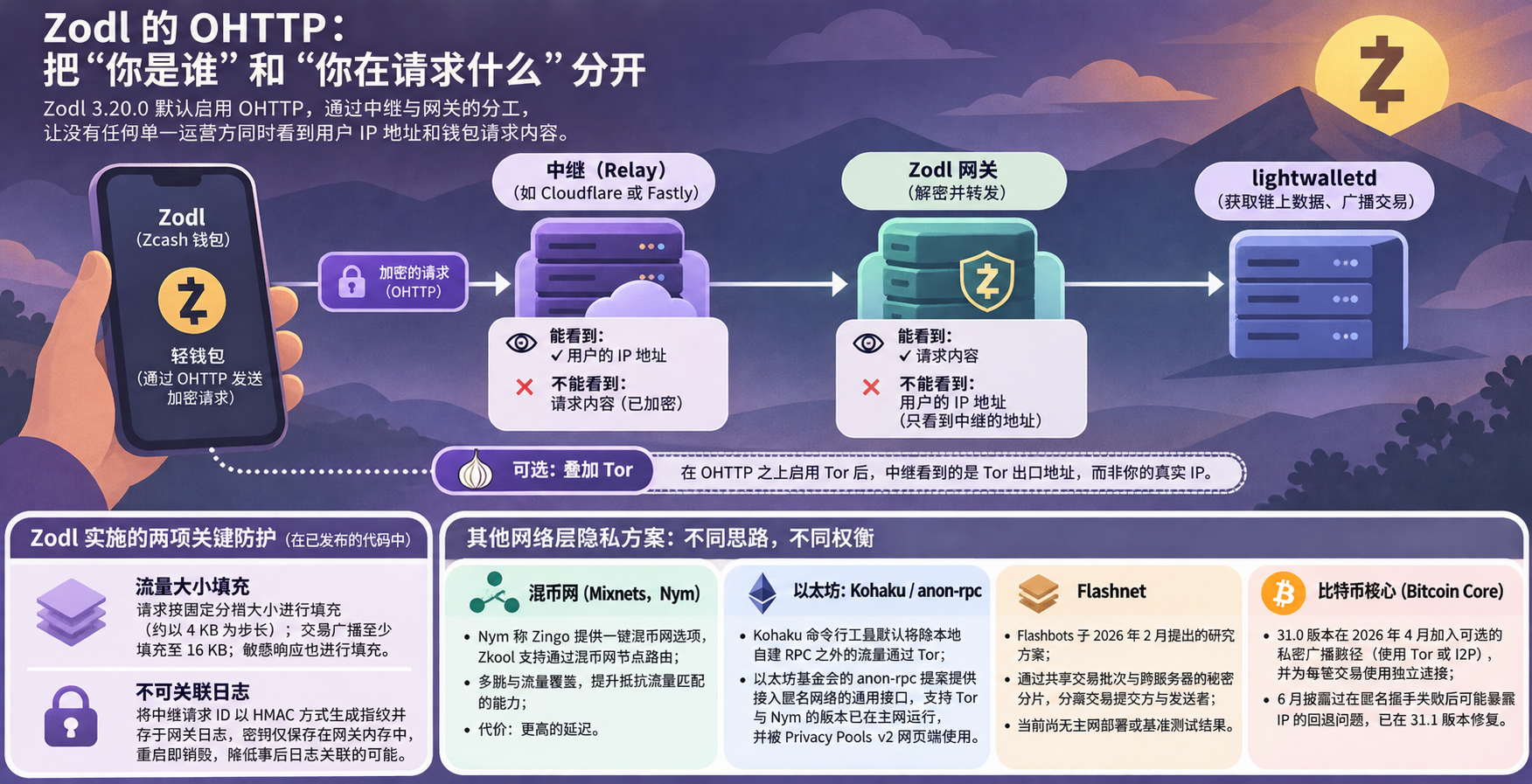
- Mixnets: Nym reported in September 2026 that Zingo offered a one-click mixnet option and Zkool supported routing through mixnet nodes. Nym also said it was in talks with Zodl. Mixnets use multiple hops and cover traffic to frustrate traffic matching, at a latency cost.
- Ethereum wallet and RPC routing: The report says Kohaku’s command-line tool routed traffic other than calls to a self-hosted local RPC through Tor by default. An Ethereum Foundation anon-rpc proposal, made in June 2026, sought a common interface for anonymous-network routing. The report says a version supporting Tor and Nym was running on mainnet and was used by the Privacy Pools v2 web interface. The proposal’s broader goal should not be mistaken for a requirement already adopted by every wallet.
- Flashnet: Described as Flashbots research introduced in February 2026, it proposed shared transaction batches and secret sharing across servers to separate submissions from senders. The report noted no production mainnet deployment or benchmark results at the time.
- Bitcoin Core: According to the report, version 31.0 added an optional private-broadcast path in April 2026 using Tor or I2P and separate connections for individual transactions. It also says a fallback that could expose an IP address after a failed anonymous handshake was disclosed in June and fixed in version 31.1.
OHTTP’s narrower aim is to prevent one wallet-service operator from routinely seeing both an IP address and request contents. Whether that default is sufficient depends on the adversary: it does not eliminate relay metadata, collusion risk or dependence on a small set of cloud providers. The report notes that Zodl users could still choose community nodes in advanced settings.