As reported on November 11, 2026, Chainalysis examined how proxy services resell access to AI models and how some customers pay for that access on-chain. Its findings describe a payment network, but the transaction data alone cannot establish what customers did with the models.
What the survey found
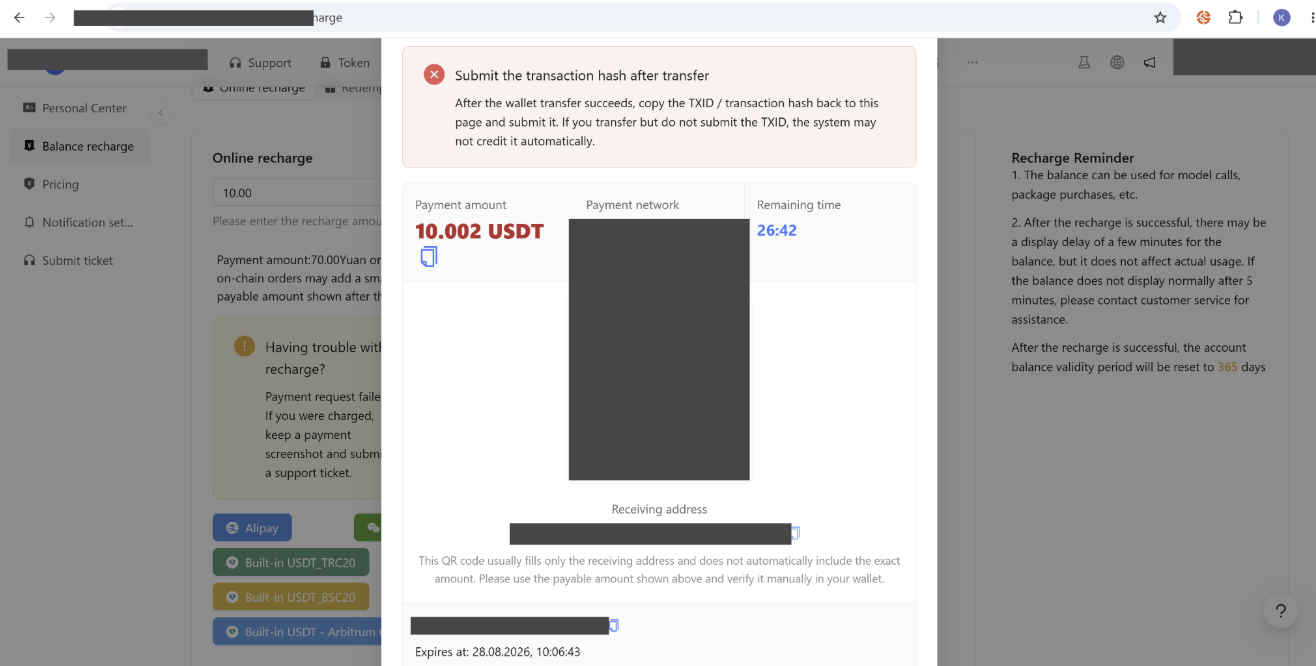
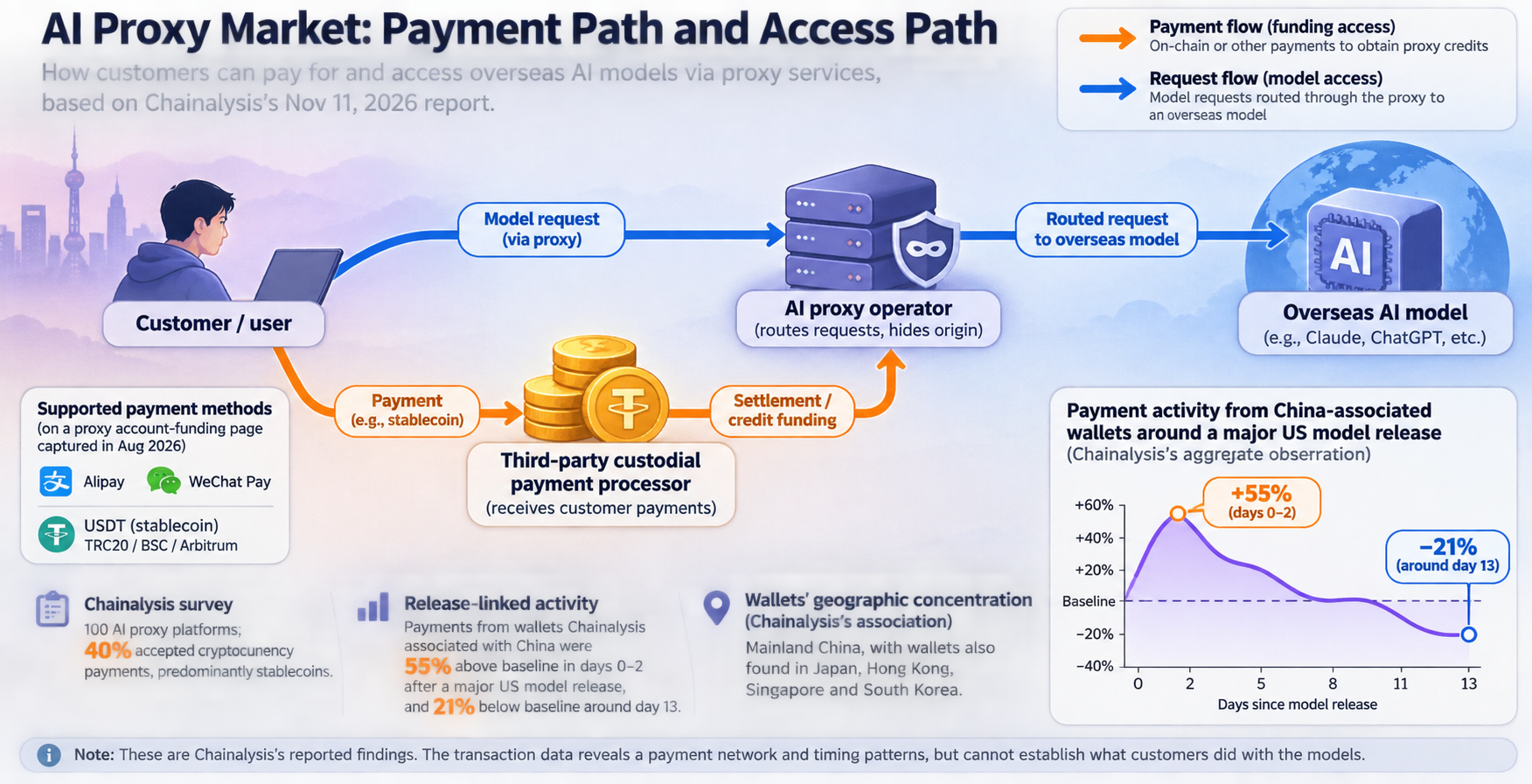
Chainalysis surveyed 100 AI proxy platforms and found that 40% accepted cryptocurrency payments, predominantly in stablecoins. The services route requests to overseas models while obscuring the requests’ origin, according to the report. A proxy account-funding page captured in August 2026 offered Alipay and WeChat Pay alongside USDT deposits on TRC20, BSC and Arbitrum.
The report says most proxy operators it examined used third-party custodial crypto payment processors rather than receiving customer payments directly at their own addresses. That arrangement separates a visible customer payment from the operator’s collection account. Chainalysis argues that tracing the payment processor and subsequent flows could help investigators identify connections among customers, proxy operators and exchanges; a payment to a processor does not, by itself, identify the customer’s model usage.
Activity around model releases
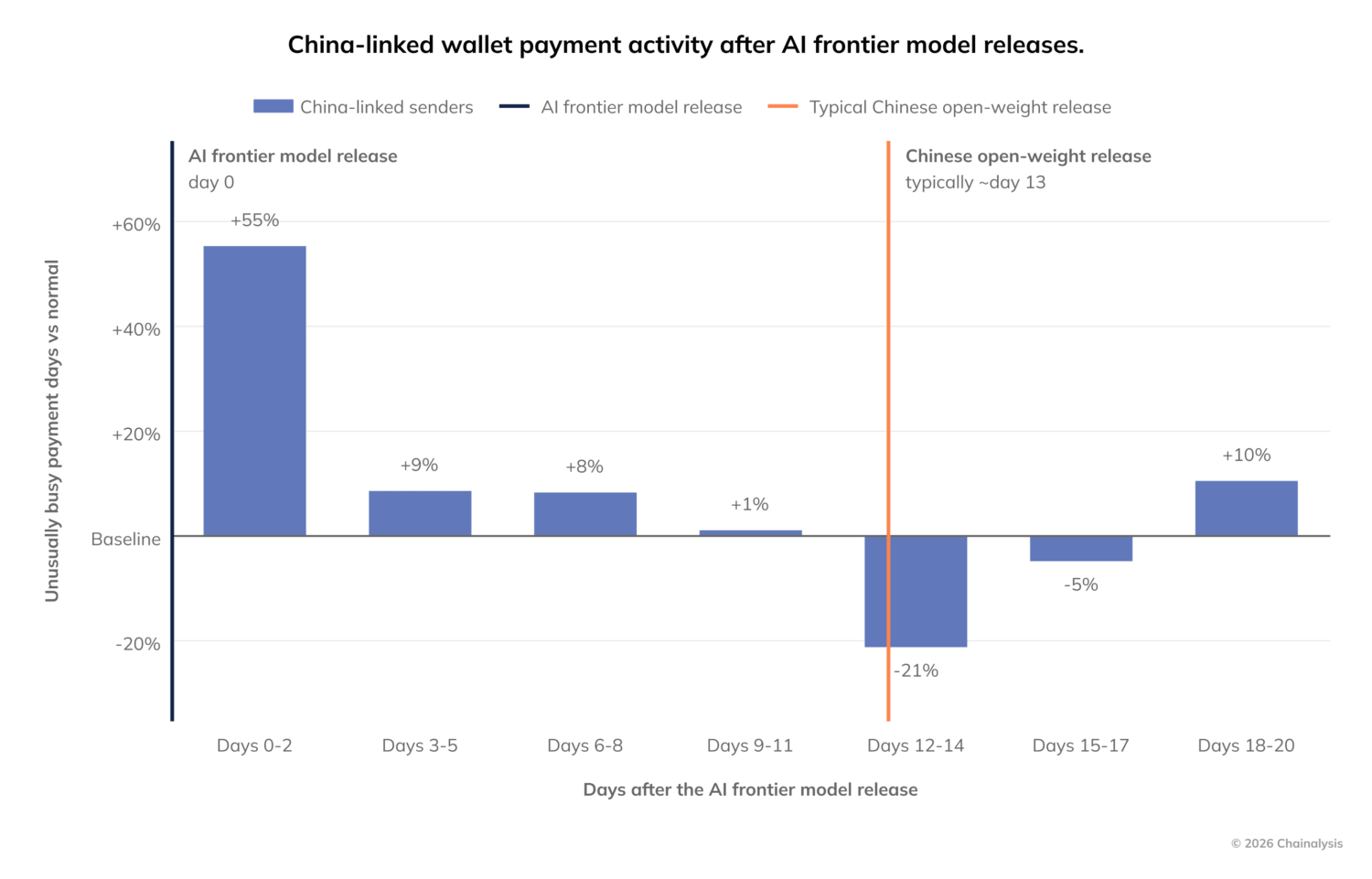
Chainalysis tracked payments from wallets it assessed as potentially associated with China to proxy payment channels around releases of major US AI models. It reported that payment activity in the first three days after a release—days 0 through 2—was 55% above its normal baseline. Around day 13, activity was 21% below baseline. The report also says the initial increase exceeded the average for other wallets.
Those are aggregate observations, not a record of individual model requests. Chainalysis interprets the timing as consistent with demand for newly released models, while acknowledging that the on-chain data cannot establish the purpose of any particular payment. The supplied account does not specify the model-release dates or the dates used to construct the baseline, limiting independent assessment of the comparison.
Access and attribution remain separate questions
The report places the proxy market in the context of restrictions on access to US AI models. Anthropic has separately accused DeepSeek, Moonshot and MiniMax of using 24,000 fraudulent accounts through proxy services to extract capabilities from Claude. That is Anthropic’s allegation, not a finding established by the payment patterns above. The concern is that model outputs could be used for distillation—training another model on those outputs—but payments to a proxy cannot demonstrate that such training occurred.
Chainalysis reports that wallets paying AI proxies were concentrated in mainland China and were also found in Japan, Hong Kong, Singapore and South Korea. These are its wallet-association findings, not proof of every payer’s location or identity. The strongest supported conclusion is narrower than a claim about a confirmed wave of model distillation: stablecoins are an available payment method in this proxy market, and Chainalysis observed a release-linked rise in payments from wallets it associated with China.