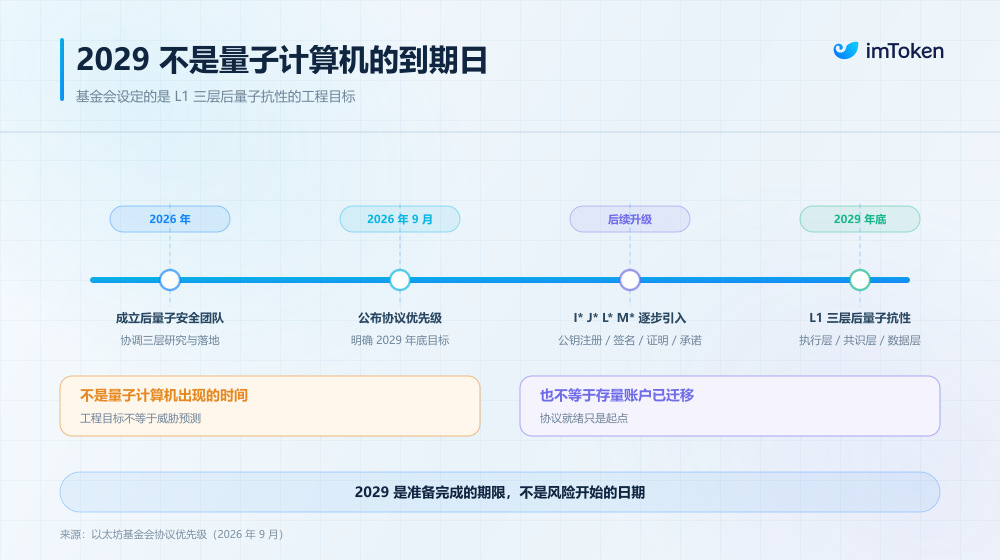
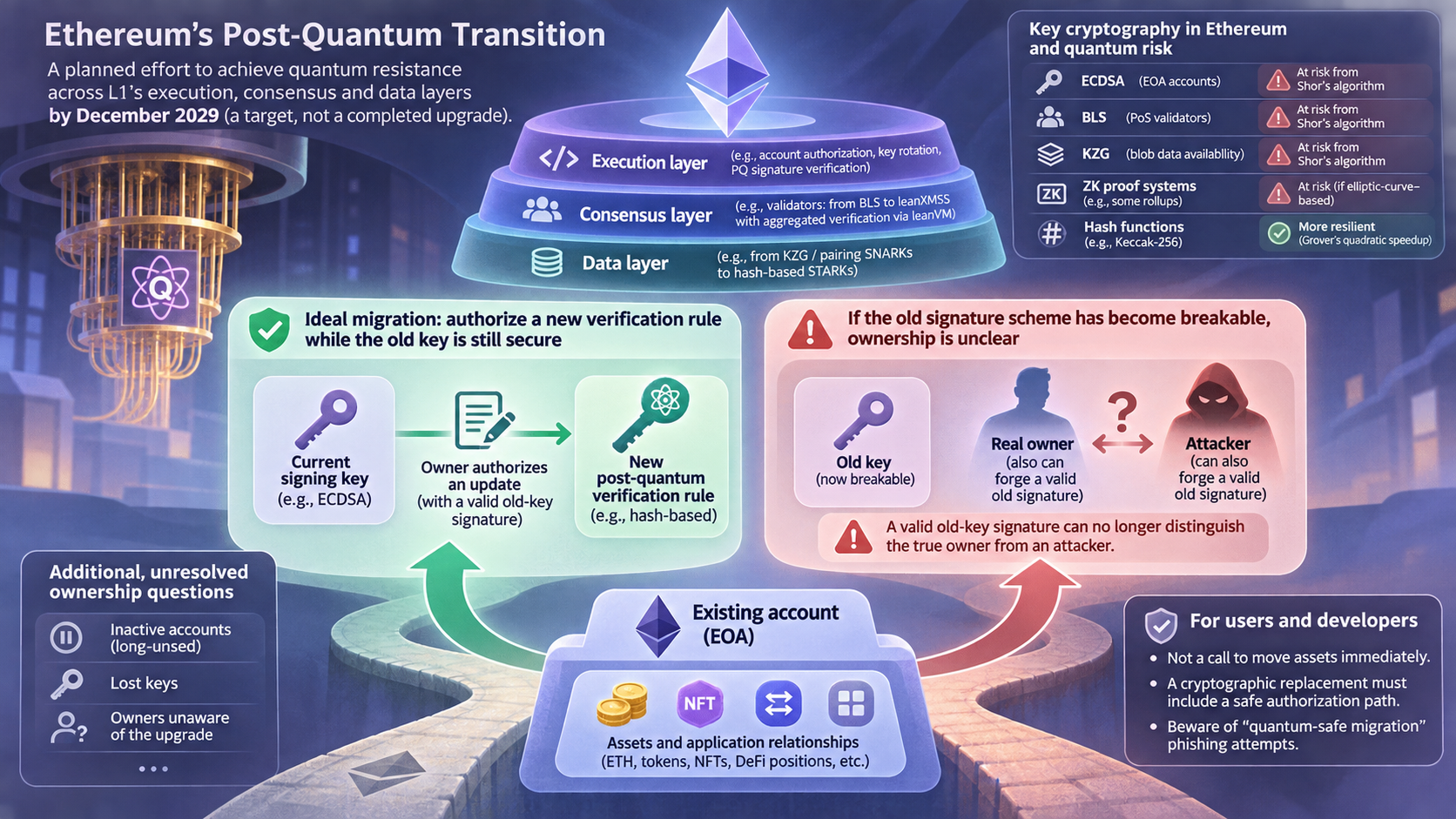
As reported on November 19, 2026, Ethereum’s post-quantum work had a stated engineering target: the Ethereum Foundation’s September 2026 protocol priorities aimed for quantum resistance across L1’s execution, consensus and data layers by December 2029. That is a target, not a completed upgrade. The harder question is how existing accounts and applications could move to new cryptographic rules without losing control of assets.
Where the risk sits
Ethereum uses different cryptographic tools for different jobs. Ordinary externally owned accounts (EOAs) use ECDSA signatures; proof-of-stake validators use BLS signatures; KZG commitments support blob data availability; and some rollup proof systems rely on elliptic-curve assumptions. A sufficiently capable, fault-tolerant quantum computer running Shor’s algorithm could, in theory, undermine the mathematical assumptions behind those systems. No quantum computer capable of breaking this cryptography had emerged at the time of the report.
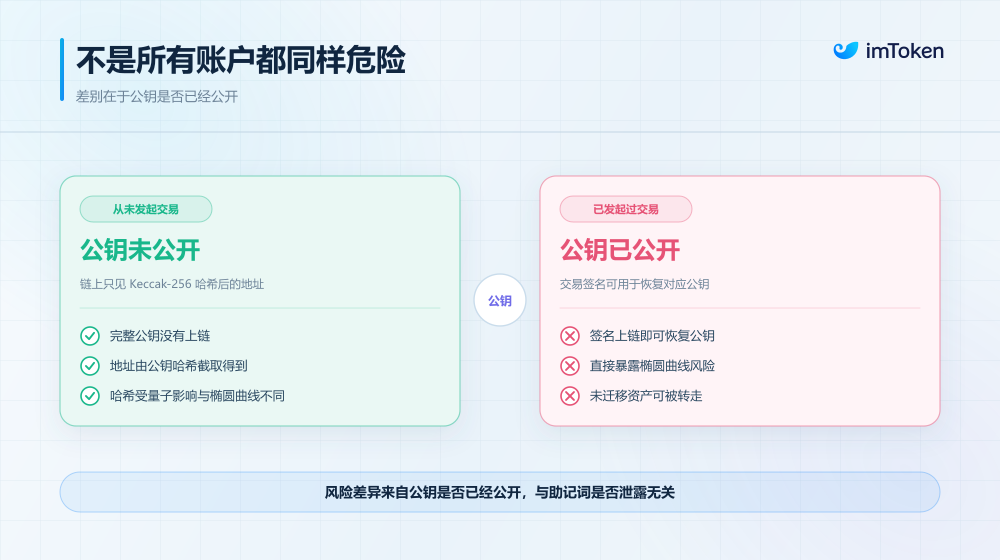
Exposure also differs between accounts. An EOA address is derived by hashing a public key. If an account has never sent a transaction or disclosed a signature elsewhere, its full public key is not exposed by the address alone. Once it sends a transaction, its public key can be recovered from the public signature. That distinction matters to the threat model, but it does not make an unused account a permanent migration strategy.
Hash-based cryptography presents a different risk profile. Grover’s algorithm offers a quadratic speedup against hash searches, rather than the kind of break Shor’s algorithm poses to relevant elliptic-curve systems. This is one reason the proposed replacements differ across Ethereum’s layers.
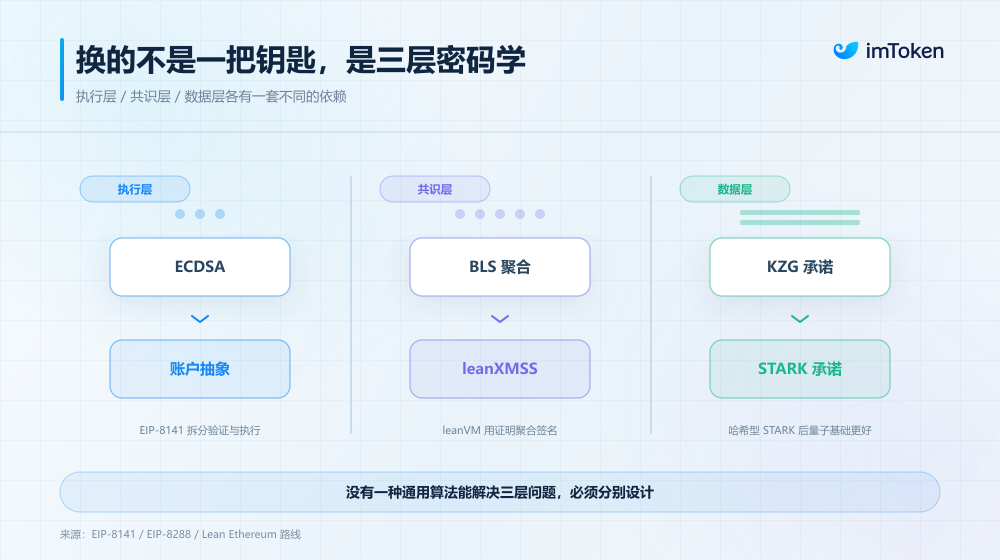
Three layers, different proposed changes
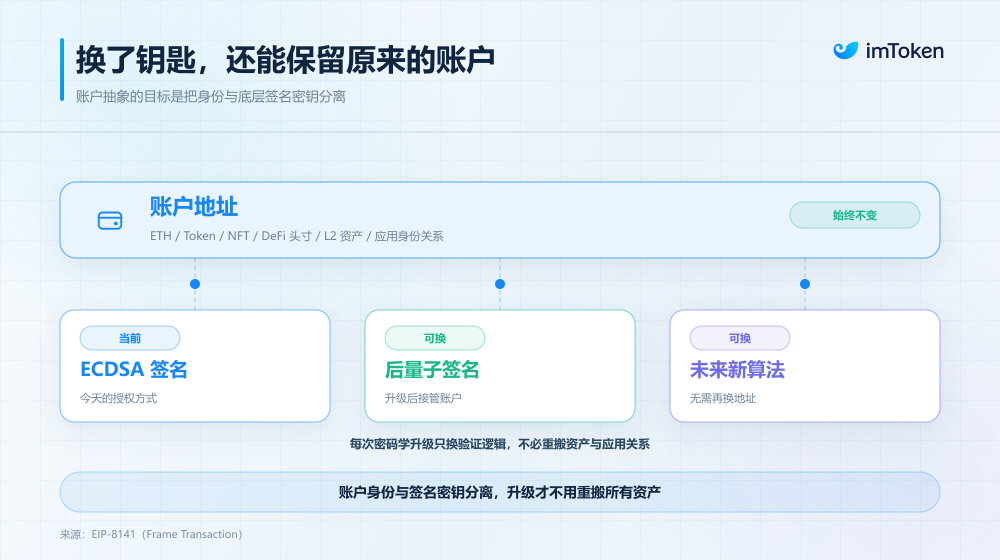
At the execution layer, the account problem is not simply generating a post-quantum key. A conventional EOA binds authorization to a particular signing scheme. Moving to a new address can also mean moving tokens, NFTs, DeFi positions and application relationships tied to the old one. The proposed EIP-8141 approach to native account abstraction would separate transaction validation, execution and gas payment, creating room for programmable authorization and key rotation. The report also describes work on post-quantum signature-verification precompiles. These are prospective capabilities, not evidence that existing EOAs can already switch signature schemes in place.
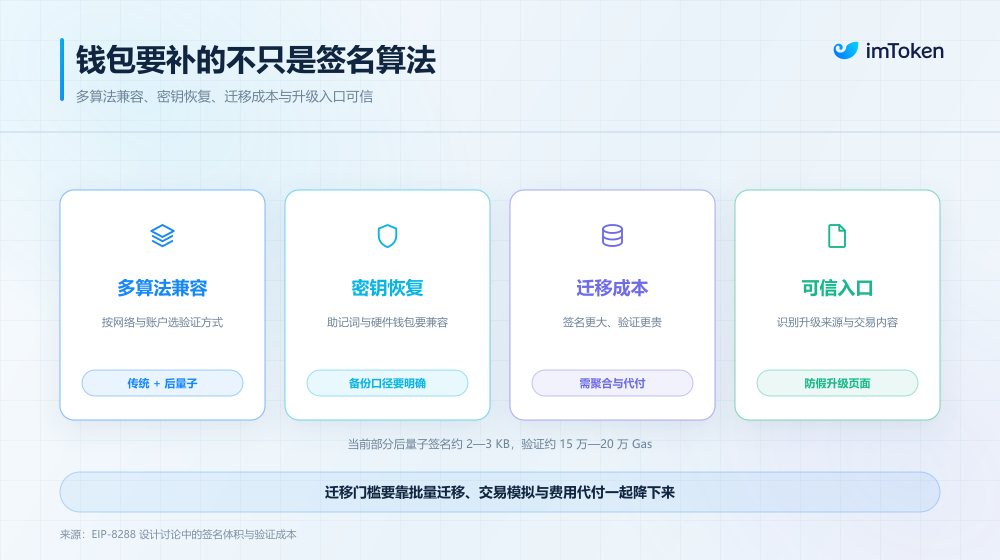
Larger post-quantum signatures create costs of their own. EIP-8288 proposes recursive STARK aggregation to compress the results of verifying many such signatures, rather than placing every verification burden directly on-chain.
At the consensus layer, Ethereum currently benefits from aggregating BLS validator signatures. The Lean Ethereum direction described in the report pairs leanXMSS, a proposed hash-based replacement for validator signatures, with leanVM, a proposed system for aggregating their verification into compact proofs. Whether that design can preserve practical network and verification performance remains an engineering question.
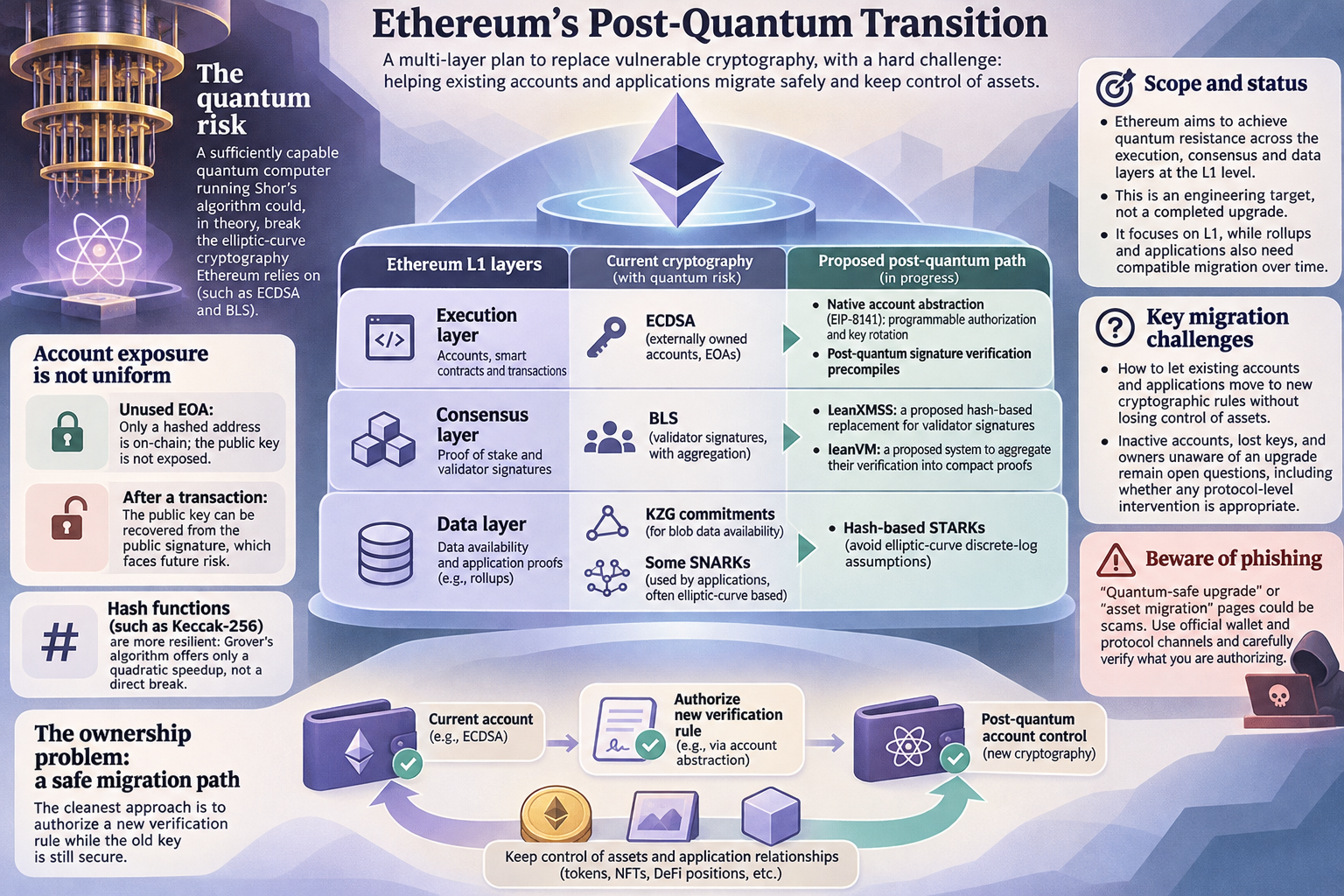
The data layer cannot be left out: KZG commitments depend on elliptic-curve-related assumptions, while some pairing-based SNARKs used by applications face similar long-term concerns. Hash-based STARKs avoid the elliptic-curve discrete-log assumption. Consequently, a migration confined to L1 account signatures would not address every cryptographic dependency in the wider rollup ecosystem.
The ownership problem migration cannot postpone
The cleanest prospective path is for an owner to authorize a new verification rule while the old key remains secure. If the old signature scheme has already become breakable, a valid old-key signature may no longer distinguish the owner from an attacker. Inactive accounts, lost keys and owners unaware of an upgrade pose further unresolved questions, including whether any protocol-level intervention would be appropriate.
For users, the report’s conclusion was not a call to move assets immediately. For protocol and wallet developers, it was a warning that a cryptographic replacement must include a safe authorization path—and that purported “quantum-safe” migration pages could themselves be phishing attempts. The December 2029 target describes the intended scope of L1 work; it does not settle how every existing account or application will migrate.