
A validator’s signature, an invalid block header and an estimated $25 million in losses put Ethereum’s transaction-ordering system before a federal court. As reported on November 19, 2026, a judge had acquitted brothers Anton and James Peraire-Bueno three days earlier. The ruling turned on a narrower question than whether their conduct was acceptable: what false representation, if any, had they made, and to whom?
How the transaction ordering was exploited
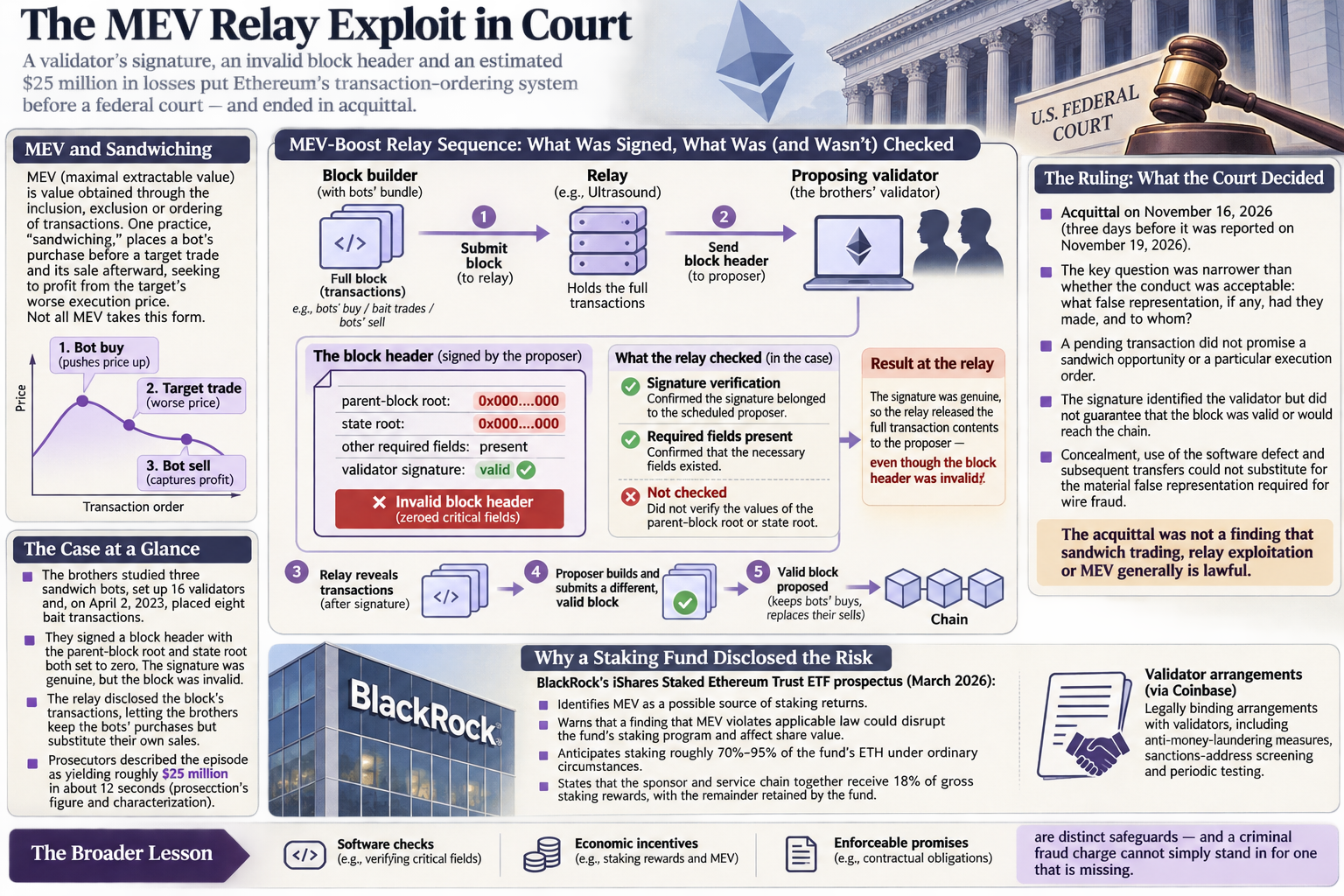
MEV, or maximal extractable value, is value obtained through the inclusion, exclusion or ordering of transactions. One practice, sandwiching, places a bot’s purchase before a target trade and its sale afterward, seeking to profit from the target’s worse execution price. Not all MEV takes this form.
According to the court record, three professional traders operating sandwich bots were the targets in this case. The brothers studied the bots, established 16 validators and, when a validator they controlled was due to propose a block on April 2, 2023, placed eight bait transactions in the public pending-transaction queue. The bots submitted bundles designed to trade around them.
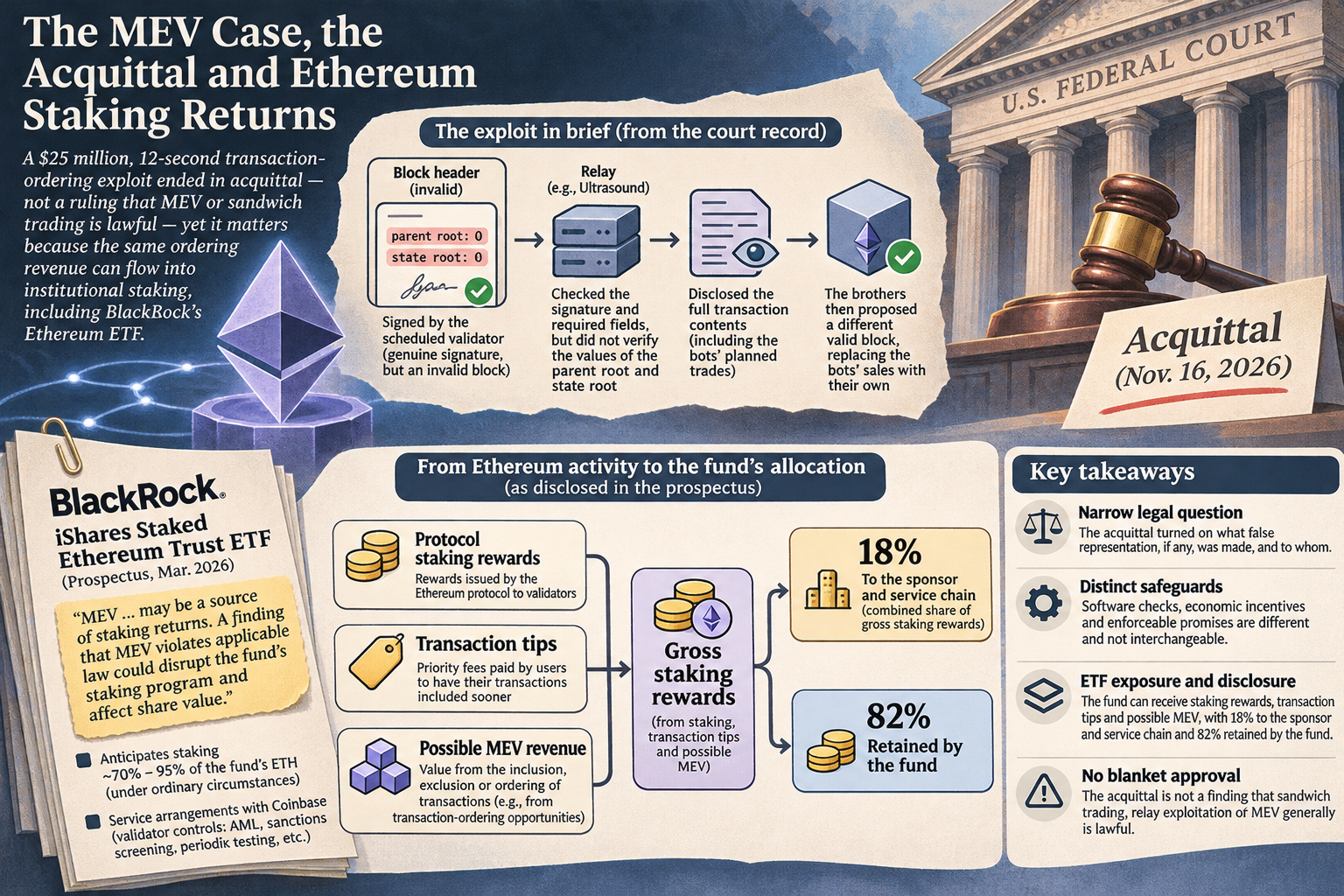
In the MEV-Boost process described in the case, a relay initially gives the proposing validator a block header; the full transaction contents follow the validator’s signature. The court record says the Ultrasound relay software checked that the signature belonged to the scheduled proposer and that required fields were present, but did not verify the values of two fields: the parent-block root and state root. The brothers signed a header with both values set to zero. Its signature was genuine, but the proposed block was invalid. The relay nevertheless disclosed the transaction contents.
Having seen the bots’ planned purchases and sales, the brothers proposed a different valid block that retained the bots’ purchases but substituted their own sales. Prosecutors described the episode as yielding roughly $25 million in about 12 seconds. That figure and characterization came from the prosecution, not an independent civil accounting of every loss by the judge.
Why the fraud charges failed
Federal prosecutors charged the brothers in May 2024 with wire fraud, conspiracy to commit wire fraud and conspiracy to launder money. A nearly four-week jury trial ended without a unanimous verdict in 2025. Following a trial without a jury, the judge acquitted them on November 16, 2026.
The prosecution argued that the bait transactions implied they would execute as the bots expected, and that signing the header promised publication of the original block. The judge rejected both proposed representations. A pending transaction did not promise anyone a sandwich opportunity or a particular execution order. The signature identified the validator but did not guarantee that the block was valid or would reach the chain. The relay’s failure to check the zeroed fields was a software error, its operator testified.
The judge also found that concealment, use of the software defect and subsequent transfers could not substitute for the material false representation required for the wire-fraud charges. With those charges unproven, the laundering-conspiracy charge, which depended on their proceeds, failed too. The acquittal was not a finding that sandwich trading, relay exploitation or MEV generally is lawful.
Why a staking fund disclosed the risk
BlackRock’s March 2026 prospectus for its iShares Staked Ethereum Trust ETF identifies MEV as a possible source of staking returns. It warns that a finding that MEV violates applicable law could disrupt the fund’s staking program and affect share value. The document anticipates staking roughly 70%–95% of the fund’s ETH under ordinary circumstances and says the sponsor and service chain together receive 18% of gross staking rewards, with the remainder retained by the fund.
That disclosure does not say the fund runs sandwich bots or participated in this case. It does show why the legal treatment of transaction-ordering revenue matters to an institution expecting to share in staking returns. The prospectus also describes legally binding arrangements through Coinbase under which validators undertake specified controls, including anti-money-laundering measures, sanctions-address screening and periodic testing. Those contractual obligations differ from a promise the prosecution tried, but failed, to establish from a validator’s signature in this case.
The unresolved research question is the composition of MEV revenue: the prospectus identifies a potential return and its allocation, but does not identify the transaction strategy behind each payment. The case likewise does not classify every form of MEV. Its narrower lesson is that software checks, economic incentives and enforceable promises are distinct safeguards—and a criminal fraud charge cannot simply stand in for one that is missing.