
In a November 19, 2026 report, Deep Tide TechFlow said K3 Capital’s Ethereum sBOLD savings vault had lost approximately $3.4 million in liquidity through 97 transactions over about eight minutes. The report attributed the exploit to how the vault accounted for assets when calculating the value of sBOLD shares. It did not provide transaction hashes or a contract-level reproduction, so the mechanism described below remains the reported explanation rather than an independently verified reconstruction.
The reported accounting failure
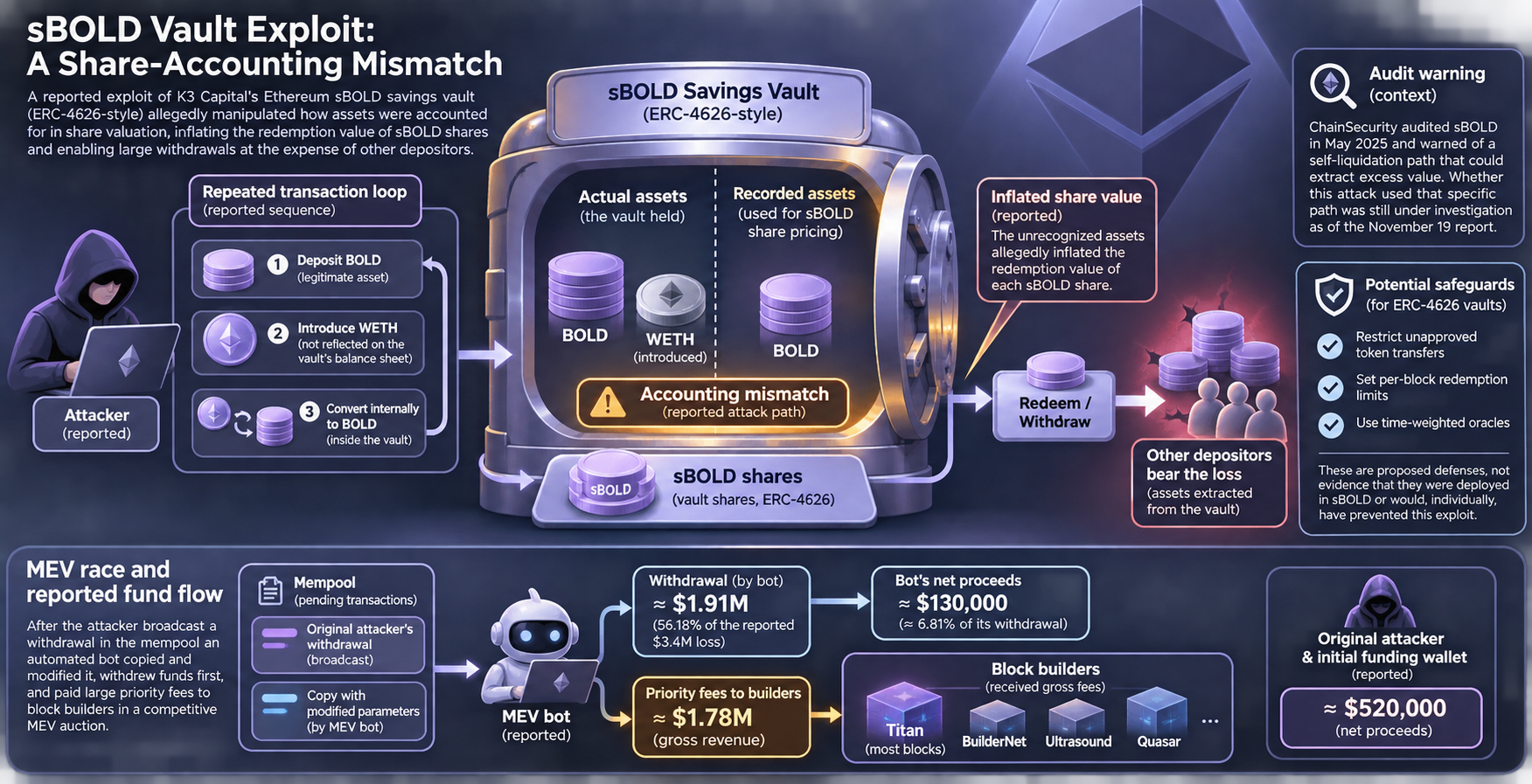
sBOLD is a yield-bearing vault built around BOLD, the stablecoin associated with Liquity. Citing transaction analysis by Bitquery, the report said the attacker repeatedly deposited BOLD, introduced wrapped ether (WETH) that was not reflected on the vault’s balance sheet, and converted it internally into BOLD. According to that reconstruction, the sequence inflated the redemption value of each sBOLD share, allowing withdrawals at the expense of other depositors.
The distinction is between assets the vault held and assets its share-pricing calculation recognized. The report identifies a mismatch between those two quantities as the attack path, but does not establish from the supplied evidence exactly which contract checks failed.
Where the extracted funds went
The report said an automated bot observed the original attacker’s withdrawal transaction in the mempool, copied and modified its parameters, and withdrew approximately $1.91 million first—56.18% of the reported $3.4 million loss. It said the bot paid roughly $1.78 million in priority fees to block builders, leaving about $130,000 from that withdrawal. The original attacker and the wallet that initially funded the attack reportedly retained approximately $520,000 in net proceeds.
According to the report, Titan built most of the blocks containing the bot’s transactions, while BuilderNet, Ultrasound and Quasar also participated in ordering related blocks. The reported $1.78 million is gross revenue received by builders, not their net profit: builders still had to bid for block proposals through MEV-Boost.
What remains unresolved
ChainSecurity audited sBOLD in May 2025 and, according to the report, warned of a self-liquidation path that could extract excess value. Whether this attack used that specific path was still under investigation as of the November 19 report. The report also said the team was monitoring possible cross-chain fund movements, assessing depositor losses and working on vault-code repairs; it did not establish that funds had crossed chains.
The report identified restrictions on unapproved token transfers, per-block redemption limits and time-weighted oracles as potential safeguards for ERC-4626 vaults. Those are proposed defenses, not evidence that they were deployed in sBOLD or would, individually, have prevented this exploit.