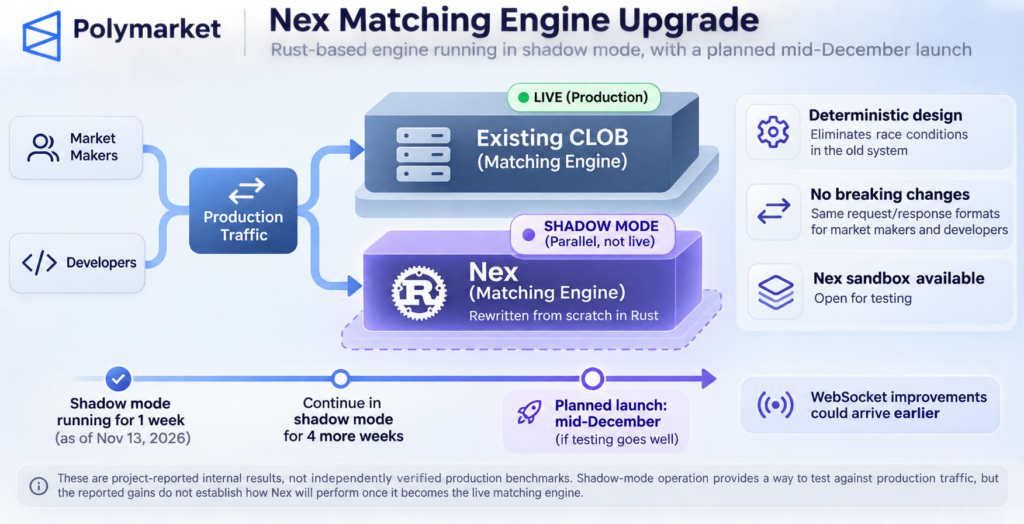
As reported on November 13, 2026, Polymarket engineering vice president Josh Stevens said Nex, a matching engine rewritten from scratch in Rust, had been running in shadow mode alongside production traffic for one week. Nex was not yet the live matching engine; Stevens said it would remain in shadow mode for another four weeks, with a launch planned for mid-December if testing went well. WebSocket improvements could arrive earlier.
Stevens reported the following results from internal tests:
| Measure | Existing system | Nex |
|---|---|---|
| p99 order-placement latency | 1.55 seconds | 3.76 milliseconds |
| Order-cancellation latency | 627.92 milliseconds | 3.20 milliseconds |
| p99 WebSocket write latency | 44.5–88.1 milliseconds | 0.099 milliseconds |
| Steady-state command throughput | 10,000 per second | 100,000 per second |
| Startup time | 5 minutes | 15 seconds |
Stevens also said Nex could reach a peak throughput of 150,000 commands per second. He described its design as deterministic, saying it eliminated race conditions in the old system, and said it would not require breaking changes to request or response formats used by market makers and developers. Polymarket had opened a Nex sandbox for testing.
These are project-reported internal results, not independently verified production benchmarks. Shadow-mode operation provides a way to test against production traffic, but the reported gains do not establish how Nex will perform once it becomes the live matching engine.