In an article published on November 19, 2026, wallet developer imToken framed Ethereum’s post-quantum work around a practical question: if today’s signature schemes eventually become unsafe, how can users retain control of their existing accounts and assets while changing the keys that authorize transactions?
The threat is theoretical, not an active break. imToken noted that no quantum computer capable of breaking the cryptography used by mainstream blockchains had emerged. Its concern is the time required to change that cryptography across Ethereum and its applications.
Which components face the risk?
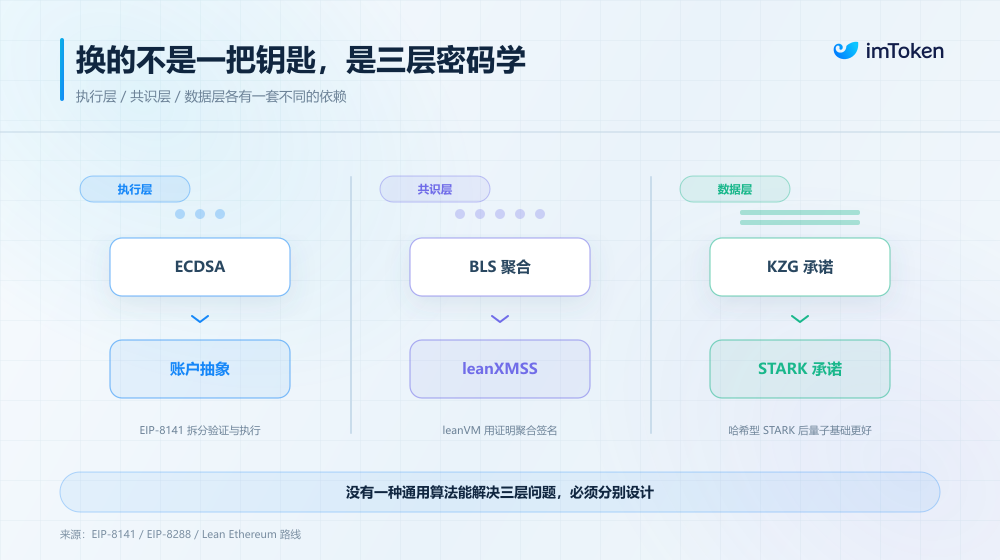
Ethereum uses different cryptographic tools for different jobs. Ordinary externally owned accounts (EOAs) use ECDSA signatures; proof-of-stake validators use BLS signatures. Ethereum also uses KZG commitments for blob-related data availability, while some rollup proof systems rely on elliptic-curve-based assumptions.
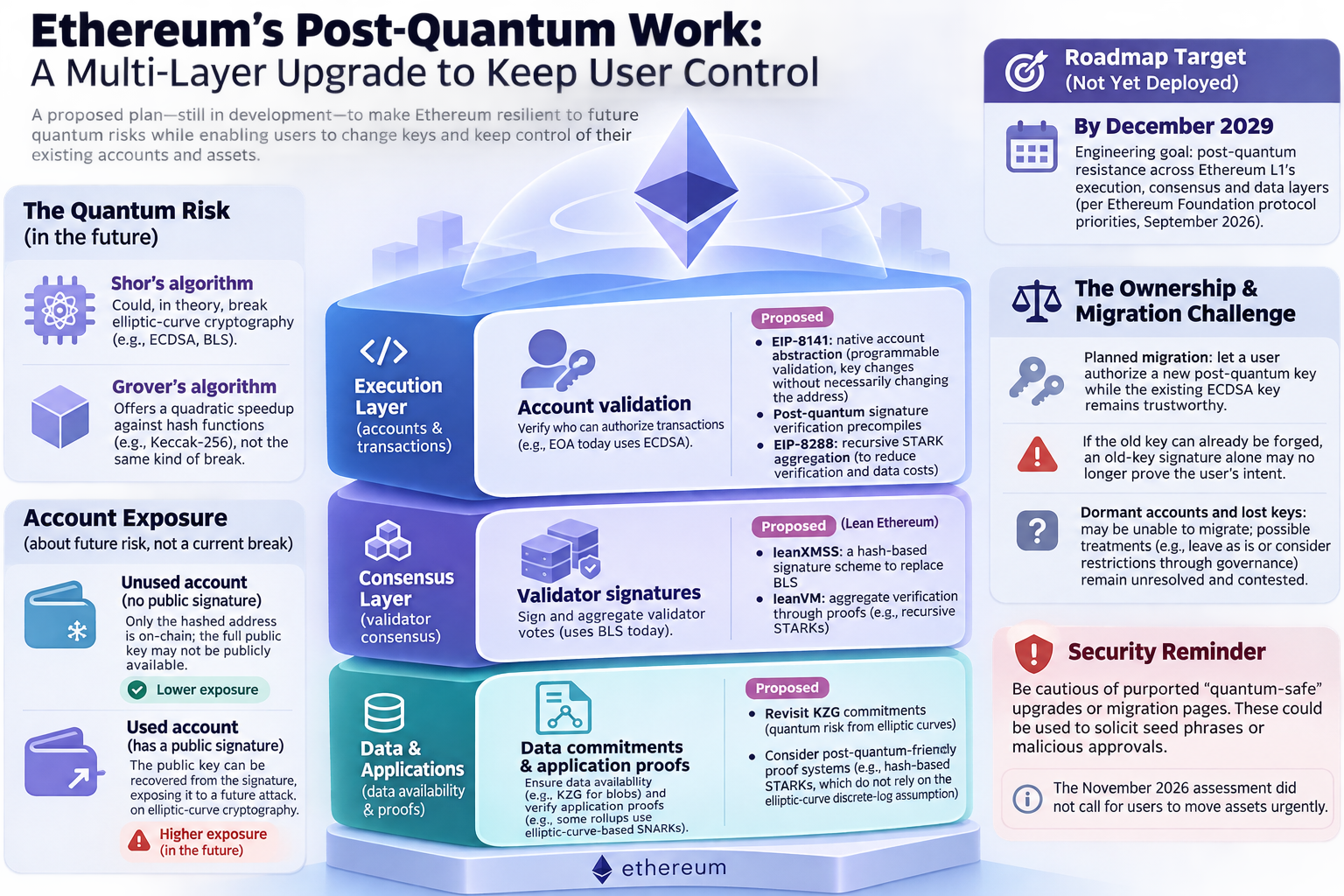
A sufficiently capable fault-tolerant quantum computer running Shor’s algorithm could, in theory, undermine the mathematical assumptions behind elliptic-curve signatures. Hash functions such as Keccak-256 face a different quantum risk: Grover’s algorithm offers a quadratic speedup, rather than the same kind of break.
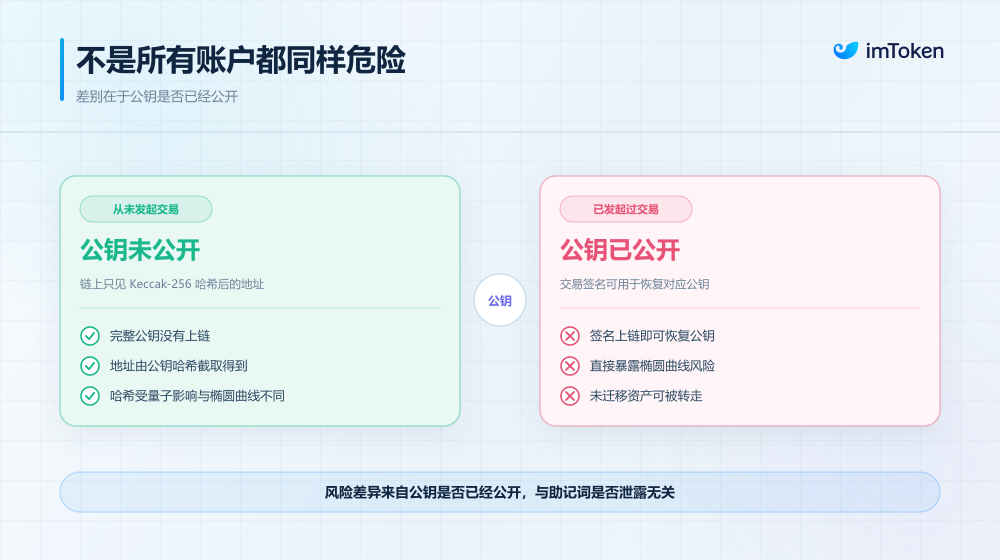
That distinction matters for account exposure. An EOA address is derived from a hash of its public key. If an account has never sent a transaction or otherwise disclosed a signature, its full public key may not be publicly available. Once it has signed a public transaction, the public key can be recovered from the signature, exposing it to a future attack on elliptic-curve cryptography. This is a distinction about future risk, not a reason to assume any account is currently compromised.
A proposed upgrade across three layers
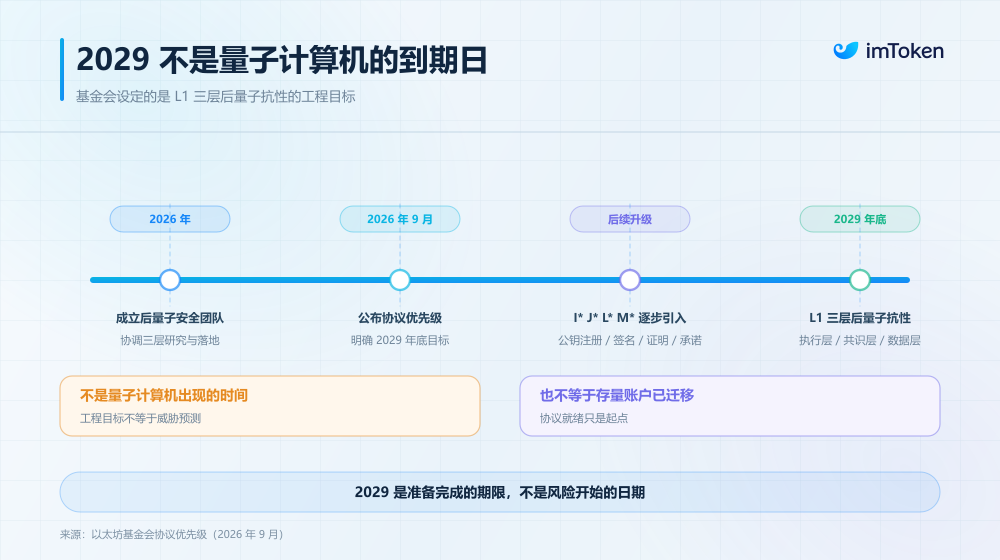
According to imToken, Ethereum Foundation protocol priorities published in September 2026 set an engineering goal of post-quantum resistance across Ethereum L1’s execution, consensus and data layers by December 2029. That is a target, not a completed upgrade.
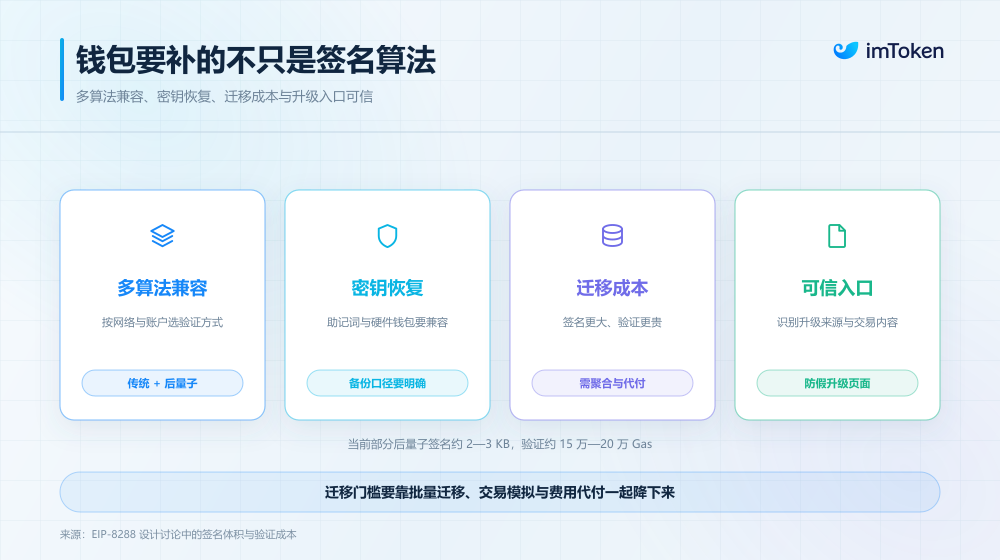
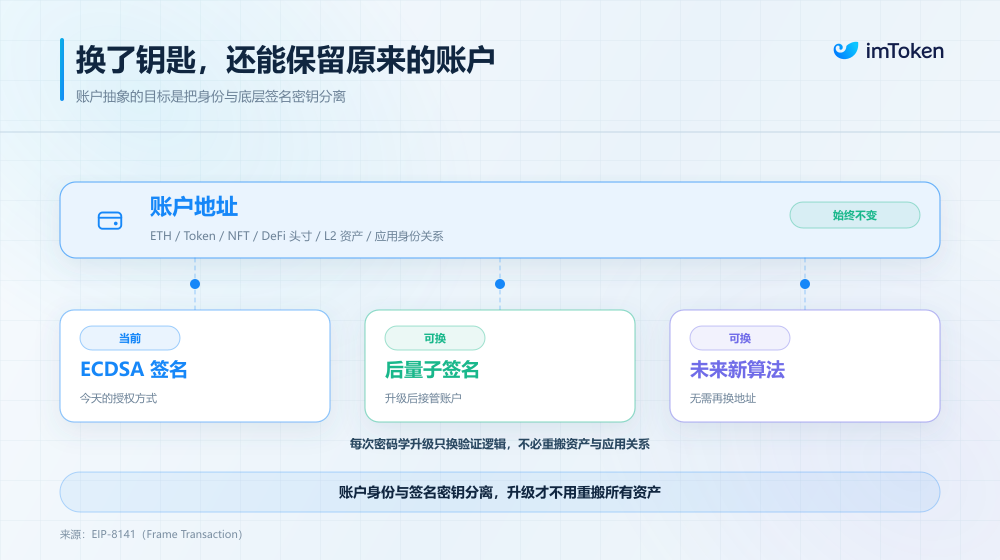
At the execution layer, imToken describes EIP-8141’s proposed native account-abstraction approach as a way to separate transaction validation, execution and gas payment. Programmable validation could make it possible for an account to change its authorization method without necessarily changing its address. The article also discusses research into post-quantum signature-verification precompiles. Because such signatures can be much larger than existing ones, it presents EIP-8288’s proposed recursive STARK aggregation as one approach to reducing on-chain verification and data costs.
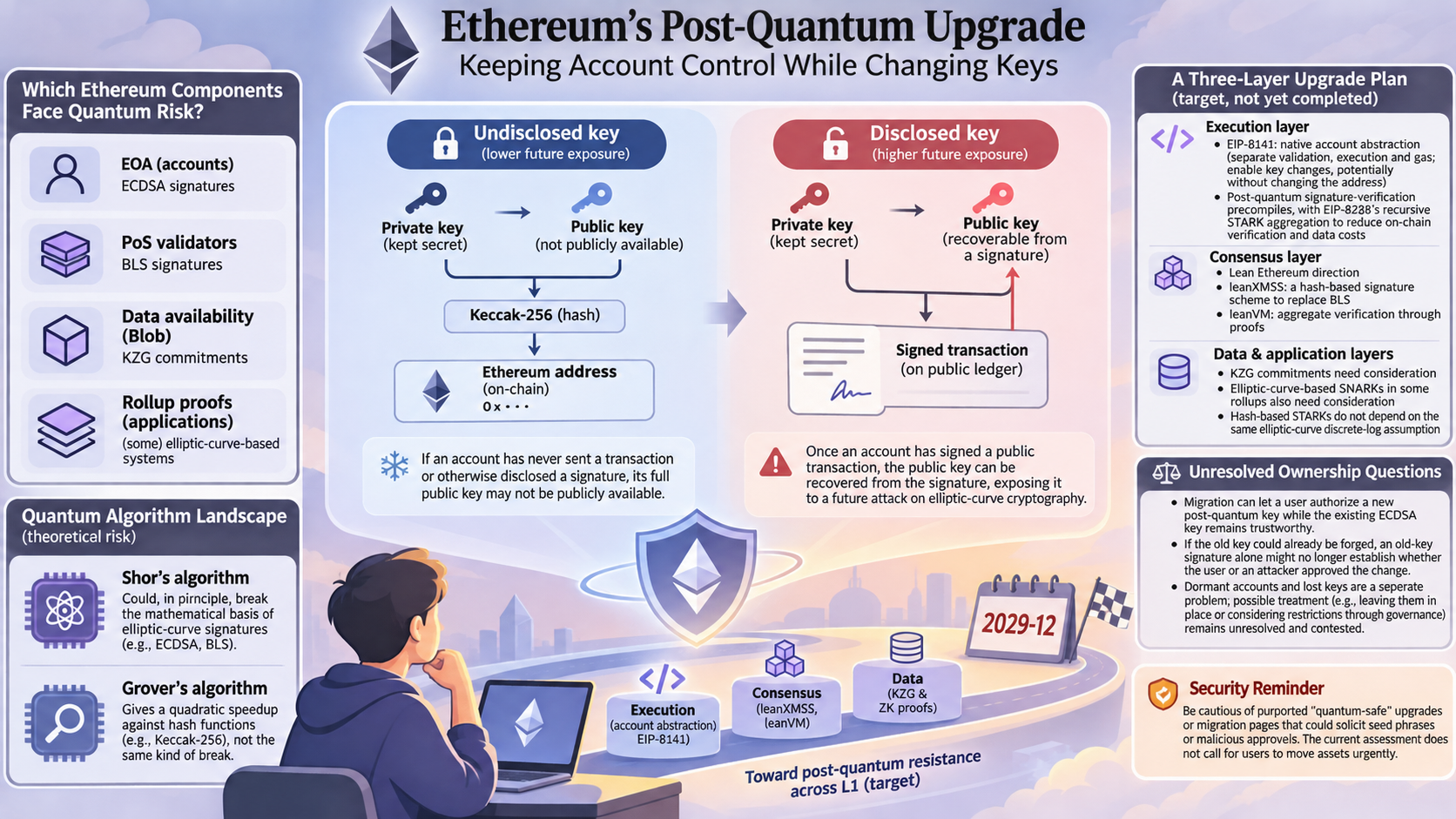
At the consensus layer, the proposed Lean Ethereum direction described by imToken includes leanXMSS, a hash-based signature scheme intended to replace validator BLS signatures, and leanVM, intended to aggregate verification through proofs. Replacing BLS without addressing signature size would increase propagation, storage and verification demands. At the data and application layers, KZG commitments and elliptic-curve-based SNARKs would also need consideration; hash-based STARKs do not depend on the same elliptic-curve discrete-log assumption.
The unresolved ownership question
A planned migration could let a user authorize a new post-quantum key while their existing ECDSA key remains trustworthy. If that key could already be forged, however, an old-key signature alone might no longer establish whether the user or an attacker approved the change. Dormant accounts and lost keys pose a separate problem because their owners may be unable to migrate at all. imToken describes possible treatment of such accounts, including leaving them in place or considering restrictions through governance, as unresolved and contested.
The reported roadmap therefore addresses more than algorithm selection. Its account-level test is whether a future upgrade can preserve legitimate control without creating a migration process that attackers can exploit. imToken cautioned that purported “quantum-safe” upgrades or migration pages could themselves be used to solicit seed phrases or malicious approvals. Its November 2026 assessment did not call for users to move assets urgently.