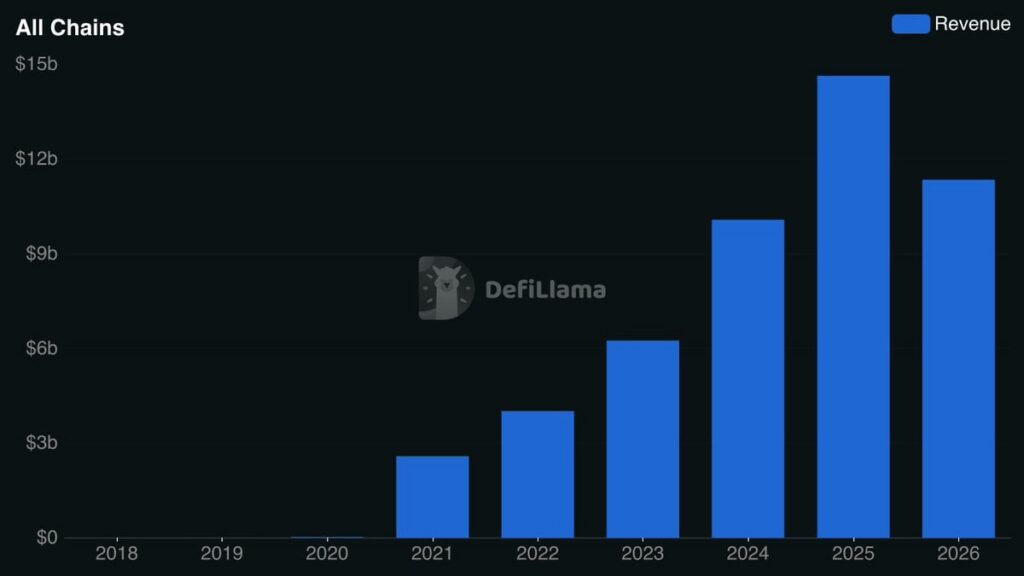
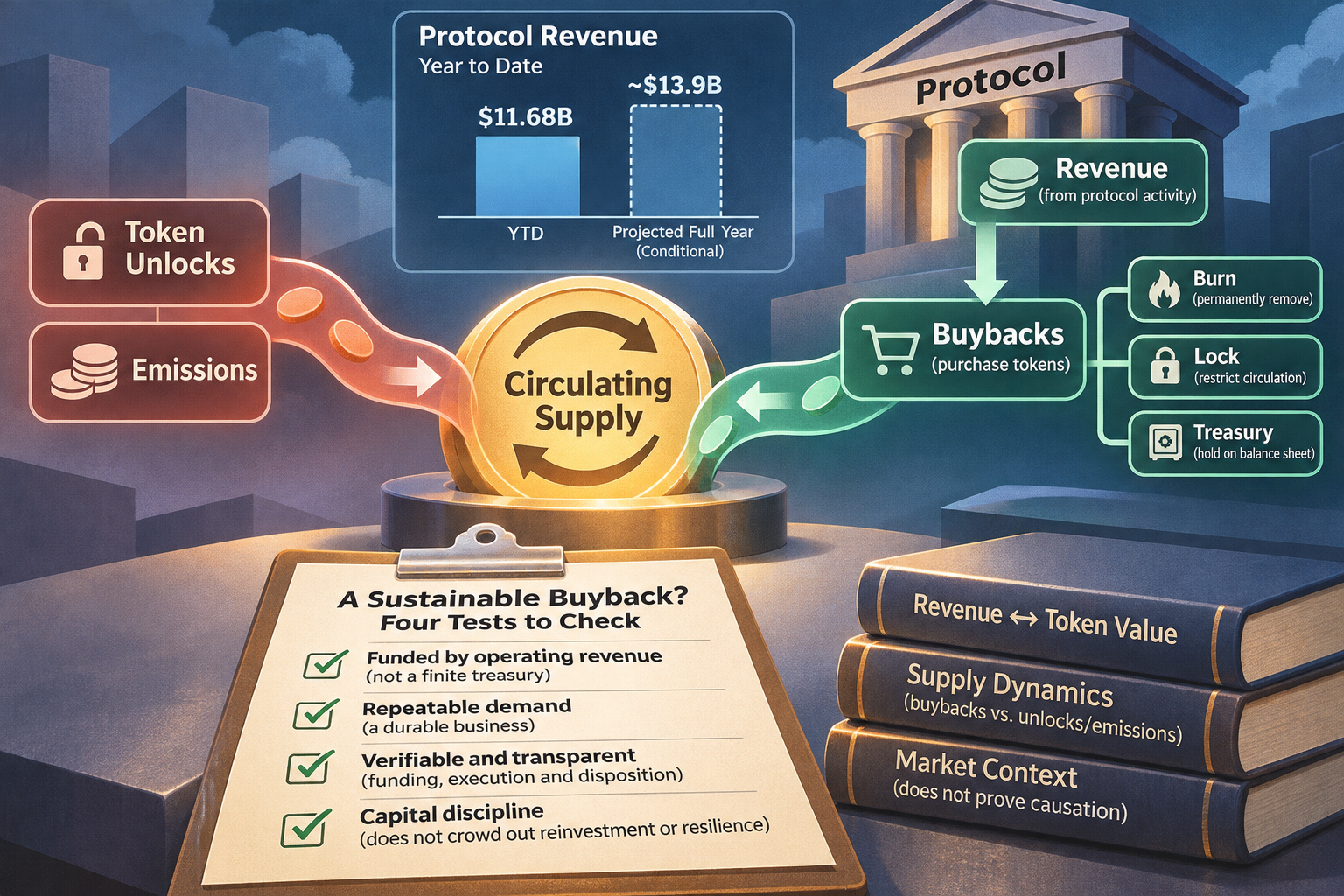
As reported on November 13, 2026, the case for revenue-backed crypto tokens rests on two separate questions: whether a protocol earns durable revenue, and whether any of that value reaches its token. The analysis cited aggregate protocol revenue of $11.68 billion year to date. It projected roughly $13.9 billion for the full year if November and December matched October—a conditional estimate, not a reported result.
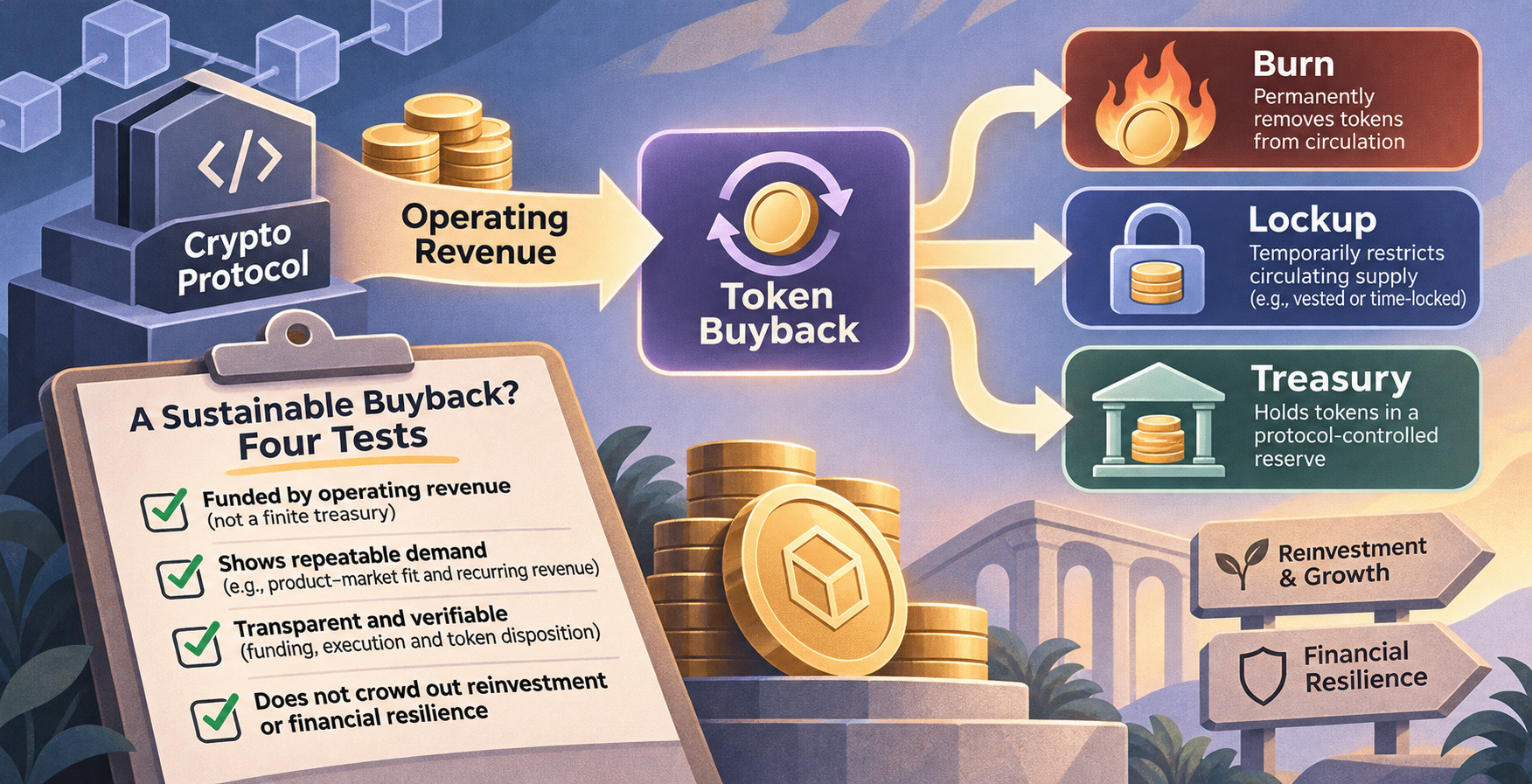
Revenue alone does not give token holders a legal claim on a business or its profits. A protocol can succeed commercially while its token captures little of that success. Buybacks are one way projects attempt to connect the two: they use funds to purchase tokens, then burn them, lock them or hold them in a treasury. Those destinations have different implications for circulating supply, so the purchase amount is not enough to assess the mechanism.
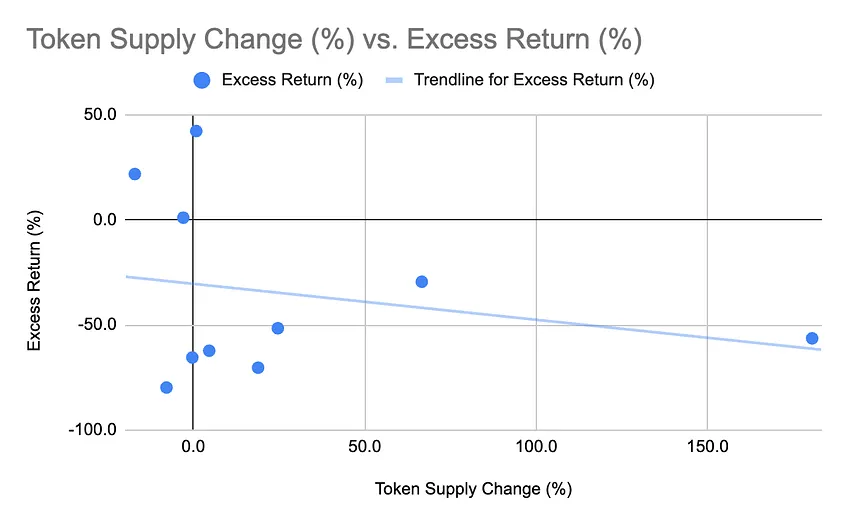
What would make a buyback sustainable?
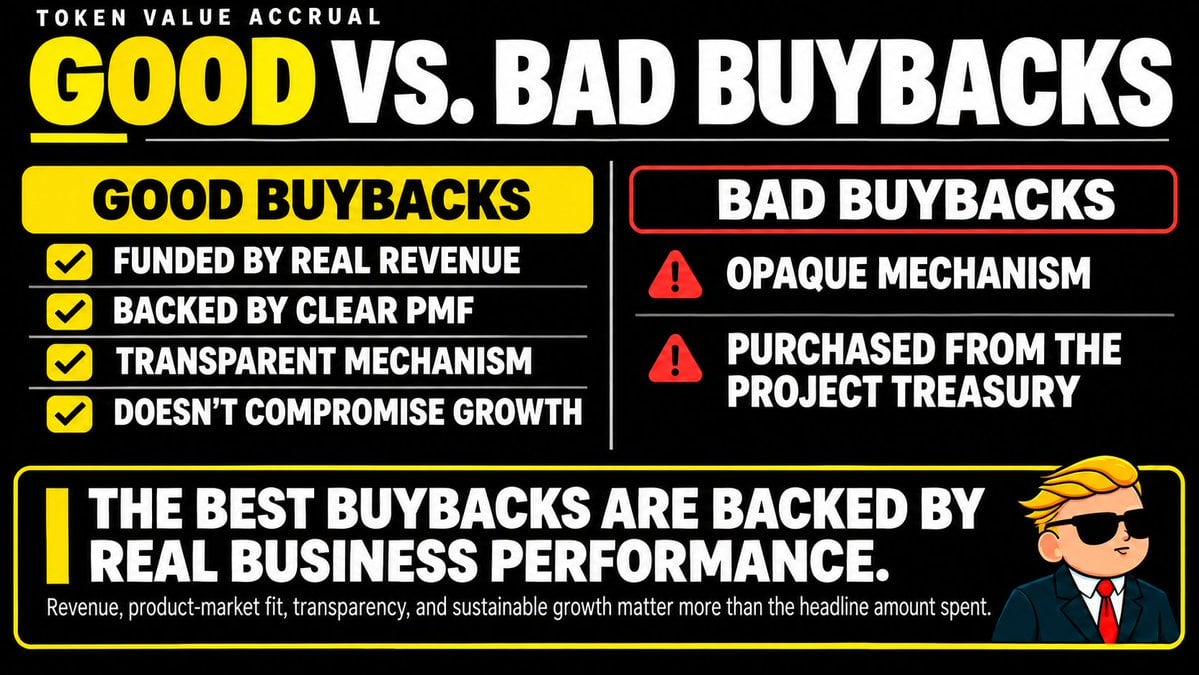
The analysis proposed four tests: purchases should be funded by operating revenue rather than a finite treasury; the business should show repeatable demand; holders should be able to verify funding, execution and token disposition; and buybacks should not crowd out reinvestment or financial resilience. Token unlocks and emissions also matter. If new supply exceeds the amount absorbed by purchases, a large buyback budget may have limited effect on supply dynamics.
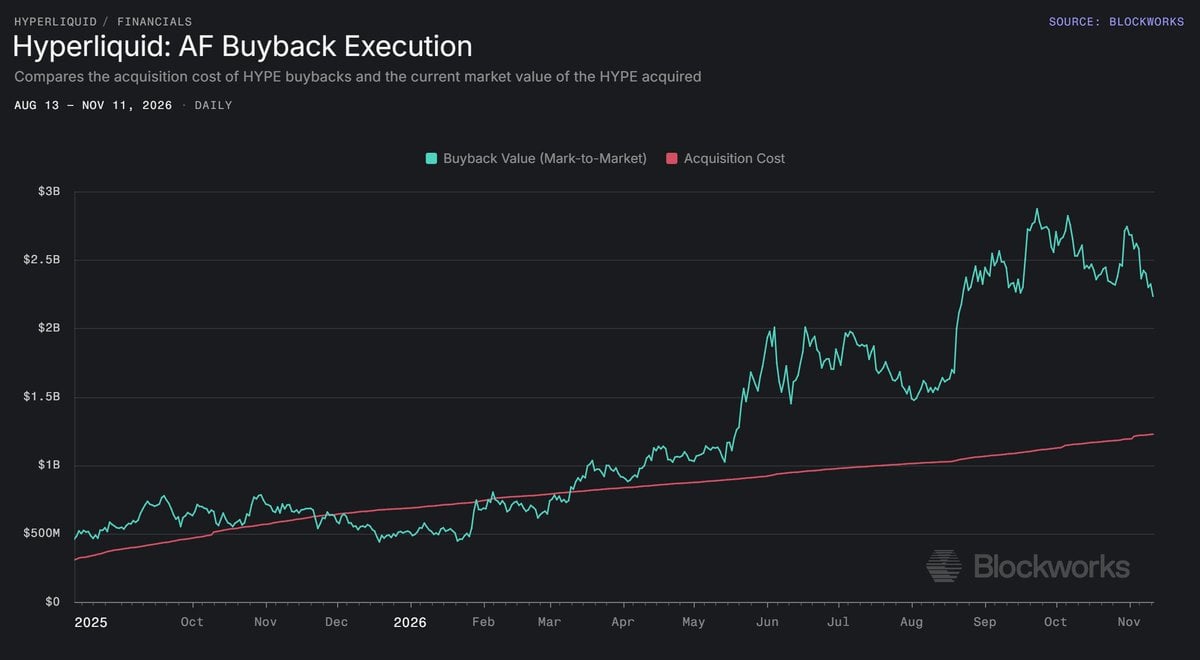
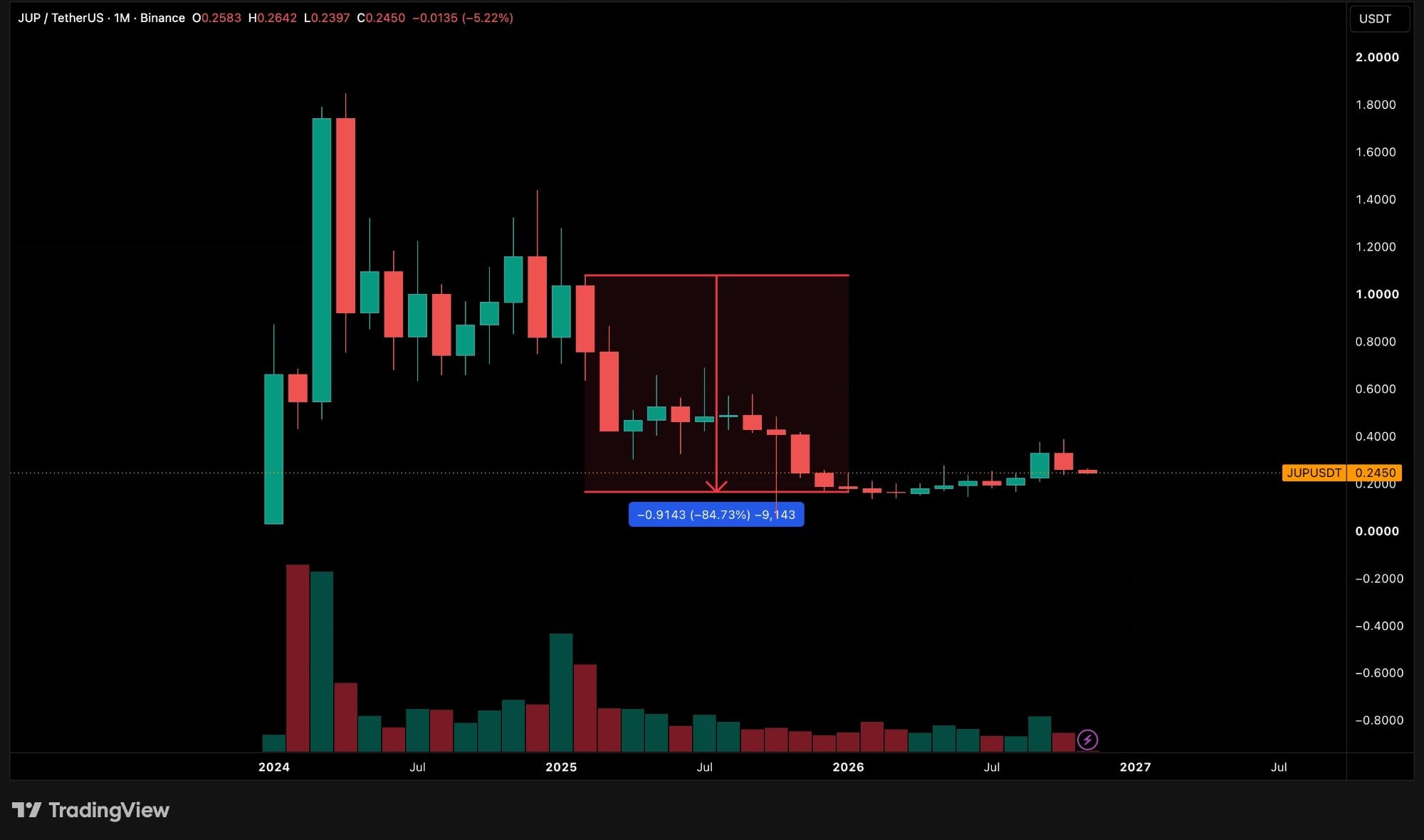
Market conditions complicate any price-based verdict. The article reported that 28 major projects spent more than $1.4 billion on buybacks in 2025, but only AAVE, HYPE and SKY outperformed Bitcoin during their respective buyback windows. Jupiter, for example, began allocating 50% of on-chain protocol revenue to JUP purchases in February 2025 and had spent more than $70 million by January 2026, while JUP continued to fall. The analysis placed that result alongside a broad decline in Solana-related assets. Neither the expenditure nor the subsequent price move, on its own, establishes what the token would have done without the purchases.
What the 2026 comparisons show—and do not show
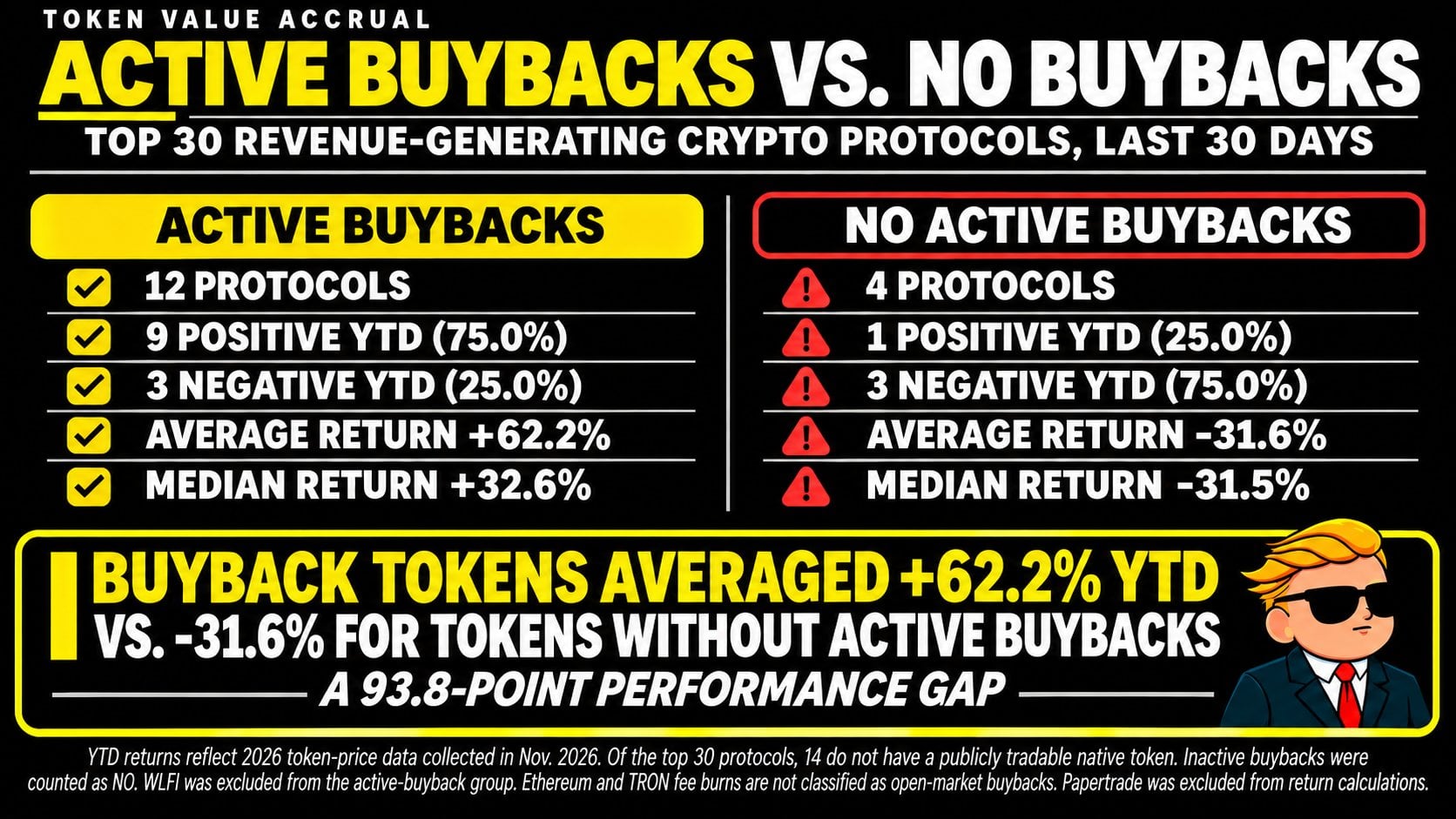
By the reporting date, the analysis said projects had spent more than $900 million on token buybacks and related burn mechanisms in 2026, with Hyperliquid and Pump.fun accounting for most of that amount. It then examined the 30 protocols with the highest revenue over the preceding 30 days. Fourteen had no publicly traded native token. Of the remaining 16, twelve had active buybacks: nine tokens had positive year-to-date returns and three had negative returns, with a 62.2% average and 32.6% median. Among the four without active buybacks, one was positive and three were negative; their average was −31.6% and median −31.5%.
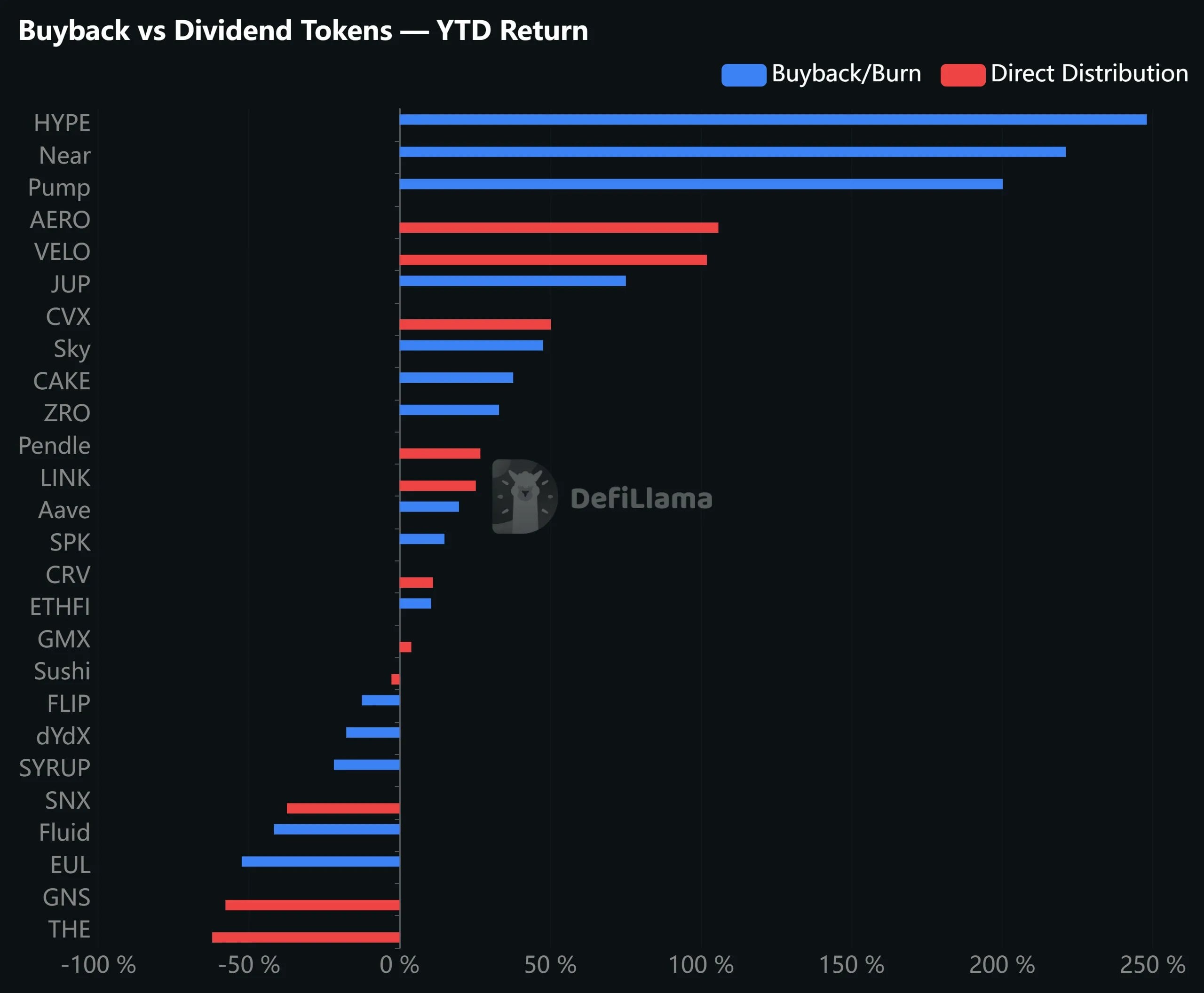
That is a 93.8-percentage-point difference between the two group averages, not an estimate of the return caused by buybacks. The groups are small, selected for recent revenue and potentially different in other ways. The article also cited a September DeFiLlama comparison: median year-to-date returns of 19.7% for tokens with buybacks versus 11.1% for tokens distributing revenue directly to holders. Those comparisons describe performance; they do not isolate the effect of the distribution method.
Mechanisms to examine
The reported cases illustrate different links between activity and token demand:
- World Liberty Financial: The article said its newly started WLFI plan would use part of USD1 reserve-related revenue, described as exceeding $150 million annually. The analytical question is how much revenue actually funds purchases and what happens to the acquired tokens; the stated revenue figure is not itself a token-holder entitlement.
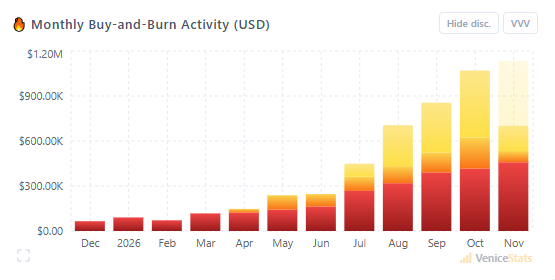
- Venice: The article reported that the privacy-focused AI platform AskVenice had passed 4 million users and $100 million in annualized revenue. It said a November 9 buyback removed approximately $458,000 worth of tokens from circulation, while subscription and API-credit purchases funded automated burns. These are distinct mechanisms and should be measured separately.
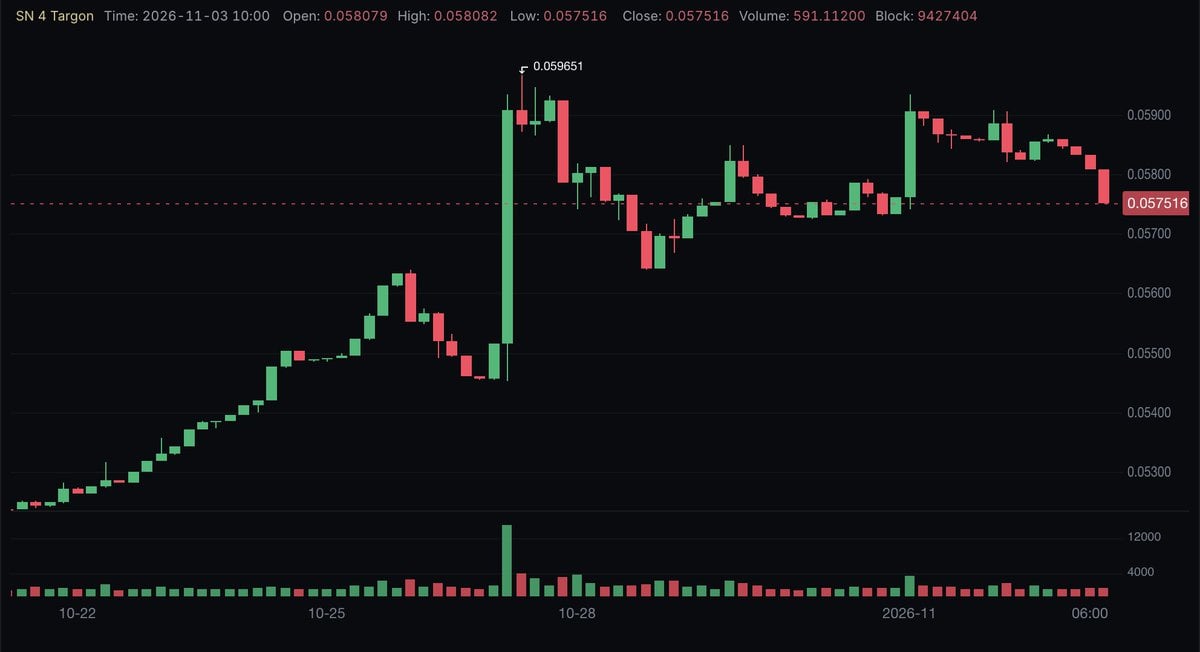
- Bittensor subnets: Citing Subconnect data through August 2026, the analysis said 14 of 24 subnets with external revenue used it to buy back their alpha tokens. It estimated combined annualized revenue for the 24 at $28 million–$35 million. It also reported that Targon announced an October 27 burn of about $2.1 million worth of SN4, including roughly $445,000 in newly purchased tokens, funded by its AI-compute business. A short-term price reaction to that announcement is not evidence of a lasting effect.
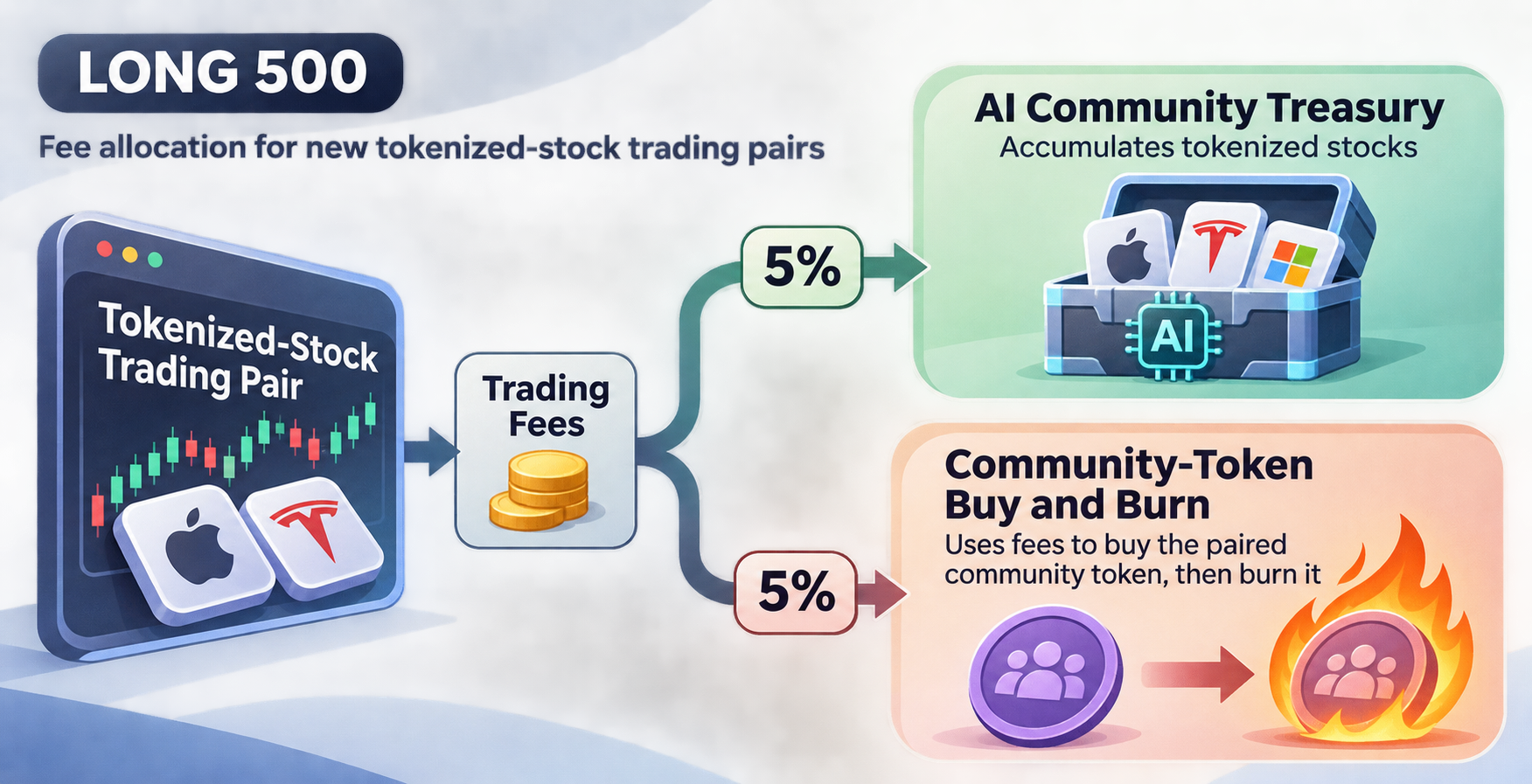
- LONG 500: The article described a mechanism introduced by longdotxyz in September: 5% of fees from new tokenized-stock trading pairs would enter an AI community treasury accumulating tokenized stocks, and another 5% would buy and burn the community token paired with each stock. This is a stated design, not evidence here of realized reserves or buyback volume.
The research question is therefore narrower than whether buybacks “work.” For each protocol, it is whether independently checkable revenue can sustain purchases, whether net token supply changes after all emissions and unlocks, and whether the chosen use of capital remains sensible at the token’s prevailing valuation. The reported 2026 returns make those questions worth investigating; they do not settle them.