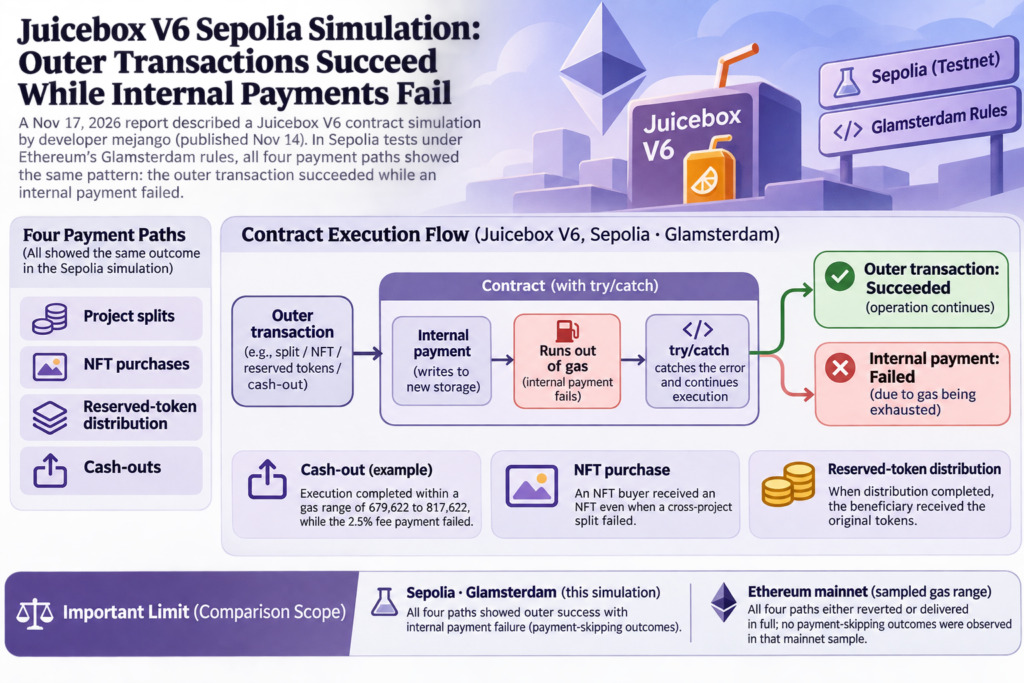
A November 17, 2026 report described a Juicebox V6 contract simulation published by developer mejango on November 14. In the Sepolia tests, all four payment paths examined under Ethereum’s Glamsterdam rules showed the same outcome: the outer transaction succeeded while an internal payment failed. The paths covered project splits, NFT purchases, reserved-token distribution and cash-outs.
Mejango attributed the behavior to gas being exhausted when an internal payment tried to write to new storage. The contract’s try/catch then caught the error and allowed the outer operation to continue. In one reported cash-out case, execution completed within a gas range of 679,622 to 817,622 while the 2.5% fee payment failed. The tests also showed an NFT buyer receiving an NFT when a cross-project split failed, and a reserved-token beneficiary receiving the original tokens when distribution completed.
The comparison has an important limit: within the sampled Ethereum mainnet gas range, all four paths either reverted or delivered in full. The reported payment-skipping outcomes were observed in the Sepolia simulation under Glamsterdam rules, not in that mainnet sample.