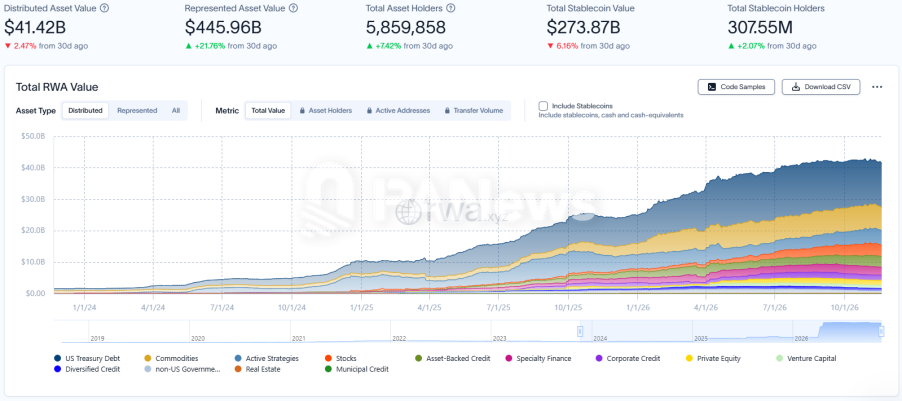
Reporting period: November 13–20, 2026. RWA.xyz figures cited in the November 20 weekly report show a divergence: the value of on-chain real-world assets fell from the same point a month earlier, while the number of holders rose. The same pattern appears in stablecoins, where supply and transfer volume declined even as address and holder counts increased. Those measures describe different aspects of activity; they do not, on their own, establish why the changes occurred.
The data: values down, participation measures up
As of November 20, 2026, RWA.xyz put the total on-chain RWA value at $41.42 billion, down 2.47% from the same point a month earlier. It counted 5.8599 million asset holders, up 2.42%.
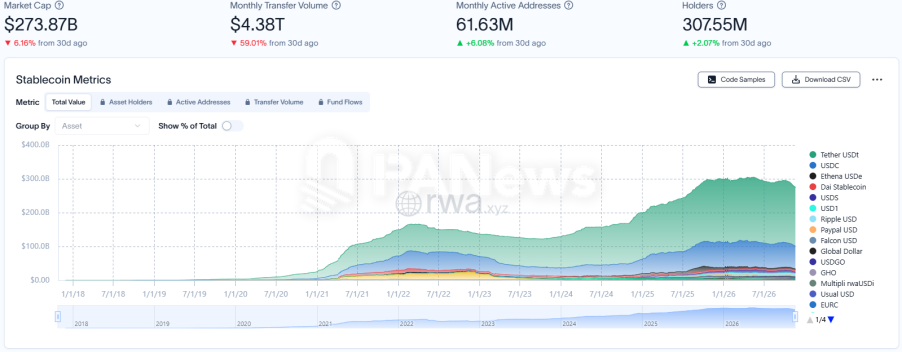
Stablecoin market capitalization was $273.87 billion, down 6.16% on the same comparison. Monthly transfer volume was $4.38 trillion, down 59.01%; monthly active addresses reached 61.63 million, up 6.08%; and holders totaled 308 million, up 2.07%. The source suggests weaker trading appetite as a possible explanation for the volume decline, but the figures alone cannot identify its cause or establish that rising holder counts represent new users.
What the settlement pilots tested
Several developments concerned interoperability between tokenized deposits rather than changes to the market totals. On November 16, the Hong Kong Monetary Authority said it was working with Swift and banks to explore how Swift’s ledger could interoperate with the settlement layer of its Ensemble project for multicurrency, cross-border payments.
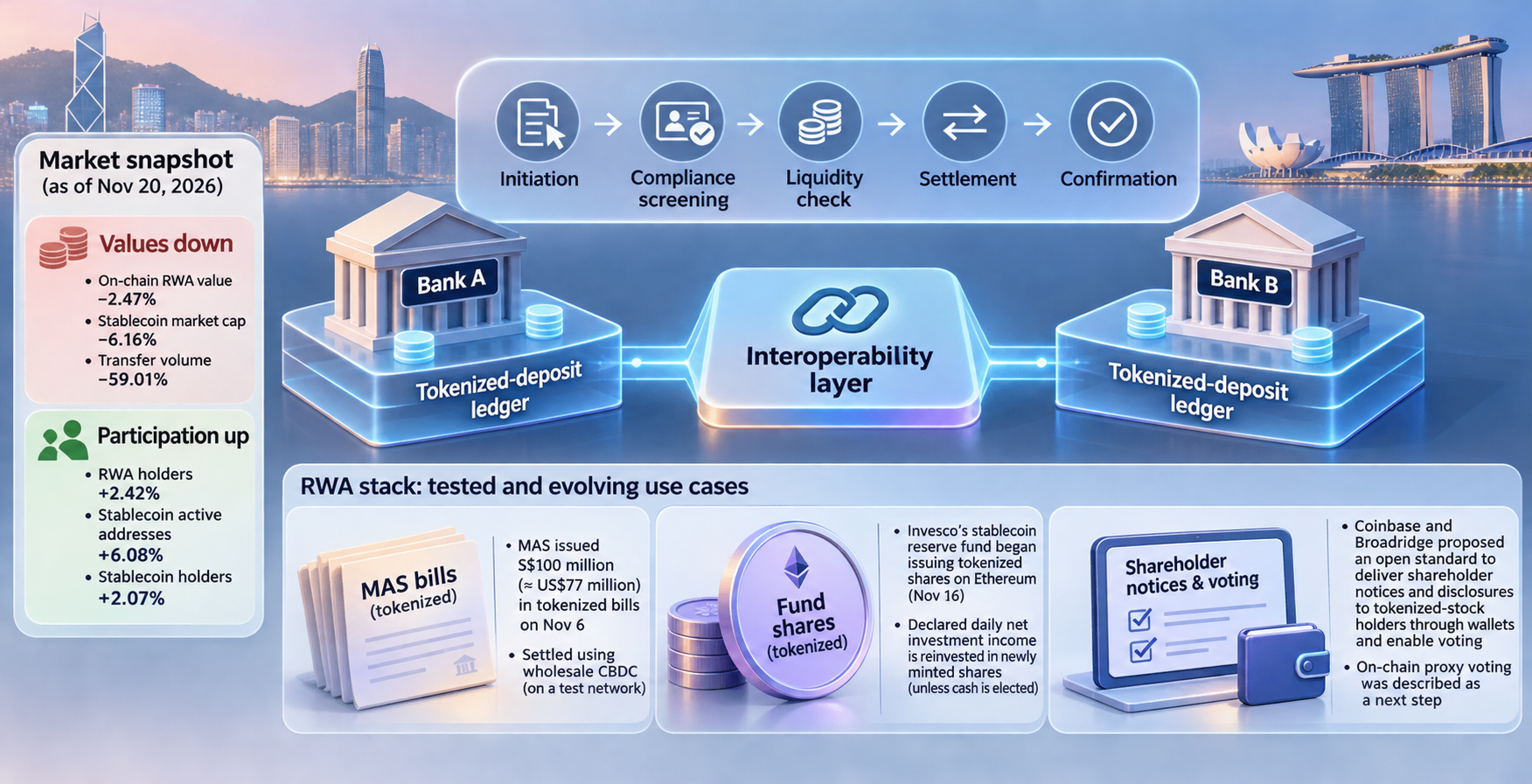
In Singapore, StraitsX, OCBC and Standard Chartered completed a proof of concept under the Monetary Authority of Singapore’s BLOOM initiative. It tested payment initiation, compliance screening, liquidity checks, settlement and confirmation across the banks’ tokenized-deposit ecosystems. The parties reported completing a US-dollar payment flow outside normal banking hours in a controlled test; they said commercial deployment would still require legal, regulatory, operational and business assessments. Separately, DBS and JPMorgan’s Kinexys introduced an interoperability solution connecting their tokenized-deposit networks for cross-border US-dollar transfers.
MAS also issued S$100 million, approximately US$77 million, in tokenized MAS bills on November 6, according to The Block’s account cited in the weekly report. The bills were issued natively on a MAS-operated Singapore-dollar test network and settled using wholesale central bank digital currency. They were due to mature on December 4. This was a test of issuance and settlement infrastructure, not evidence that the proposed next phase had already been implemented.
Fund shares and shareholder rights
Invesco’s stablecoin reserve fund began issuing tokenized shares on Ethereum using Superstate infrastructure, according to The Defiant. Etherscan records cited in the report show an initial issuance of 80,000 IROXX shares on November 16 and an initial on-chain supply of 80,008. Under the fund prospectus, declared daily net investment income is reinvested in newly minted shares at net asset value unless an investor elects cash. That mechanism is distinct from a claim that tokenization changes the fund’s underlying returns.
Coinbase and Broadridge, meanwhile, proposed an open standard for delivering shareholder notices and disclosures to tokenized-stock holders through wallets and enabling voting. The companies described on-chain proxy voting as a next step, not a completed capability under the proposed standard.
These cases illustrate different points in the RWA stack: measuring outstanding assets and holders, moving bank liabilities between networks, settling tokenized instruments, and administering rights attached to fund or equity interests. The reported pilots establish what was tested; they do not resolve the conditions for broader deployment.