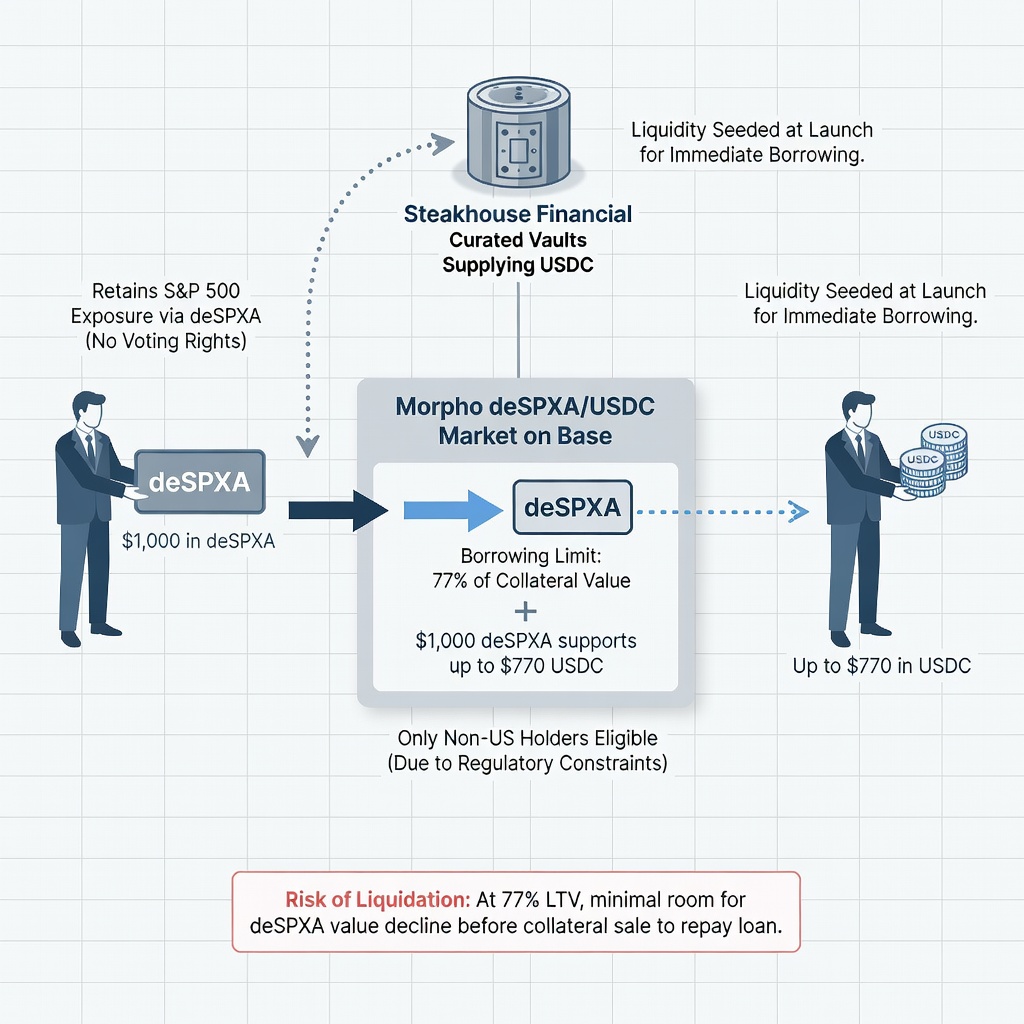
Eligible non-US holders of Centrifuge’s deSPXA can use the token as collateral to borrow USDC on Morpho’s lending market on Base. The borrowing limit is 77% of the collateral’s value: $1,000 worth of deSPXA can support a loan of up to $770 in USDC. Borrowers retain their exposure to the S&P 500 without selling the token.
What borrowers pledge and where the USDC comes from
deSPXA represents the Janus Henderson Anemoy S&P 500 Index Fund. The token went live on March 30, 2026, and Morpho’s deSPXA/USDC market opened shortly afterward. In her November 27, 2026 report, Vivian Nguyen described the fund as the first tokenized equity index fund licensed by S&P Dow Jones Indices to serve as collateral in a decentralized lending market.
The token gives holders economic exposure to the fund’s performance, but no voting rights. US holders cannot borrow through the market, a restriction the report attributed to regulatory constraints.
Steakhouse Financial supplied USDC from launch through curated Morpho vaults. These vaults pool lender capital, and the curator chooses which markets to fund. By allocating capital to the deSPXA market when it opened, Steakhouse made USDC available for borrowers to draw immediately.
Why the borrowing limit matters
Loan-to-value is the outstanding loan divided by the current value of the collateral. If deSPXA falls in value while the debt stays the same, that ratio rises. A borrower who draws close to the 77% limit therefore has little room for a decline before the position risks liquidation, when collateral can be sold to repay the loan.
The report identified hedging and carry trades as possible uses. For a carry trade, the relevant comparison is the return on the retained index exposure versus the cost of borrowing USDC. The spread is positive only if the index return exceeds the borrowing cost. Borrowers must also monitor the collateral value throughout the loan: the position can face liquidation before any hoped-for index gain materializes.