Historical-source note: This article is based on Spencer Applebaum’s analysis, translated and published by TechFlow on November 11, 2026, at 11:22 a.m. UTC+8. The figures below reflect the periods stated in that report, not current measurements.
AI-assisted development may make DeFi software cheaper to build, but cheaper code does not necessarily make a financial business easier to replicate. Applebaum’s argument is that durable pricing power depends less on the protocol implementation than on three scarce assets: customer distribution, risk-bearing capital and proprietary data. This is a framework for assessing value capture, not evidence that any particular token will capture it.
Distribution: who controls the customer relationship?
Applebaum defines distribution as the ability to direct order flow or customer balances. His clearest example is Hyperliquid’s relationship with USDC. He reports that the platform held more than $6 billion in USDC derivatives margin and, under an arrangement with Coinbase, approximately 90% of the reserve yield attributable to USDC on Hyperliquid flows to its Assistance Fund for HYPE buybacks rather than remaining with Circle or Coinbase. He estimates that $5.5 billion in balances subject to that share would produce roughly $185 million annually. Those amounts and the yield estimate are the author’s reported figures, not an independently measured forecast here.
A user-facing interface can also negotiate a larger share of trading economics: the report says Phantom charged an additional five basis points for access to Hyperliquid perpetuals, above Hyperliquid’s native 4.5-basis-point rate. But a wallet interface is not automatically a durable moat. Users can import their keys into another wallet, and competing front ends can cut fees. The relevant research question is therefore not simply who has the interface? but how costly is it for users and balances to leave?
Capital: liquidity is not the same as a balance sheet
AI can generate financing software; it cannot supply funds or absorb losses. Applebaum distinguishes mobile, incentive-driven deposits from capital that can reliably support financing or backstop protocol risk. His examples include shared-margin prime brokerage and risk-bearing facilities such as Hyperliquid’s HLP vault and Aave’s Umbrella mechanism. He reports that HLP lost approximately $4 million while handling a large ETH liquidation in March 2025.
That distinction limits the moat claim. A competing protocol cannot fork the funds deposited in a vault, but third-party depositors may withdraw them. Capital accumulated and retained by a protocol could be more persistent, while also exposing it to losses.
Data: public risk models versus private underwriting
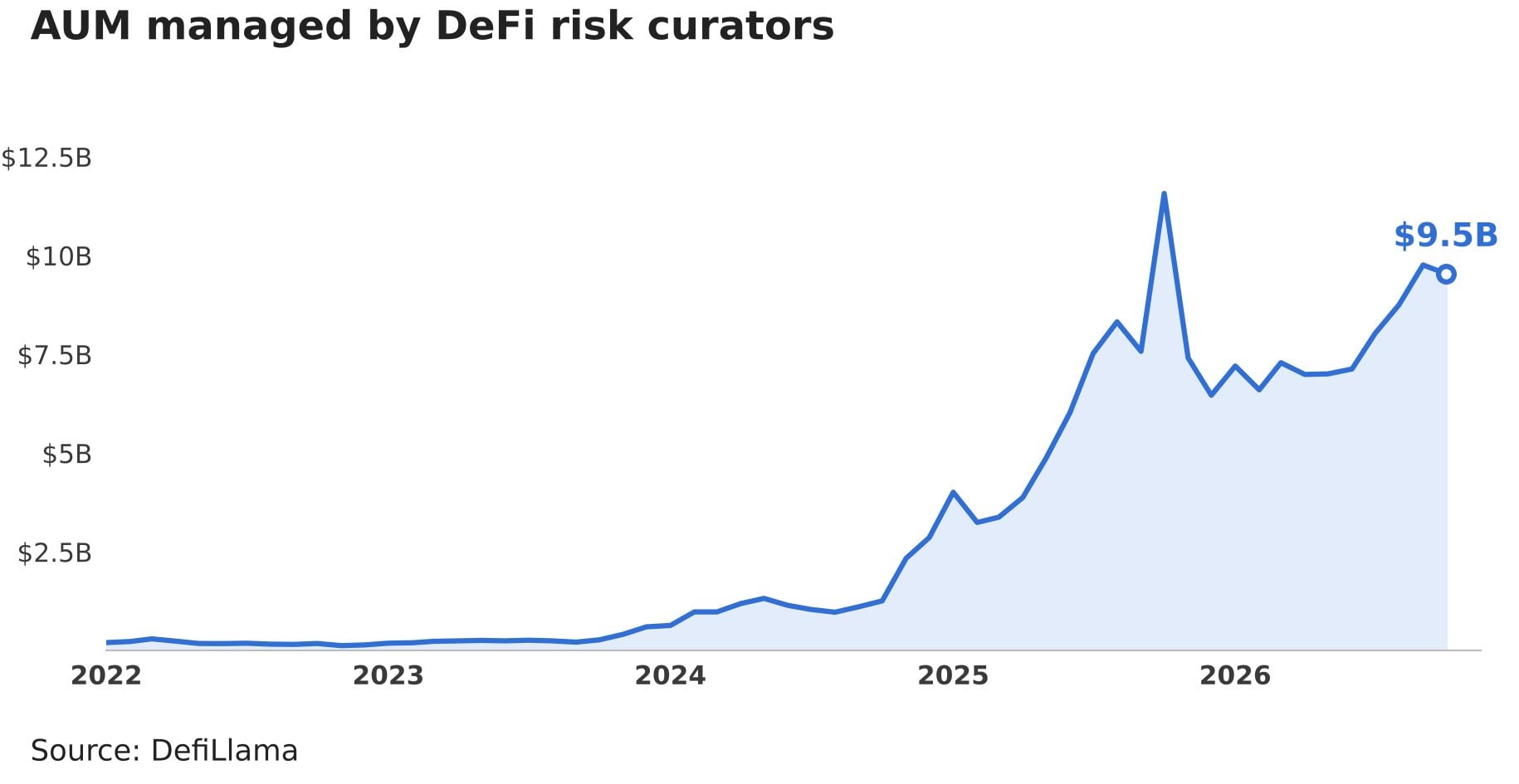
For lending against publicly observable crypto collateral, competing risk managers can often work from similar prices, positions and liquidation rules. Citing DefiLlama, the report puts assets managed by risk curators across platforms including Morpho, Kamino and Euler at $9.5 billion and their average fee at 19 basis points. The source gives no precise measurement date for that snapshot.

Applebaum contrasts this with OnRe’s reinsurance underwriting, which requires claims histories, loss estimates and contract terms unavailable on a block explorer. He reports a 75-basis-point management fee plus 20% of excess returns for OnRe. These are materially different businesses and risks; their fees alone cannot establish how much of the difference is attributable to proprietary data.
The framework’s central limitation is measurement. Customer retention, dependable risk capital and exclusive underwriting information require evidence beyond a forkable codebase or a headline total-value-locked figure. Applebaum presents greater risk tolerance as a possible entry point for startups, not a lasting fourth moat: the test is whether an initial opening becomes defensible distribution, capital or data.
Source: techflowpost.com (originally published 2026-11-11 11:22 UTC+8)