As reported on November 10, 2026, Elysium, a Layer 2 network in the Hyperliquid ecosystem built by the Kinetiq team, had launched its mainnet. Its design aims to connect application execution with HyperCore’s markets, but the launch configuration also leaves important infrastructure concentrated in single operators.
How the network is configured
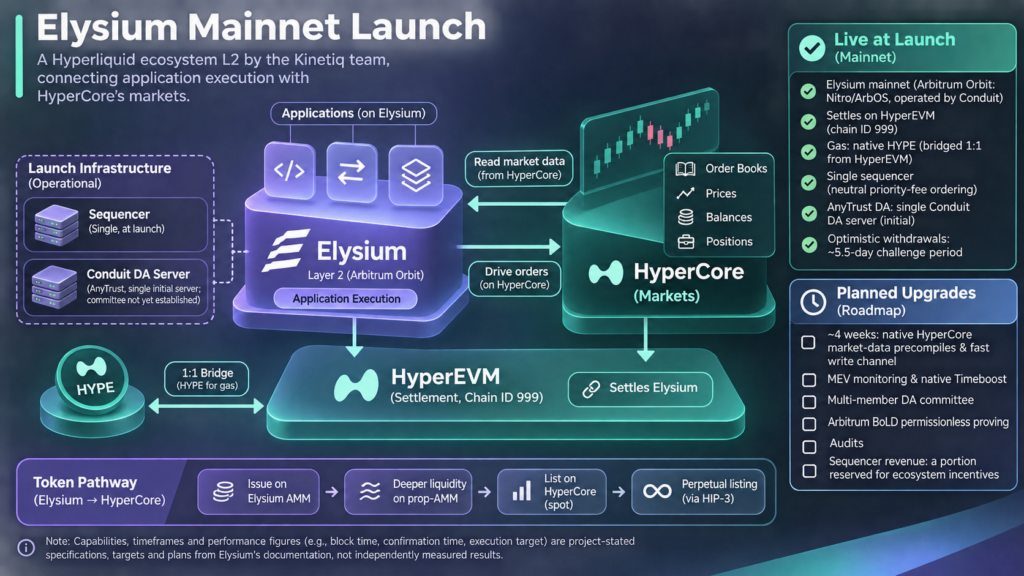
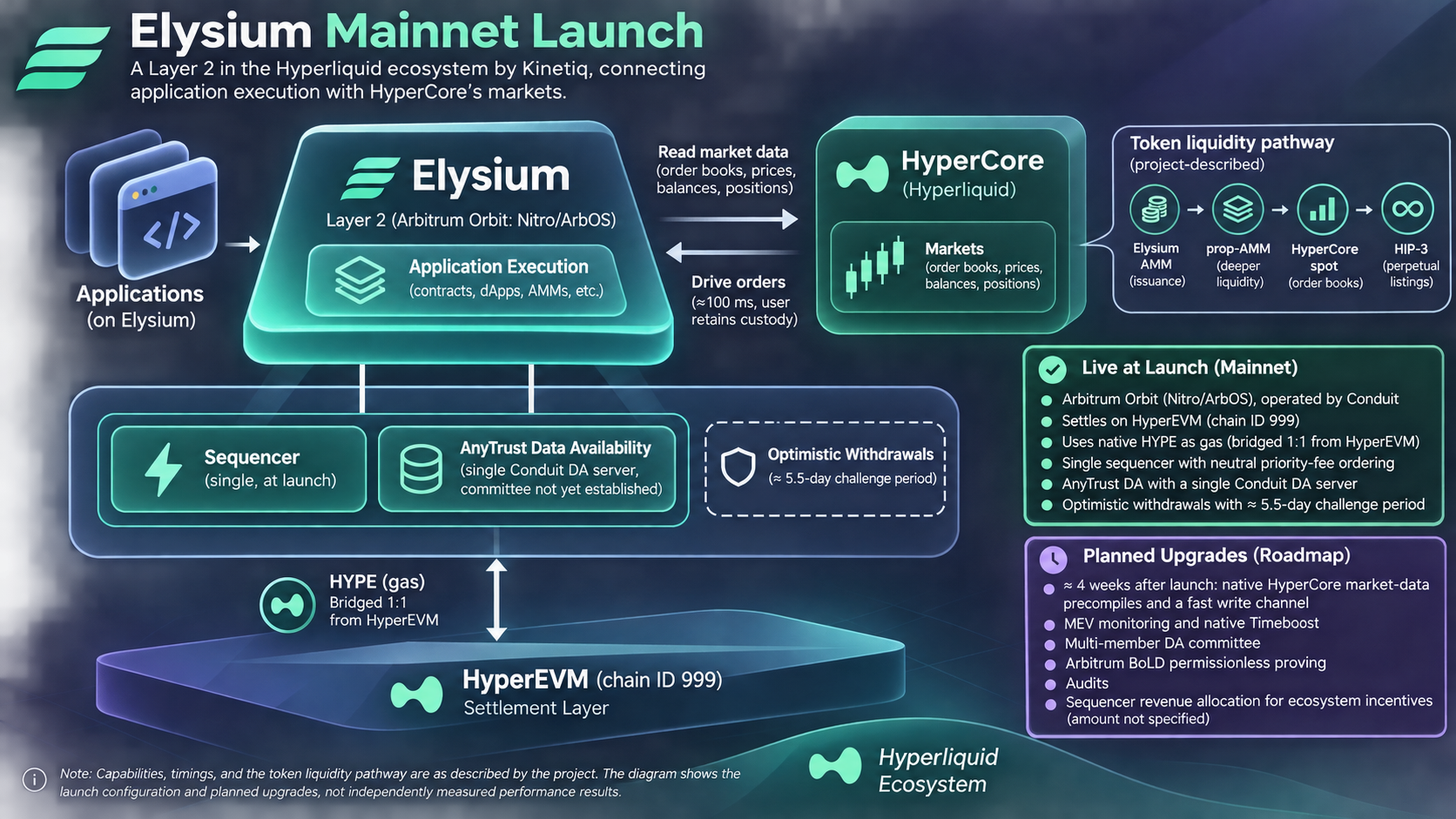
Elysium is based on Arbitrum Orbit’s Nitro/ArbOS stack and operated by Conduit. According to its documentation, it settles on HyperEVM (chain ID 999) and uses native HYPE as gas, bridged 1:1 from HyperEVM. The documentation specifies a 100-millisecond block time, roughly 300-millisecond user-perceived confirmation and a 300 Mgas/s execution target. These are project-stated specifications and targets, not independently measured performance results.
At launch, Elysium uses one sequencer with neutral priority-fee ordering. Its AnyTrust data-availability setup initially relies on a single Conduit DA server; a multi-member committee has not yet been established. Standard optimistic withdrawals carry an approximately 5.5-day challenge period. Those launch conditions matter when assessing the network’s availability and trust assumptions, regardless of its stated execution speed.
The proposed HyperCore connection
Elysium says contracts can read HyperCore order books, prices, balances and positions, and can drive HyperCore orders in approximately 100 milliseconds while the user retains custody of assets. It also describes a potential path for tokens from issuance on an Elysium AMM to deeper prop-AMM liquidity, then to HyperCore spot order books and, through HIP-3, perpetual listings. The source reports these as the project’s described capabilities and pathway; it does not provide independent usage or latency measurements.
The project said an upgrade roughly four weeks after mainnet launch would add native HyperCore market-data precompiles and a fast write channel. MEV monitoring, native Timeboost, a multi-member DA committee, Arbitrum BoLD permissionless proving and audits were described as later plans, not launch features. A portion of sequencer revenue is also reserved for ecosystem incentives, though the report provides no allocation figure.
The key distinction at launch is between the intended integration with HyperCore and the infrastructure already operating: the reported configuration has a single sequencer and a single initial DA server, while several proposed safeguards and connectivity upgrades remain on the roadmap.