As reported on November 9, 2026, Kinetiq’s Elysium Layer 2 had launched its mainnet. Its central proposition was not simply more capacity for Hyperliquid applications: Elysium was designed to connect token issuance and application liquidity with HyperCore’s spot order book and, ultimately, HIP-3 perpetual markets. Whether that route produces sustained spot activity remained an open question at launch.
The problem Elysium is meant to address
Kinetiq, the issuer of the liquid-staking token kHYPE, built Elysium within the Hyperliquid ecosystem. The original report described a mismatch between Hyperliquid’s strength in perpetual trading and its weaker spot and DeFi activity. It cited on-chain monitoring that put Hyperliquid spot volume relative to Binance at a 15-month low and HIP-2 activity at its lowest level since the fourth quarter of 2024. It also reported that Solana spot volume led by PropAMMs had been more than 30 times HyperCore spot volume, while Robinhood Chain had reached roughly 10 times that volume. The report did not name the monitoring dataset or provide measurement dates for those comparisons, limiting their use as independently reproducible benchmarks.
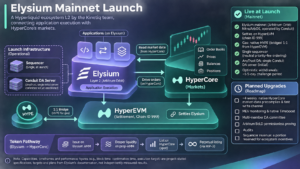
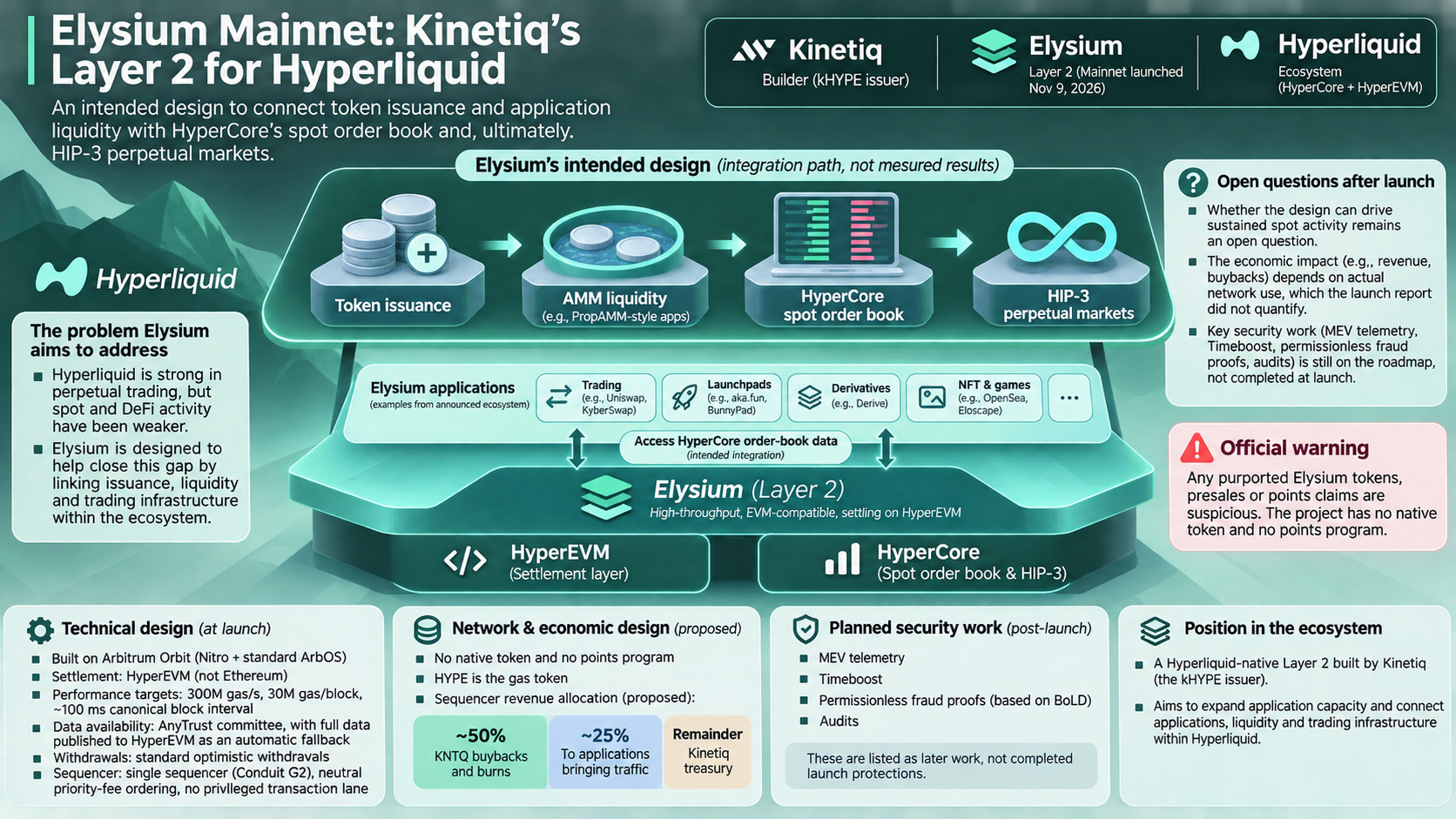
Elysium’s proposed path runs from token issuance to AMM liquidity, then to the HyperCore spot order book and HIP-3 perpetual markets. The design also aims to let PropAMM-style applications access HyperCore order-book data. That is an intended integration, not evidence that spot volumes have already improved.
Architecture and outstanding security work
Elysium uses Arbitrum Orbit’s Nitro and standard ArbOS, with HyperEVM—rather than Ethereum—as its settlement layer. Kinetiq’s stated performance targets were 300 million gas per second, 30 million gas per block and approximately 100-millisecond canonical block intervals. Its comparison with HyperEVM’s approximately 30 million gas per 60 seconds yielded a claimed 600-fold difference; those figures are design targets and a project comparison, not independently reported production throughput.
The reported configuration uses an AnyTrust data-availability committee, with full data published to HyperEVM as an automatic fallback, and standard optimistic withdrawals. At launch, Elysium had one sequencer, run using Conduit’s G2 infrastructure, with neutral priority-fee ordering and no privileged transaction lane. MEV telemetry, Timeboost, permissionless fraud proofs based on BoLD and audits were listed as later work—not completed launch protections. The report said the underlying sequencer architecture met SOC II Type 2 standards; it did not establish that Elysium itself had received a security certification.
Usage must validate the economics
Elysium has no native token or points program; HYPE is its gas token. Under the revenue plan disclosed by Kinetiq, approximately 50% of sequencer revenue would fund open-market KNTQ buybacks and burns, approximately 25% would go to applications bringing traffic, and the remainder would enter the Kinetiq treasury. These are proposed allocations. Their economic significance depends on actual network use and revenue, neither of which the launch report quantified.
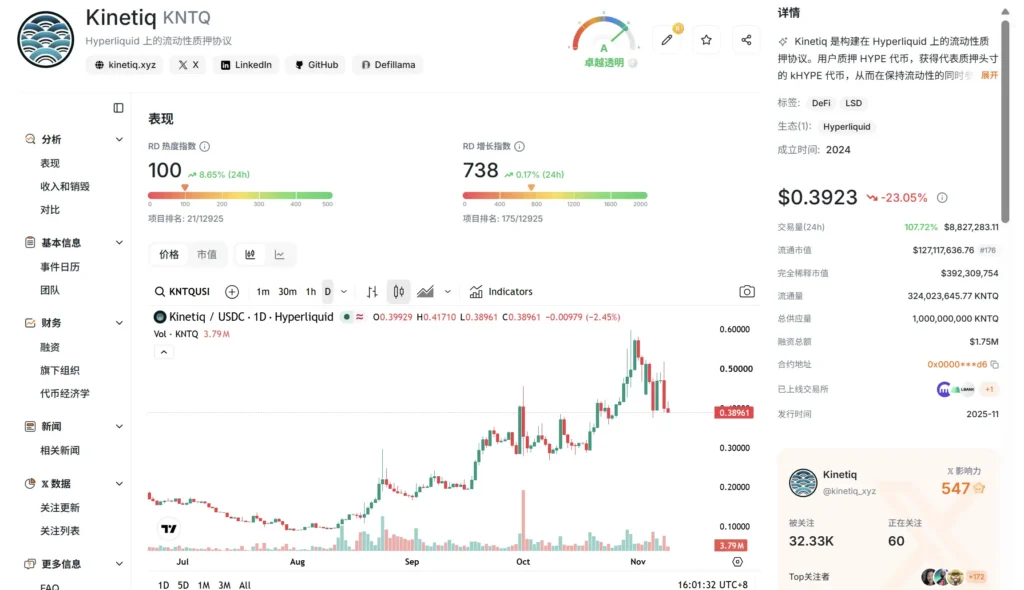
The report said KNTQ rose as much as 30% on the day the news was announced, but did not specify that announcement date or establish a causal link. It also described substantial early interest from launchpads alongside trading, NFT and other applications. That breadth of announced support does not, by itself, show durable liquidity or demand.
The clearest test is therefore measurable spot activity after launch, alongside progress on the security work still on Elysium’s roadmap. The report also relayed official warnings that purported Elysium tokens, presales and points claims were suspicious, consistent with the project’s stated no-token, no-points policy.