On November 24, 2026, BeInCrypto reported a Fidelity Digital Assets discussion of whether quantum computers threaten Bitcoin. Analyst Daniel Gray said the threat is largely solved on the cryptographic side because quantum-secure signature schemes already exist. The obstacle, he said, is getting a decentralized network to adopt one. On the same Fidelity livestream, colleague Matt Hogan called the risk real but not necessarily near-term.
The report does not describe an activated protocol change. It records analyst judgments about exposure, timing, and the coordination an upgrade would require.
What the speakers say would have to break
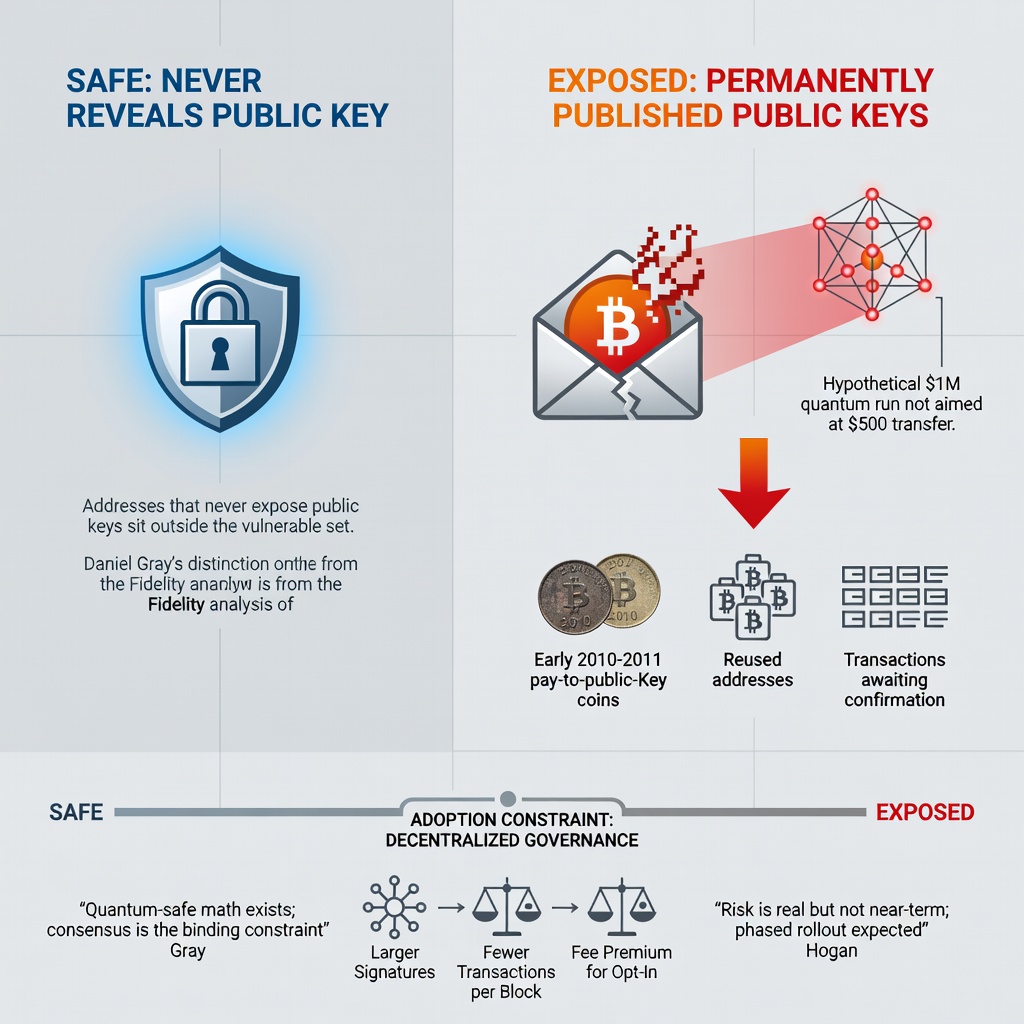
Hogan said today’s quantum computers lack the capacity to break the cryptography of Bitcoin, banks, or the internet. Gray narrowed the attack surface: quantum computers attack public keys, not private keys. The method he identified is Shor’s algorithm, a 1990s technique for deriving a private key from a public key. Addresses that never reveal a public key are not quantum-vulnerable, he added.
A November 23, 2026 post from the Bitcoin Archive account summarized the discussion as: quantum-safe math exists, consensus is the constraint, early-2010 coins and reused keys are at risk, and the threat is not imminent. That post is a social summary of the Fidelity remarks, not a protocol specification.
Three exposed sets, not the whole supply
Gray named three groups that would be in danger first if the hardware scaled.
- Early pay-to-public-key coins from 2010 and 2011, which publish their keys permanently.
- Reused addresses.
- Transactions awaiting confirmation.
He treated in-transit exposure as far off for economic reasons. His illustration was hypothetical, not a measured attack price: a quantum run he put at $1 million would not be aimed at a $500 transfer. On this account, coins whose public keys have never been revealed sit outside the vulnerable set.
The unresolved mechanism is adoption
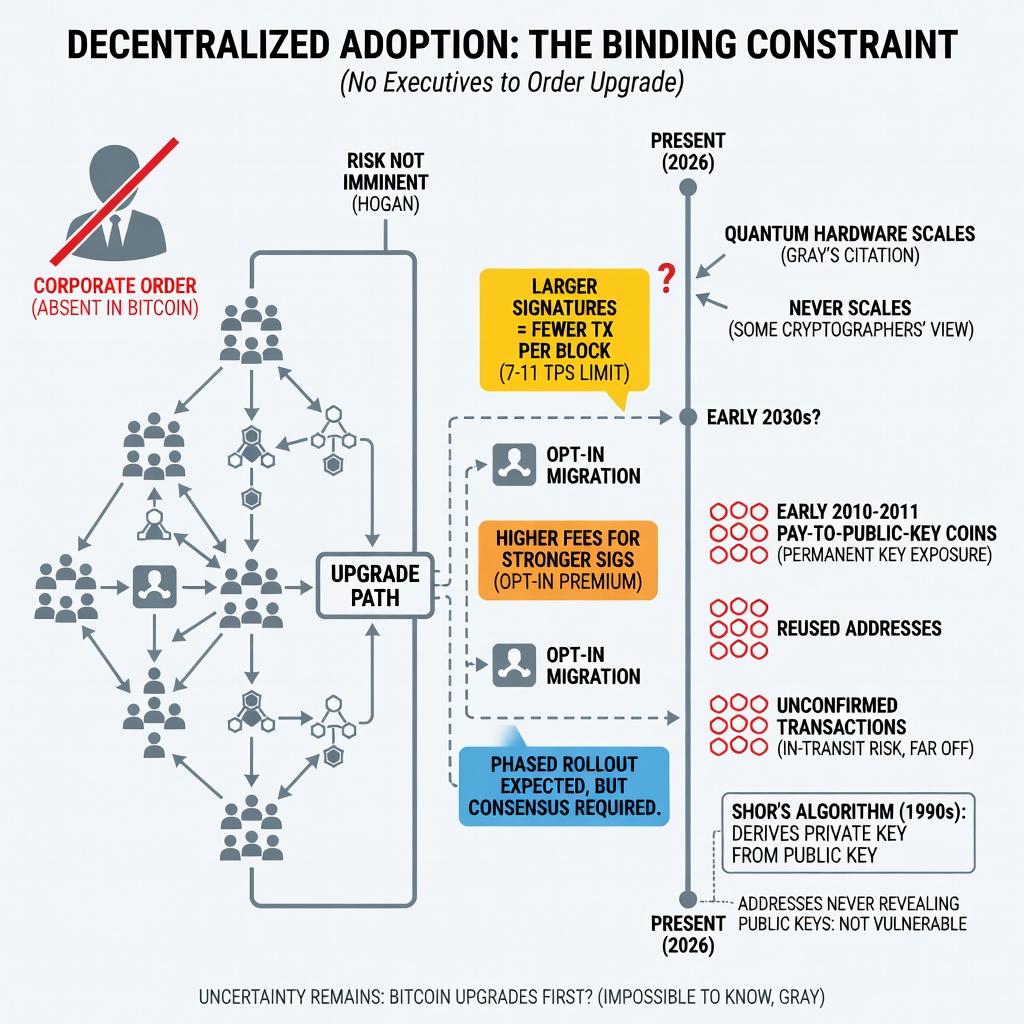
Hogan’s constraint is governance, not the existence of a scheme. Unlike a company, Bitcoin has no executives who can order an upgrade. Each fix needs community support and carries trade-offs in fees and block space. He expects a phased rollout, with funds eventually migrating to quantum-resistant addresses. That is an expectation, not a scheduled activation.
Gray said quantum-resistant signatures are larger, which would mean fewer transactions per block. BeInCrypto described the network under discussion as already limited to seven to 11 transactions per second. The report does not name a dataset or a measurement date for that range, so it remains the article’s characterization of the existing limit rather than a new throughput series.
Gray expects an opt-in model in which users worried about quantum risk pay higher fees for stronger signatures. That, too, is a proposed path, not a rule in force. The concrete trade-offs in the remarks are signature size, transactions per block, and a fee premium for users who opt in. The account does not show that the network has chosen among them.
Timelines left open
Gray cited quantum experts looking toward the early 2030s. He also recorded the contrasting view of some cryptographers that the hardware will never scale. Neither position is presented as settled. Hogan’s “real but not necessarily near-term” does not assign a date.
In the same conversation, Hogan said spot exchange-traded products bought about 900,000 BTC in their first year, roughly 4 percent of supply. The report does not name the products, define “first year” with dates, or cite a dataset. The figure is Hogan’s, as relayed by BeInCrypto. The article then says Gray guesses Bitcoin upgrades first but calls the outcome impossible to know. It does not say first relative to which other system, so that comparison stays as unspecified as he left it.
What this establishes
The documented claim, as of the November 24, 2026 report, is limited. Two Fidelity Digital Assets analysts treat quantum-resistant signature schemes as already available and treat decentralized adoption as the binding constraint. Exposure, on Gray’s account, attaches to public keys that are permanently published, reused, or visible while a transaction is unconfirmed — with 2010 and 2011 pay-to-public-key coins as the long-lived case.
Not established: that Bitcoin has adopted any such scheme, that an opt-in upgrade or phased migration is scheduled, that current hardware can run the attack, or that an early-2030s arrival is more reliable than the view that the machines never scale. The throughput range and the ETP figure are attributed remarks without a named measurement source. Gray’s own closing judgment — that Bitcoin upgrades first, and that this cannot actually be known — is the uncertainty the discussion leaves standing.