Tokenized stocks reached a market capitalization of $4.8 billion on November 13, 2026, according to Token Terminal data reported on November 25, 2026, at 15:56:15 UTC+8. Over the preceding 12 months, market capitalization grew 9.1-fold, while the reported holder count rose 40-fold to about 5.9 million.
The milestone matches the size of the stablecoin market in March 2020. For Token Terminal, the more consequential parallel is how the tokens work: a stock token can trade on-chain while a custodian holds the corresponding share. The analysis found that tokens backed one-for-one by underlying shares accounted for 91% of tokenized stock market capitalization. Tracking a stock’s price does not, by itself, establish that a platform holds the stock.
What the stablecoin comparison measures
Using figures from the Token Terminal Data Catalog, the analysis compared the two markets from the point at which each crossed $1 billion. Tokenized stocks took eight months to reach $4.8 billion; stablecoins took 11. By the time of the report, stablecoin capitalization had reached $285 billion, about 59 times its March 2020 level. USDT and USDC, backed mainly by cash and US Treasuries, accounted for 86% of that market. Terra’s algorithmic UST, by contrast, collapsed.
Stock tokens reached the same milestone with wallets, exchanges and decentralized finance (DeFi) markets already in place. The analysis also cited US Securities and Exchange Commission exemptions for tokenized stock trading dating from September 2026. Neither the shared milestone nor the shorter time to reach it establishes that stock tokens will follow the same growth path.
Where the shares are held and who can buy the tokens
US-listed stocks and exchange-traded funds accounted for 88% of tokenized stock capitalization. By a separate measure, tokens that issuers offered exclusively to non-US investors accounted for 91%. That second figure measures the market value of products subject to an eligibility restriction, not the percentage of individual holders living abroad.
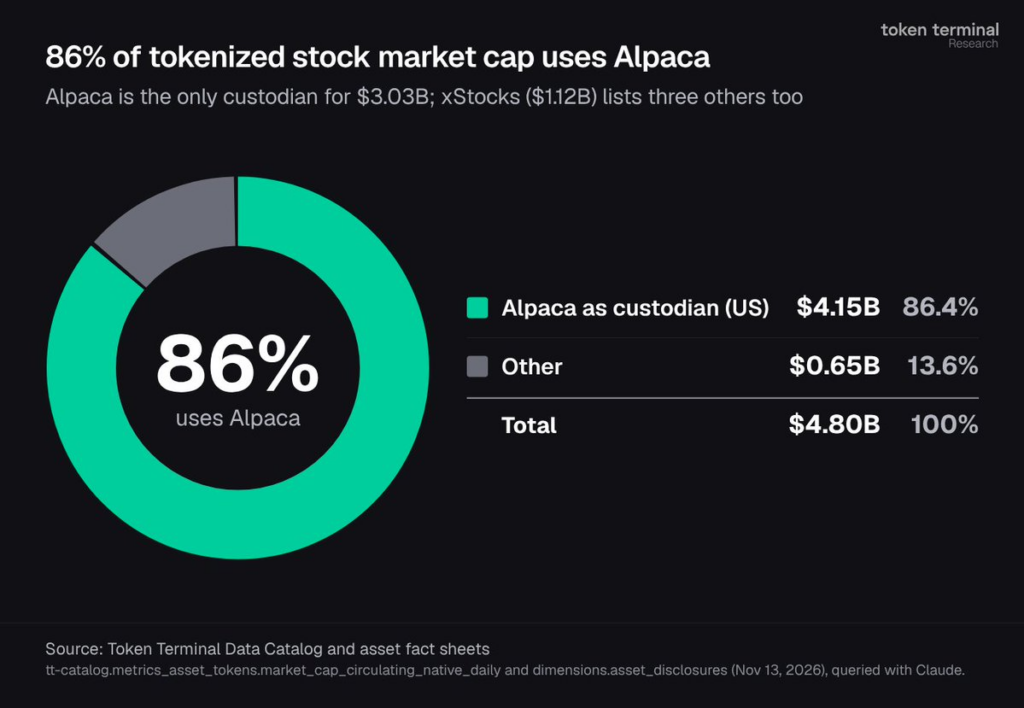
Tokens naming US broker Alpaca Securities as a custodian represented 86% of market capitalization, including $3.76 billion across Ondo, Binance and xStocks. Products worth $3.03 billion named Alpaca alone; xStocks also listed three European custodians. A token naming Alpaca therefore does not necessarily mean Alpaca holds all its backing shares.
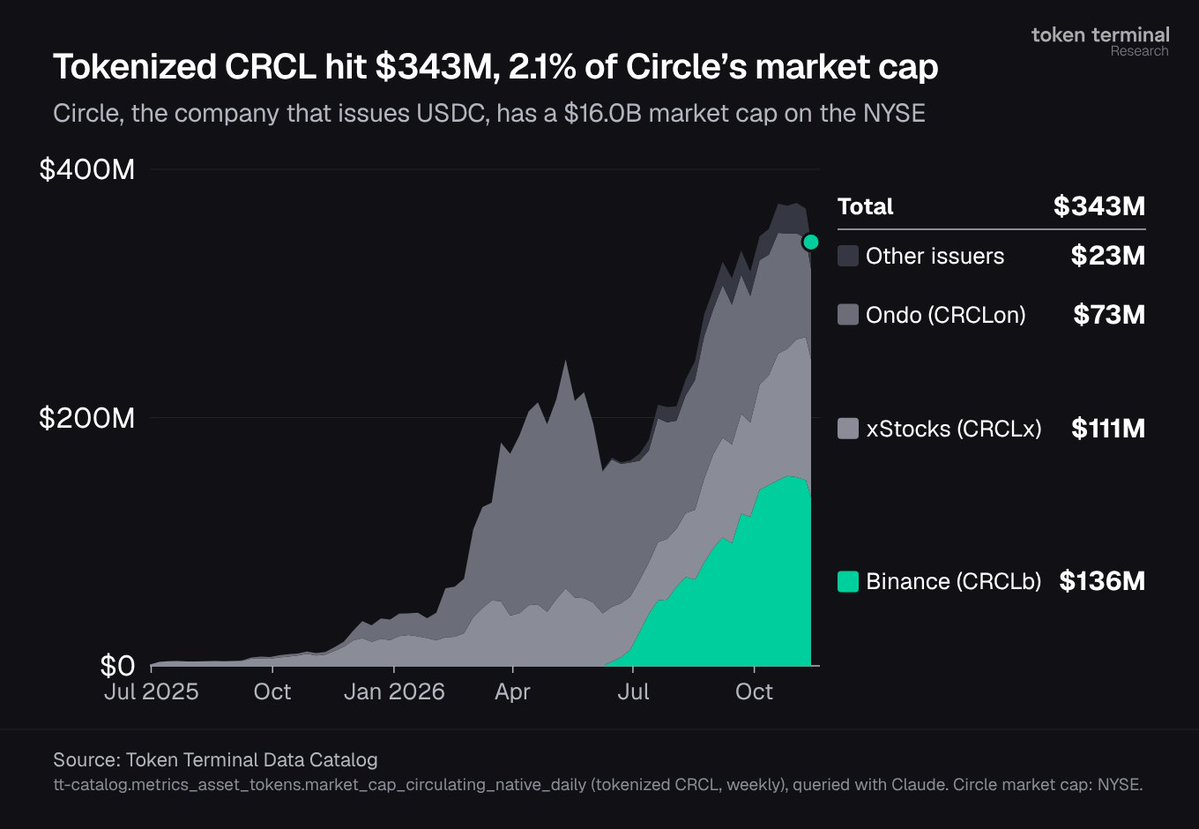
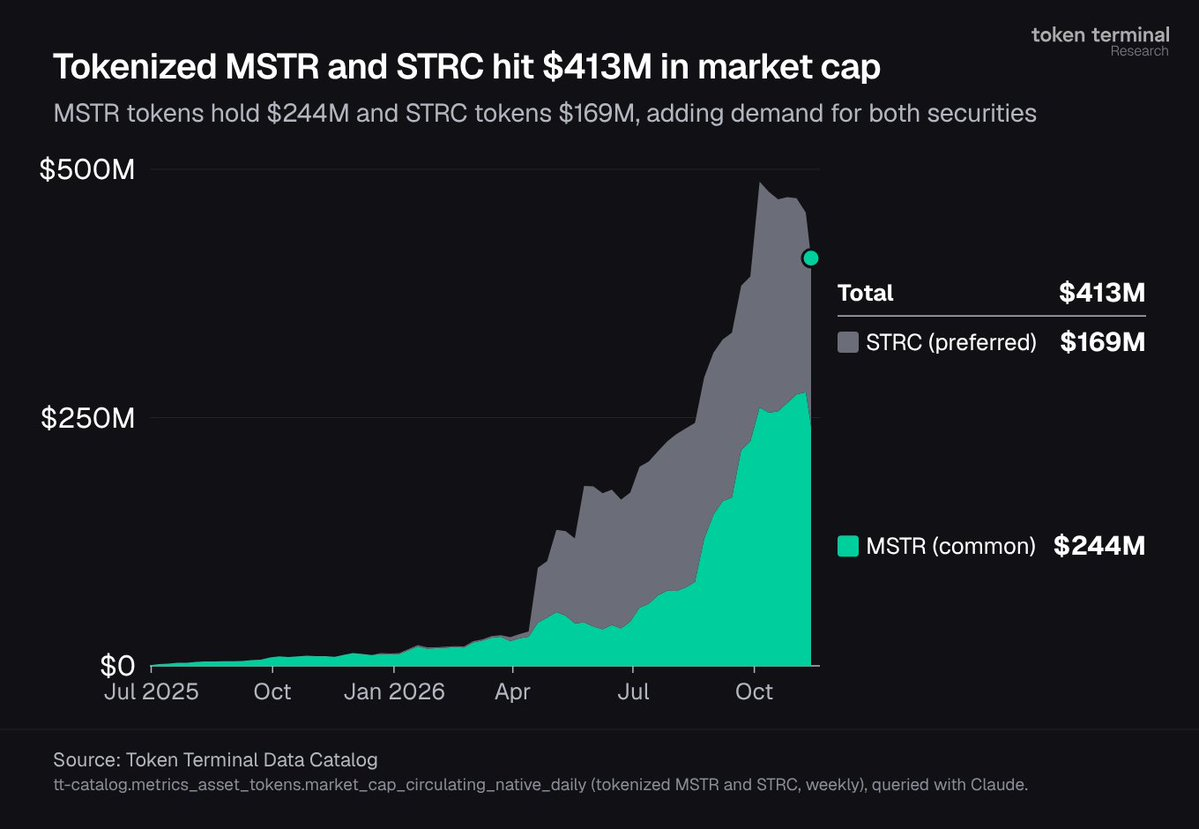
For individual securities, tokenized Circle shares were worth $343 million, equivalent to 2.1% of Circle’s $16 billion market capitalization. Tokens tracking Strategy’s common stock (MSTR) and preferred stock (STRC) had a combined value of $413 million. Strategy issues both securities to finance Bitcoin purchases; the $413 million measures the value of the tokens, not proceeds raised by Strategy.
US Treasury and Federal Reserve figures cited in the analysis put foreign holdings of US equities at $25.2 trillion, up 23% over 12 months. Tokenized stock capitalization was equivalent to about 0.02% of those holdings. If 1% of those holdings moved on-chain, that would represent $252 billion, roughly 50 times the measured token market. The 1% is a scenario, not an observed allocation or a forecast.
What holders do on-chain
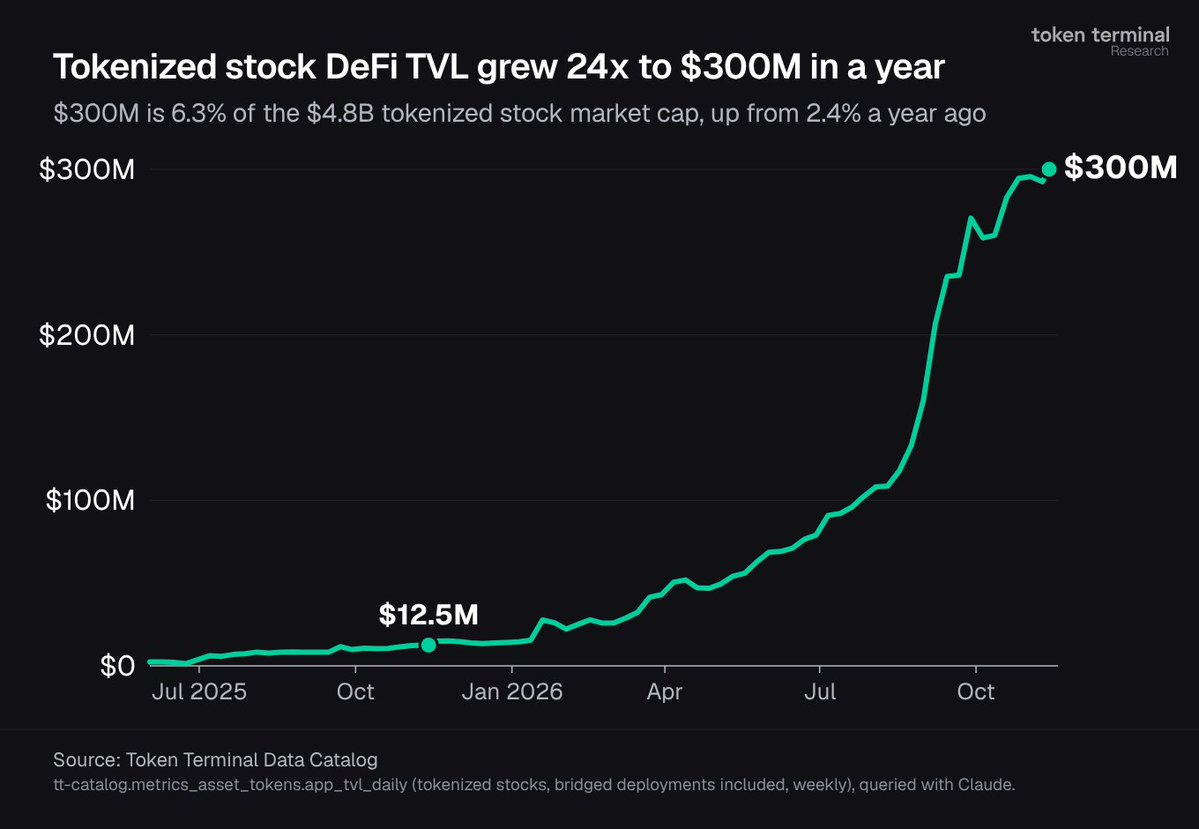
The value of stock tokens deposited in DeFi applications such as lending markets and trading pools rose 24-fold in a year to $300 million. Those deposits represented 6.3% of tokenized stock capitalization, up from 2.4% a year earlier.
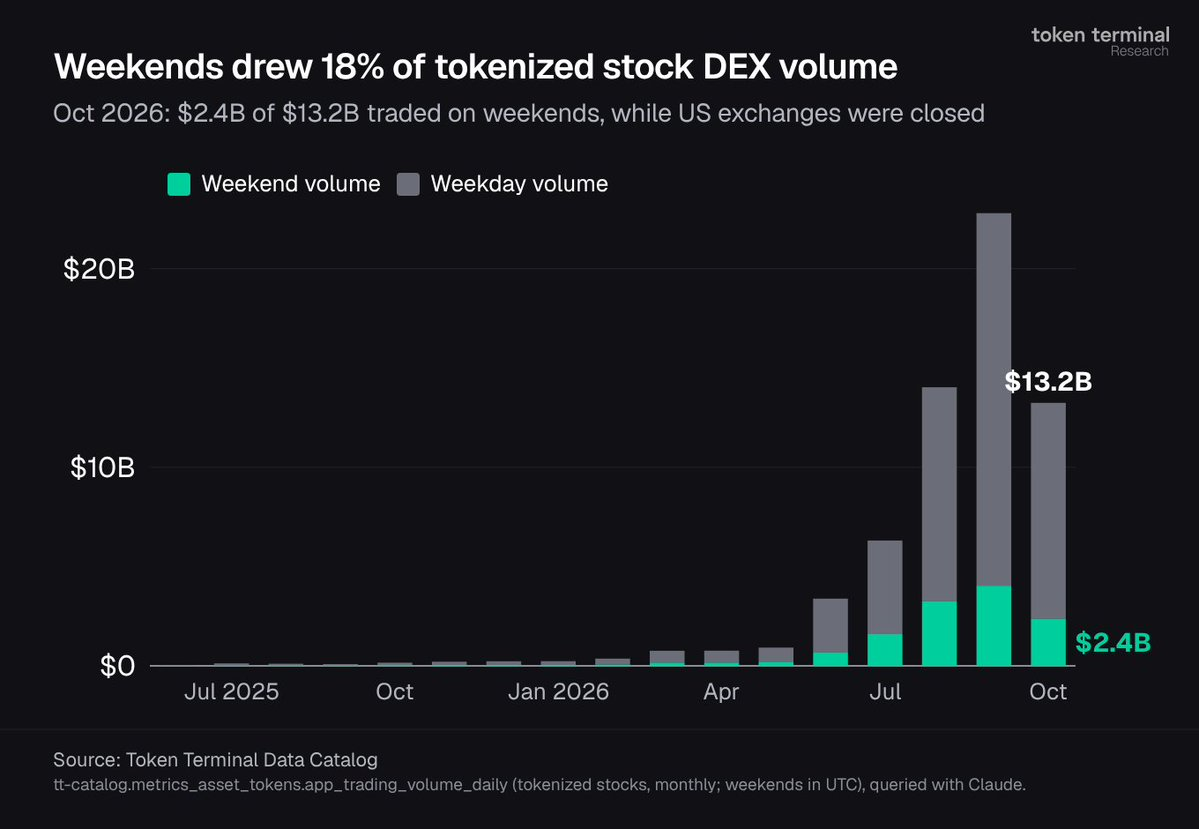
Weekend trading measures a different use: exchanging tokens while US stock exchanges are closed. In October 2026, weekend trades accounted for $2.4 billion, or 18%, of tokenized stock volume on decentralized exchanges. That weekend volume was 83 times its level a year earlier.
The alternative to holding shares
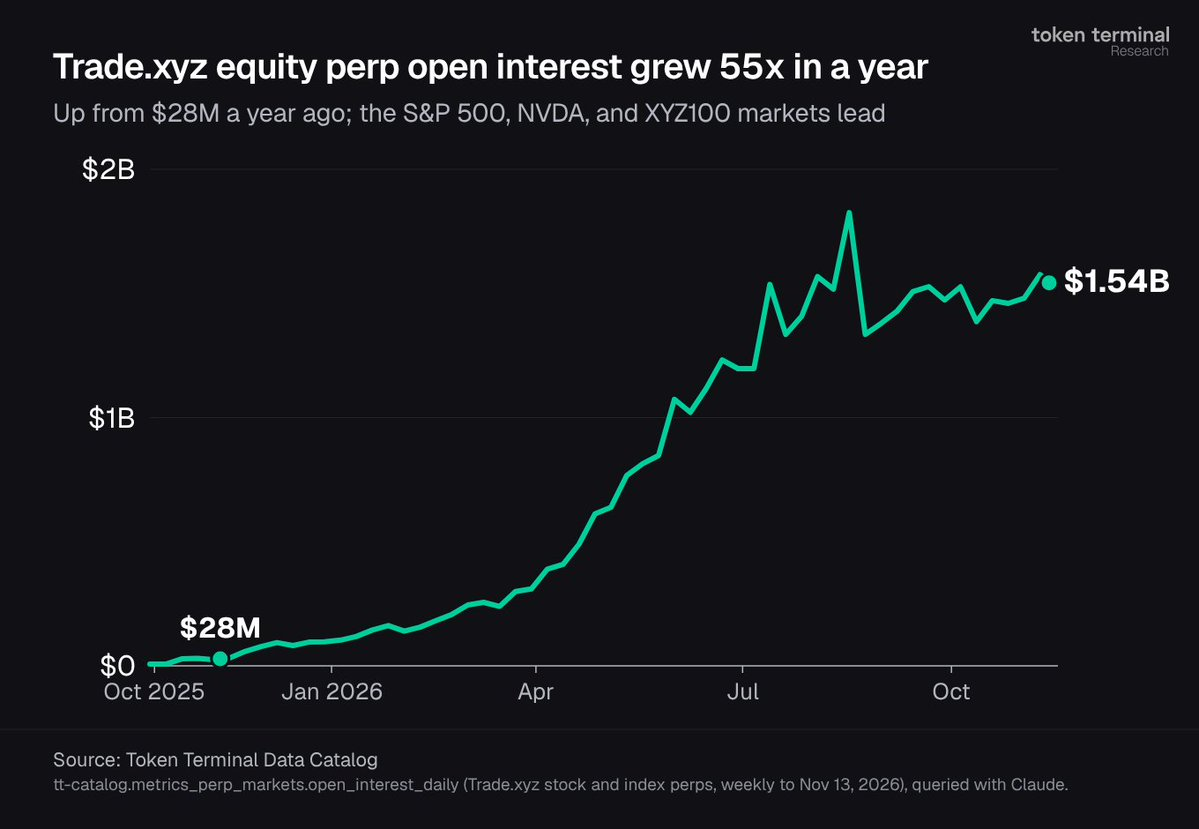
Token Terminal argued that restricting share-backed tokens could shift some overseas demand toward perpetual contracts. These derivatives track prices without expiring and do not require a custodian to hold a share against each position. On Trade.xyz, a venue built on Hyperliquid that lists US stock and index contracts, open interest rose 55-fold over a year to about $1.54 billion. Open interest measures outstanding contract positions, not shares held in reserve.
The regulatory argument turns on that distinction. An overseas investor can obtain equity price exposure through either instrument, but only the share-backed design requires someone to hold the underlying stock. The Trade.xyz figures show that a derivatives market already exists; they do not establish how much demand would move there under tighter rules.