This is a restatement of reporting by Jae for PANews, published on November 10, 2026. Figures and attributions below are those of that report and of the people it quotes. They are not a price view or a recommendation to buy or sell ETH.
The question left by the narrative change
On November 8, 2026, Ethereum co-founder Vitalik Buterin posted on X in terms that, in Jae’s account, shook an ETH valuation consensus crypto markets had held for several years. Buterin said he preferred to position ETH as a store of value rather than anchor it to the logic that fee burn supports its value. Jae treated the remark as a public correction of “ultrasound money,” the scarcity narrative that had been ETH’s most widely circulated story over the previous five years.
The setting Jae describes is a contradictory kind of prosperity. The network was handling more transactions, and the cost of using it kept falling, but the revenue and fees Ethereum earned from each transaction — and therefore the ETH destroyed — were shrinking. Once the gas-burn mechanism, previously treated as a ballast under the ETH price, could no longer carry that role, an asset with a market capitalization of about $260 billion needed a new valuation anchor. The anchor Buterin offered was a turn toward store of value.
The open question is narrower than whether a new label can support that capitalization. It is whether holding, staking, and collateral use can create demand that fee burn no longer supplies, and which measurements in the November 2026 report actually bear on that claim.
How value is supposed to reach holders
The older logic was indirect scarcity: users pay fees, the system burns ETH, and holders benefit because supply is tighter. The newer logic, as Jae relays it, is that Ethereum supplies financial infrastructure that is secure, neutral, and reliable enough for the ecosystem to hold, stake, and use ETH for long periods.
Tom Lee, chairman of Bitmine, is reported as agreeing. On his account, ETH is not a cash-flow token of the kind associated with HYPE or LIT. It is collateral that is simple and trusted. The example in the report is ordinary use: a holder can stake ETH for rewards, post it as collateral in a lending market such as Aave to obtain liquidity, and let related staked positions move into other DeFi uses. In that picture, ETH is not only a balance stored in a wallet. It is base collateral for financial activity.
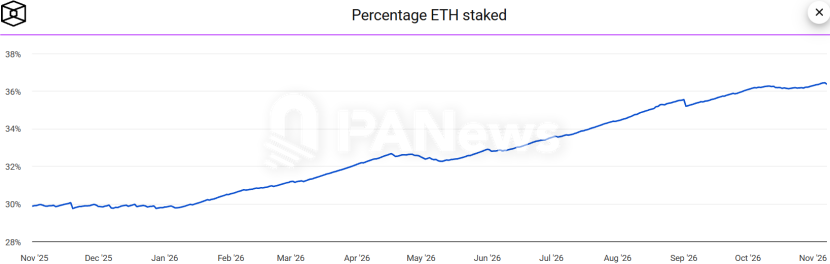
The most direct demand in this story is staking. The Block data cited by PANews put staked ETH at 36.36 percent of circulating supply as of the report, compared with 29.91 percent a year earlier. A large quantity of tokens was locked in validators. Jae reads that lockup as evidence that a considerable share of supply was performing a network-security role rather than being used for short-term speculation. That is an interpretation of a stock of staked coins, not a direct measure of why holders staked.
Use of the network is not the same as demand for ETH
Jae’s main objection is a break in how value is transmitted. Ethereum can be used more without anyone having to keep buying the native token.
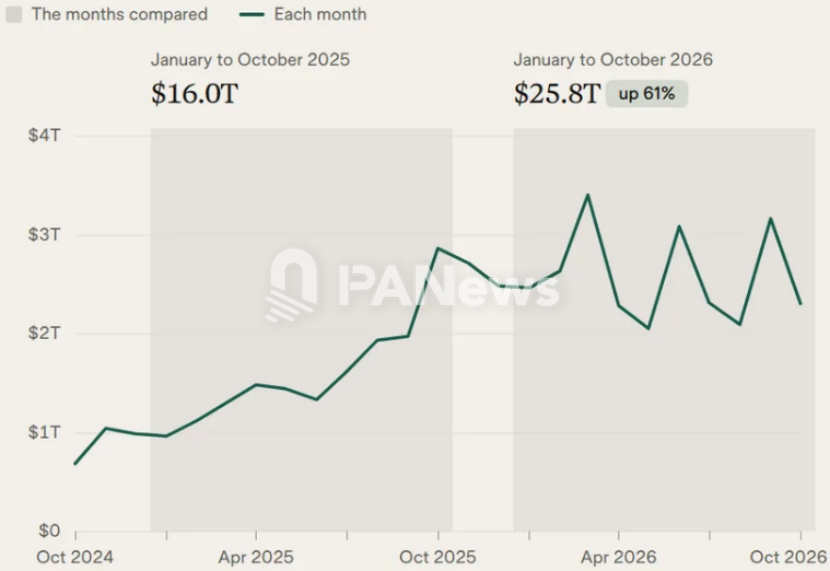
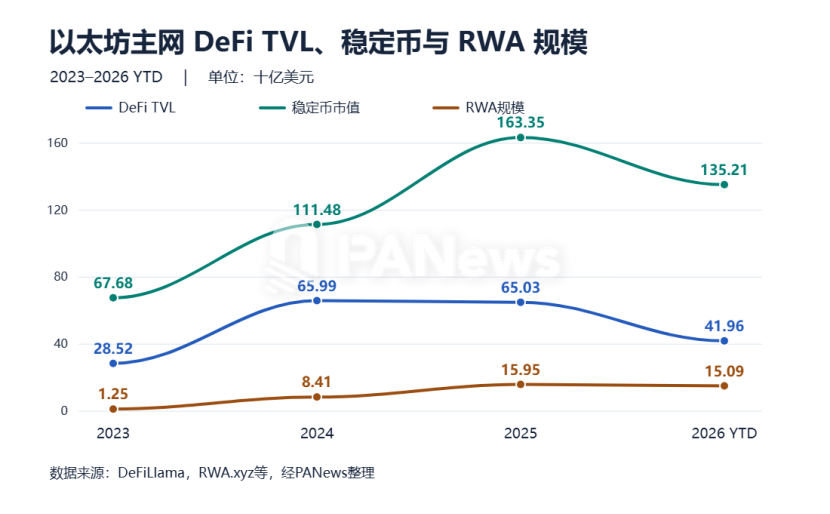
Research attributed to Ethereum Institutional found that, in the first ten months of 2026, stablecoin transfers on Ethereum mainnet totaled $25.8 trillion, up 61 percent year over year. DeFiLlama figures in the same report put mainnet DeFi total value locked at about $42 billion, stablecoin market value above $135 billion, and real-world-asset scale at $15 billion. Those series describe activity and assets on Ethereum. They do not, on the report’s own argument, show that the native token was being bought on a sustained basis.
The illustration Jae uses is a tokenized Treasury. An institution can issue $1 billion of tokenized government bonds on Ethereum while the collateral is the real-world bonds, the yield comes from coupons, and settlement is completed in USDC. The only ETH required is a small gas payment for the on-chain interaction. A larger stock of assets settled on Ethereum therefore need not become net buying of ETH.
That is the test the report assigns to an “ETH as store of value” claim. Store-of-value status is not acquired by declaring it. ETH would have to be shown as base capital that on-chain finance must hold, rather than as fuel purchased only when someone needs to use the network. The article states that test. It does not include a series that measures net ETH purchases against the growth in stablecoins, RWAs, or DeFi balances.
Why the burn no longer lines up with the market cap
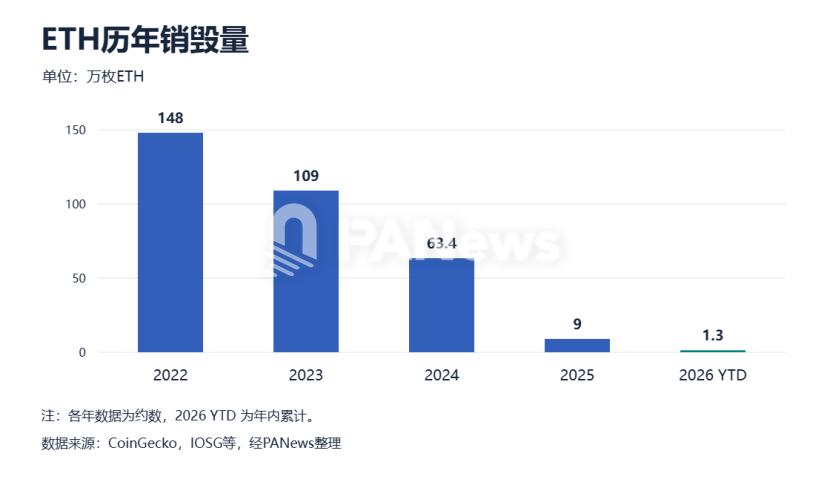
Jae argues that gas-fee destruction remains an important pillar of the valuation framework even if the story shifts toward store of value, and that the transmission gap was already visible in a collapse of ETH burned.
Buterin’s arithmetic, as relayed by PANews, is an illustration, not a forecast of Ethereum’s fees. If a token burned $1 billion of fees a year, a 4 percent discount rate would imply a theoretical present value of about $25 billion. Jae’s caveat is that transaction fees are not a stable cash flow, and treating a peak as the normal level does not survive a cycle.
Run in reverse from a market capitalization of about $260 billion, the same 4 percent rate would require Ethereum to keep burning about $10.4 billion of fees every year to support that capitalization. The report says this figure was already far from conditions at the time.
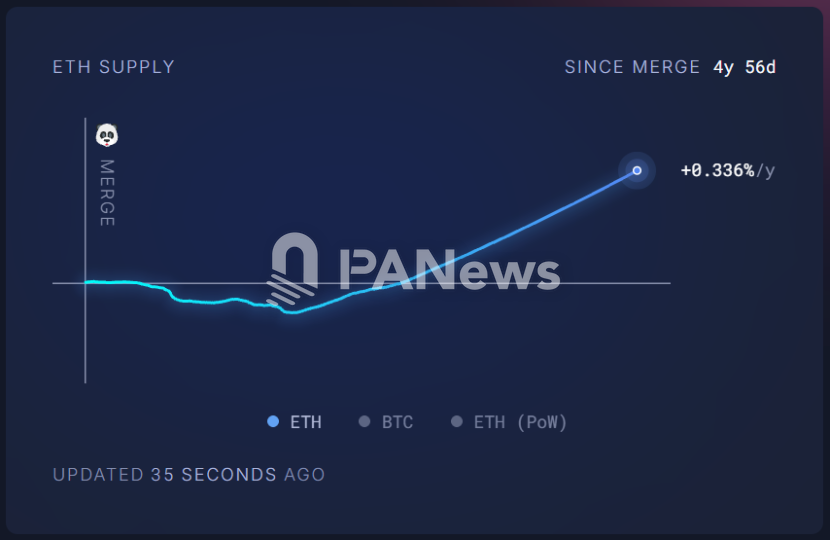
On the quantity destroyed: the system burned about 1.48 million ETH in 2022, against about 13,000 ETH from the start of 2026 through the report, a market value of about $27.3 million. In number of coins, that is a drop of more than 99 percent. PANews also states that ETH had returned from net deflation to net inflation in February 2025, and that the inflation rate kept rising. The article gives no numeric inflation rate. On its telling, the deflationary promise attached to “ultrasound money” had already broken.
These comparisons constrain the fee-burn story. They do not show that a collateral or monetary-premium story is worth about $260 billion. The $10.4 billion figure, like Buterin’s $1 billion-to-$25 billion sketch, is a discount-rate illustration. It is not an observed cash flow, and the report is explicit that fees are cyclical.
Where fee value was accruing
Jae treats the reallocation of Ethereum’s value as a longstanding issue. Thought of as one commercial system, revenue at the base network was being diverted toward Layer 2s and the application layer.
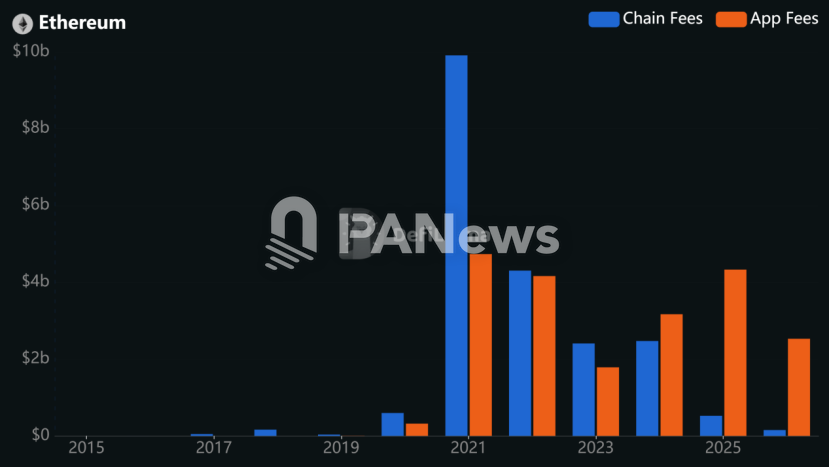
DeFiLlama data cited in the report show that fees generated on the Ethereum chain had already been surpassed by application-layer fees on mainnet in 2024. From the start of 2026 to the report, mainnet fee revenue was about $152 million, while application-layer fees were about $2.529 billion — a gap of more than 16 times.
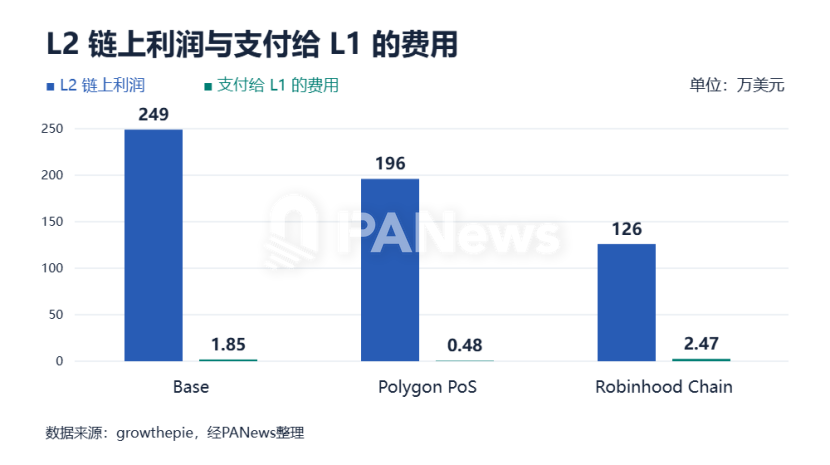
Layer 2 is presented as the clearest case. Base, described as a leading L2, relies on Ethereum for underlying settlement and security while keeping its own execution environment and user entry point. It charges end users a transaction fee, pays Ethereum for data publication and settlement, and keeps the difference as on-chain gross profit.
growthepie data for the 30 days preceding the report: the top three Ethereum L2s together made about $5.71 million of on-chain profit, of which Base contributed $2.49 million. Over the same period, their settlement payments to Ethereum mainnet totaled only about $48,000. Base’s own payment was $18,500, and that was lower than Robinhood Chain’s. Jae’s conclusion is that most of the fee value stayed on the L2s, did not flow to Ethereum mainnet, and was not converted into a return for ETH holders.
A longer-dated concern in the report is brand and user perception. As more users complete all of their on-chain activity through Base, Arbitrum, and other L2s, and scarcely touch Ethereum itself, the service and the name they recognize would increasingly belong to the L2 and the front-end application. That claim is not tied to a cited survey or usage panel. It is a hypothesis about where attention migrates if users never see the base chain.
Lower fees can also be what makes new activity possible
The report does not treat persistently low fees as only a loss. Scaling, in Jae’s account, is a reduction in the unit cost of a transaction. When a transfer cost several dollars, many high-frequency or very small uses were not practical. At a few cents or less, activity that previously lacked an economic basis — high-frequency payments by AI agents, micropayments, automated strategies — has room to develop.
Whether that added demand can accumulate into enough volume for scale to offset the fall in the fee per transaction is left unresolved. Jae says it still has to be tested over time. The article contains no volume path and no estimate of how sensitive activity is to fees.
Tom Lee is also quoted as saying that a shift of ETH toward store of value would let it capture value in a coming tokenization and AI supercycle. That is his stated expectation. It is not a result of the The Block, DeFiLlama, Ethereum Institutional, or growthepie figures above.
What the reported evidence can support
Jae’s closing reading is that the old path — high gas fees supporting burn and, through that, the token price — was difficult to sustain, and that Buterin’s remarks were closer to active management of expectations. Rather than hold onto a deflation narrative that was losing its mechanism, the report says, it was better to recognize that ETH’s value proposition was moving. In the past, Ethereum had to show it could collect enough fees to support burn. Afterward, it would have to show that ETH was still worth holding even as fees became cheaper.
The November 2026 report does document the following, with the sources and windows it names:
- Staked ETH at 36.36 percent of circulating supply, versus 29.91 percent a year earlier (The Block, as of the report).
- $25.8 trillion of mainnet stablecoin transfers in the first ten months of 2026, up 61 percent year over year (Ethereum Institutional).
- About $42 billion of mainnet DeFi TVL, stablecoin market value above $135 billion, and $15 billion of RWAs (DeFiLlama).
- About 1.48 million ETH burned in 2022, versus about 13,000 ETH, worth about $27.3 million, in 2026 up to the report — a decline of more than 99 percent by coin count — and a return from net deflation to net inflation in February 2025, with the inflation rate said to be rising but not quantified.
- Year-to-date 2026 mainnet fees of about $152 million, against about $2.529 billion at the application layer, a difference of more than 16 times, with application-layer fees on mainnet already ahead as early as 2024 (DeFiLlama).
- About $5.71 million of combined on-chain profit at the top three L2s over the prior 30 days, including $2.49 million at Base, against about $48,000 paid to mainnet for settlement, of which Base paid $18,500, less than Robinhood Chain (growthepie).
Those measurements do not establish that staking or collateral use replaces burn with net new demand for ETH, that users will hold ETH as base capital rather than buy it as gas, that L2 mindshare has shifted by any measured amount, or that cheaper fees will scale into activity large enough to matter for holders. The discount-rate examples are illustrations of persistence and size, not protocol requirements.
Original article by Jae, PANews, November 10, 2026: 从通缩到价值存储,Vitalik的叙事转向能救以太坊市值吗?