Historical research note: This article reflects Alea Research’s analysis as published by TechFlow on November 11, 2026, at 09:41 UTC+8. Dates and planned milestones below refer to that reporting period.
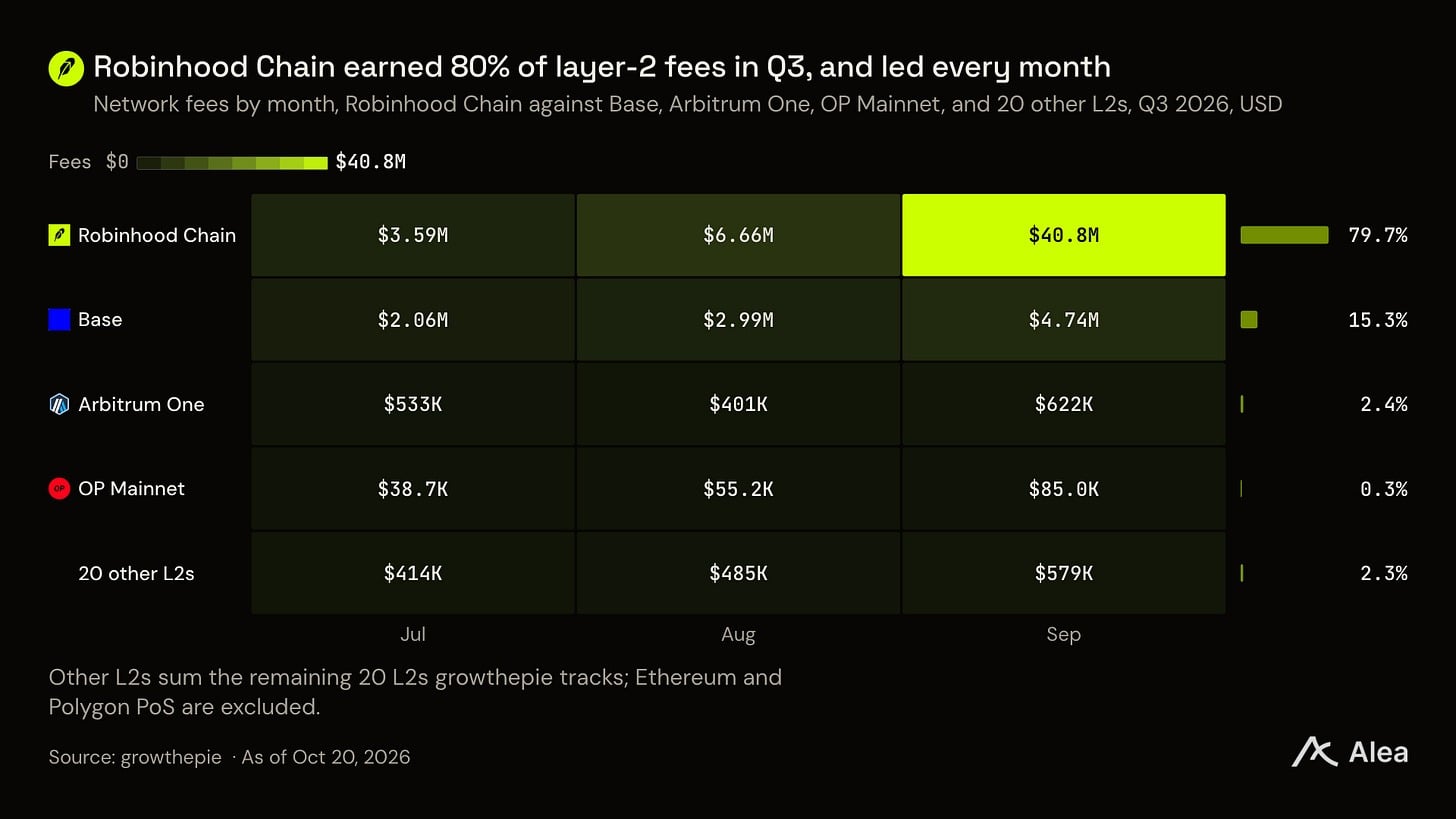
Robinhood Chain generated $51 million in network fees in Q3 2026, its first full quarter after mainnet launch, according to Alea Research. That represented about 80% of Ethereum Layer 2 network fees. Its on-chain exchange volume reached $90.7 billion, compared with a combined $50 billion in crypto trading volume through the Robinhood app and Bitstamp. Those are different measures: trading volume is not fee revenue.
The central question is how much of the fee lead survived a short-lived surge in token launches—and what activity remained after fees fell.
Separating the spike from the baseline
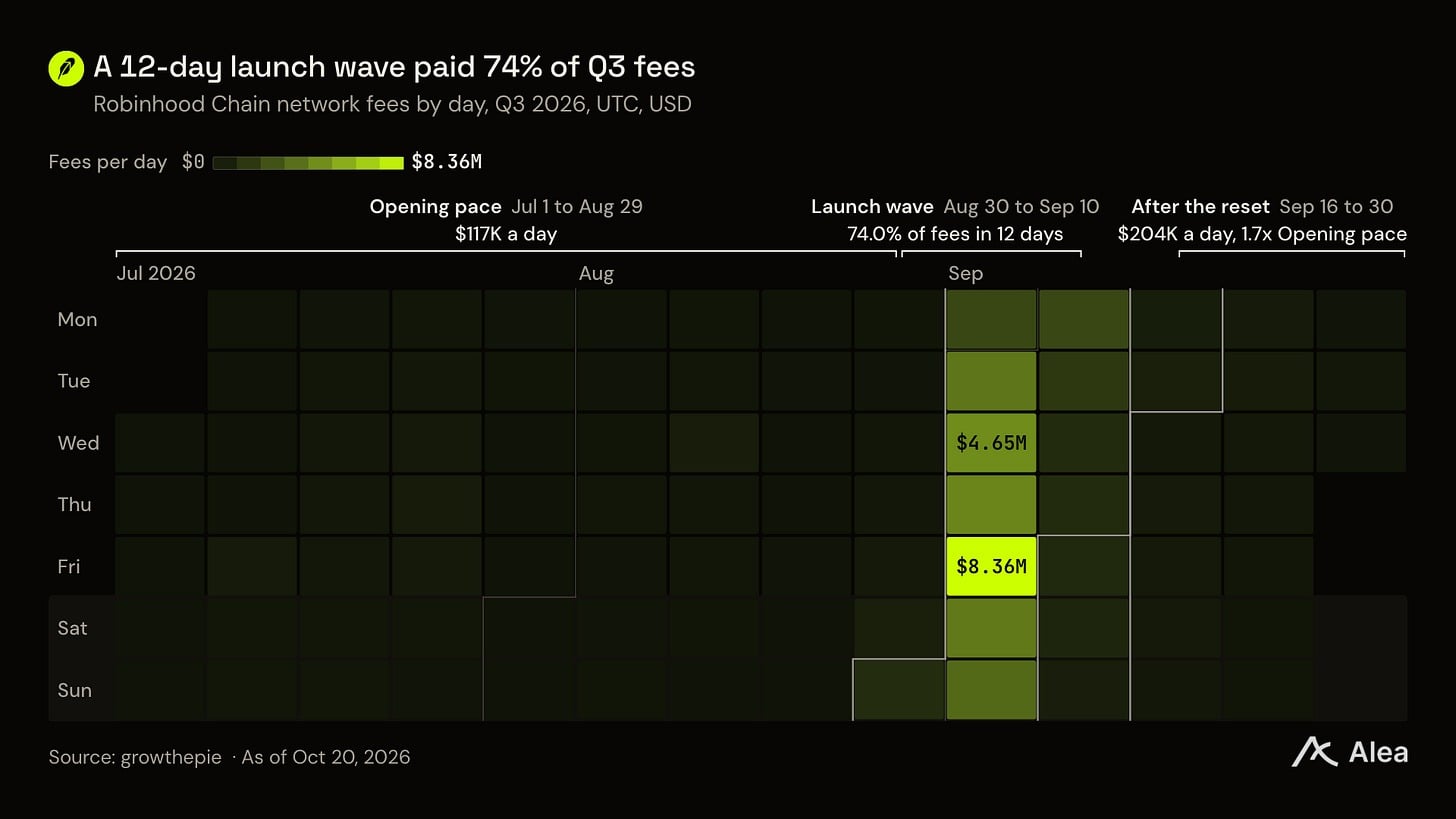
Alea attributed 74% of Robinhood Chain’s Q3 network fees to a 12-day launch wave from August 30 through September 10. Pons introduced its V2 factory contract on August 4; the analysis reports 648,701 token launches. On September 4 alone, network fees reached $8.36 million, more than twice July’s total. Across the quarter, transactions paid an average of 6.4 cents in gas, versus 1.4 cents before the launch wave.
Excluding those 12 days, the chain still accounted for 57.7% of Layer 2 network fees during the quarter’s other 80 days, against 30.7% for Base. But the run rate declined: average daily fees were $121,000 in September’s final week and $54,600 from October 1–19. The monthly Layer 2 fee comparison cited in the original analysis uses growthepie data; these figures should not be read as a forecast of recurring revenue.
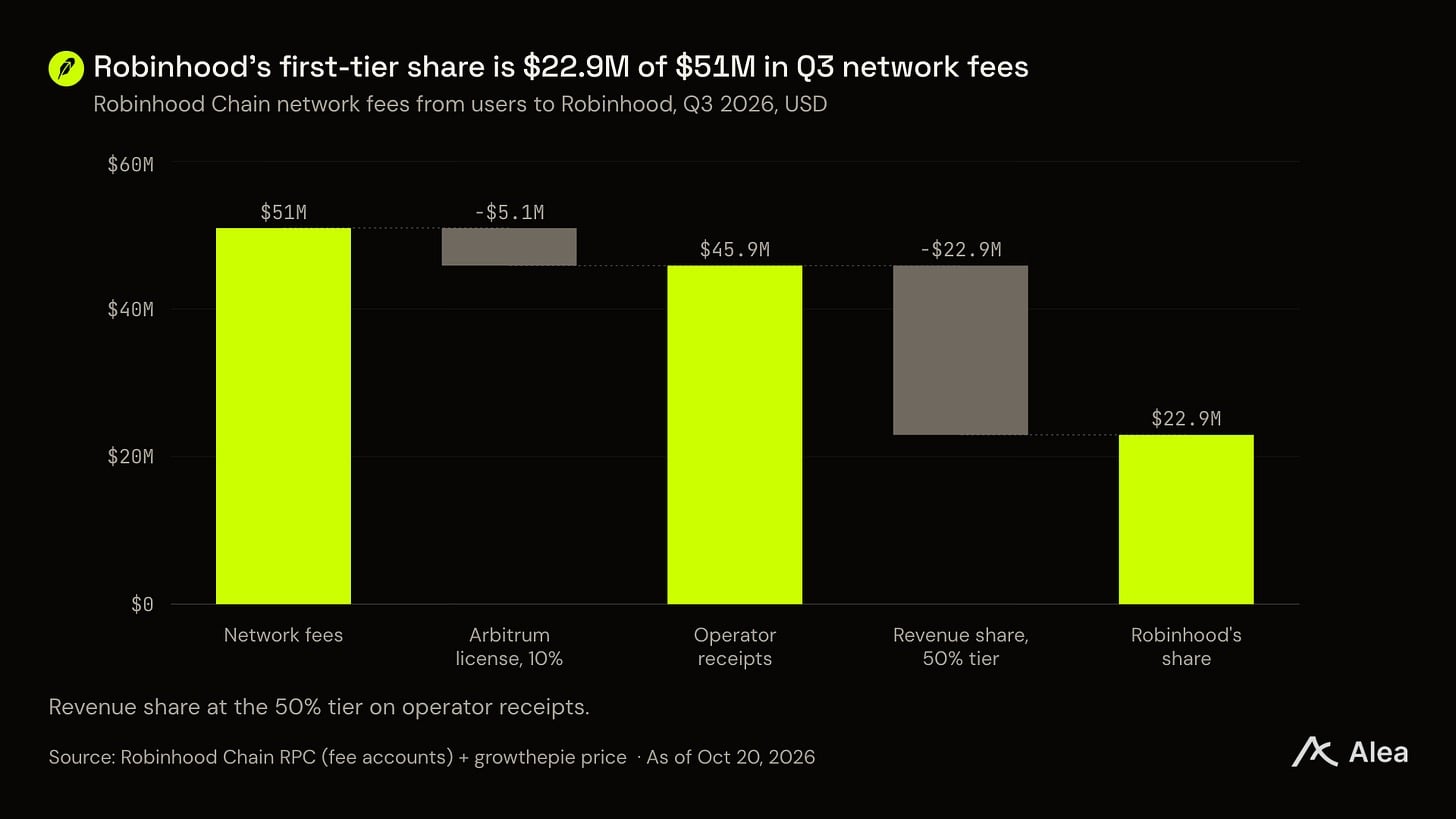
Robinhood Chain uses the Arbitrum technology stack and has no native token. Under the fee-sharing arrangement described by Alea, Arbitrum receives 10% of gross network fees. Robinhood initially retains 50% of the remainder, with higher retention tiers of 70% and 85% as cumulative operating revenue rises. Applying the initial tier to Q3 produces an estimated $22.9 million Robinhood share—about 19% of its reported $120 million in quarterly crypto-business revenue. That is an estimate under the stated fee split, not the chain’s $51 million gross fee total. Separately, traders paid $593 million in application-layer fees, of which application operators retained $147 million.
What stock-token trading showed
Robinhood’s stock tokens are described in the analysis as debt claims backed one-for-one by underlying shares and minted solely by Bitstamp. In September, trading volume in non-newly issued stock-token pairs reached $8.7 billion, versus $6.4 billion for bStocks. Stock tokens’ share of the chain’s DEX volume rose from 2.6% in July to 15.6% in September.
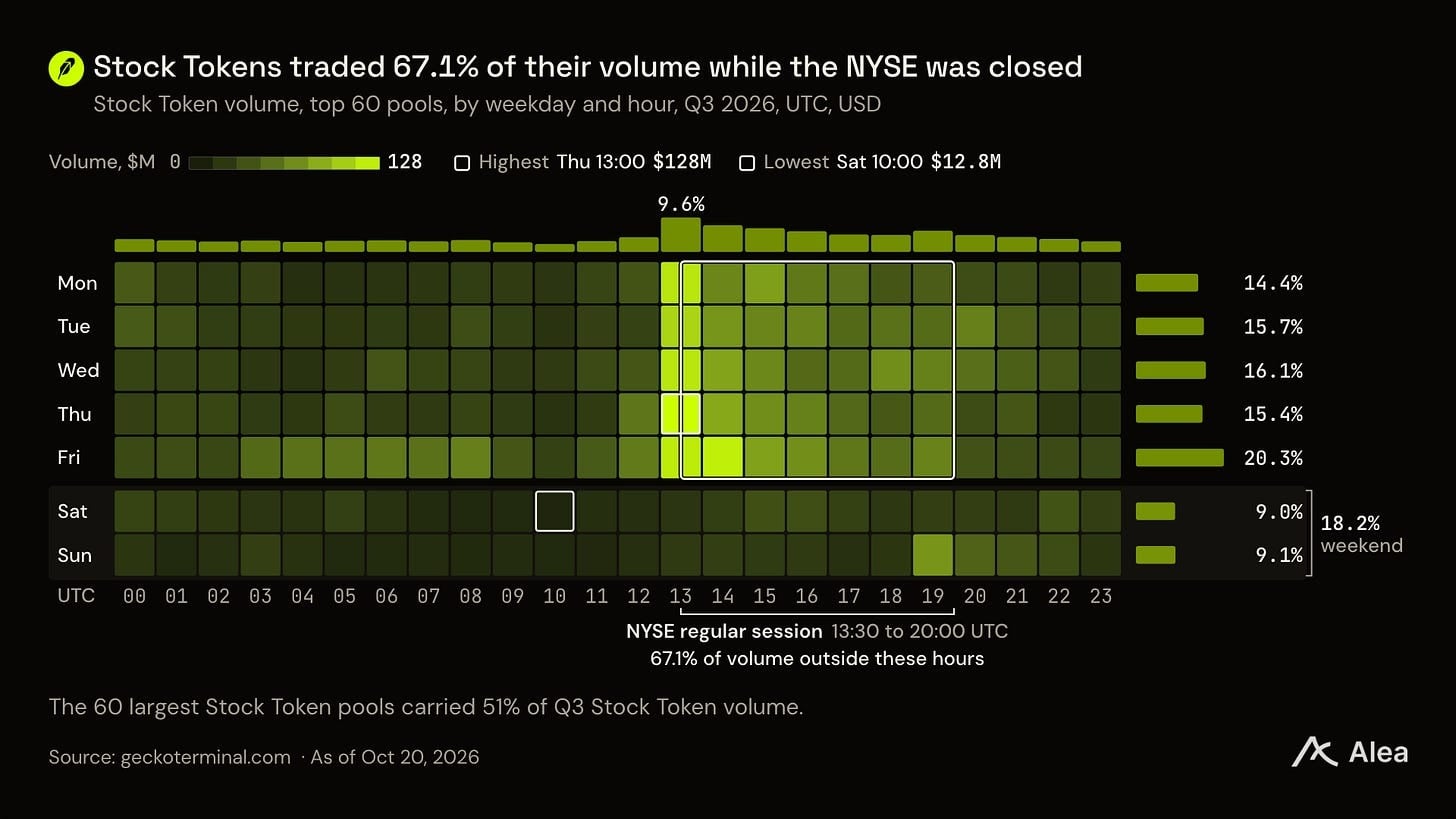
Among the 60 highest-volume stock-token pools in Q3, 67.1% of volume occurred outside regular New York Stock Exchange hours, including 18.2% on weekends. In Alea’s sample of 37 weekend or holiday moves of at least 1%, token prices indicated the direction of the subsequent Monday move before the market opened; the median proportion of the move reflected in token prices was 86%. This is a historical sample, not evidence that future gaps will be predicted reliably. The median closing-price gap between the ten most-traded tokens and their underlying shares narrowed from 29 basis points in July to 13 in September.
The product’s rights and settlement constraints matter. At the time of the report, weekend minting and redemption of the underlying Robinhood-backed shares were unavailable, and Robinhood had not set a timetable for its plans to enable eligible holders to vote or redeem tokens for shares. Alea also reported an October 22 lending-market launch with Morpho that allowed stock tokens to serve as collateral.
Revenue questions beyond gas
Alea reported that Robinhood Earn’s Steakhouse vaults on Morpho held $499 million at the start of their 92nd day, 18% more than Coinbase’s lending vaults at the same operating age. It also estimated that $683 million in underlying Treasury reserves associated with USDG could yield about $26.9 million annually at the Treasury-bill rate used in its calculation. That is a rate-dependent estimate, not realized annual revenue.
As of October 26, Alea put cumulative operator revenue $2.9 million below the approximately $50 million threshold for Robinhood’s next fee-sharing tier. The report projected a possible move to 70% retention around December 25 at October’s pace; it did not establish that the threshold would be reached then. It also identified the scheduled December 31 end of Robinhood Wallet’s gas subsidy for swaps above $0.50 as a future test of unsubsidized demand. Plans for weekend US-stock trading in the Robinhood app in early 2027 were likewise subject to regulatory approval.
The quarter therefore supports two narrower conclusions: Robinhood Chain led Layer 2 network fees even without its launch-wave days, and its stock tokens saw substantial trading outside exchange hours. Falling post-spike gas fees, the conditions of stock-token redemption, and the expiry of subsidies remained important limits on extrapolating Q3 into a durable earnings run rate.
Source: techflowpost.com (originally published 2026-11-11 09:41 UTC+8)