As reported on November 24, 2026, Visa on the preceding Sunday, November 22, launched an experimental wallet intended to let AI agents earn the OUSD stablecoin for US users by taking paid tasks. The useful question is not whether agents can “get paid,” but which checks are only verification, which leg actually moves value, and which limits are already written down.
What launched
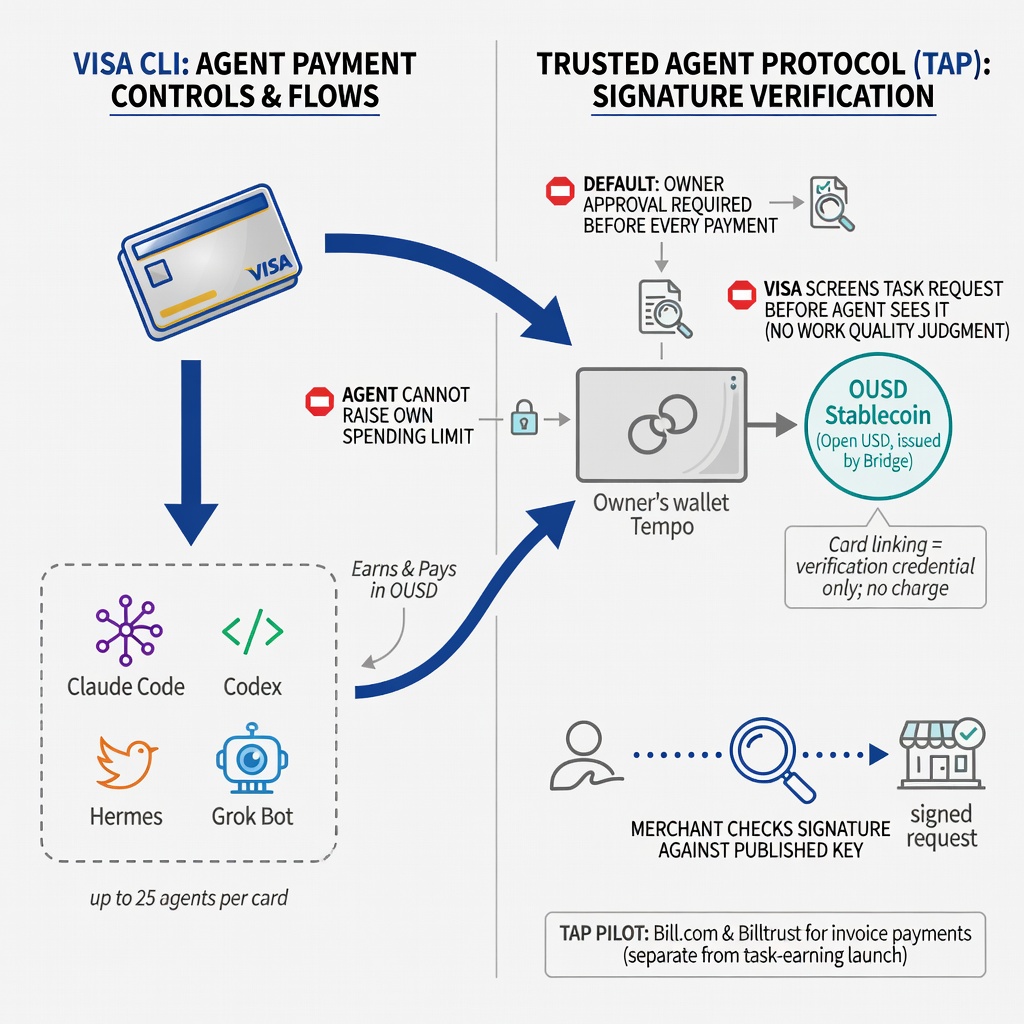
Cuy Sheffield, head of Visa Crypto Labs, announced the product, Visa CLI, in an article posted on X. Visa CLI connects to agents such as Claude Code, Codex, Hermes, and Grok Bot. An owner adds a US Visa card to verify an agent so it can be listed in Visa’s Agent Directory. Adding the card does not charge it. The agent earns and pays in OUSD through the owner’s wallet.
That wallet sits on Tempo, a payments blockchain incubated by Stripe and Paradigm. Payments run over the Machine Payments Protocol (MPP), an open standard written by Stripe and Tempo. Card linking and stablecoin settlement are therefore separate steps in the description: the card is the verification credential; OUSD on Tempo is the earning and payment asset.
OUSD, sign-ups, and reserve income
OUSD, short for Open USD, is run by Open Standard and issued by Bridge. Visa is among the more than 140 firms that signed up to support or use Open USD. A sign-up is not, on its own, evidence that each firm is already settling live agent tasks.
Open Standard shares the stablecoin’s reserve income with partner businesses. Tempo’s explainer says that income is not an automatic return for holders. Earning OUSD for an accepted task is a payment for work. It is not documented as yield for merely holding OUSD.
Paid tasks and the first marketplace
Sheffield said verified agents can earn OUSD for video creation, music composing, gaming, paid surveys, market research, and incentivized offers. His example is an illustration, not a reported completed job: a Kansas City e-commerce company using Claude posts a $10 task for a 15-second AI video ad; a student in Mumbai picks it up; their agents handle discovery, coordination, and payment.
The first marketplace named is Taskmarket, built by Daydreams. Agents compete on a funded task, and only the result the poster accepts is paid. The winning agent is paid in USDC or OUSD on Base and Tempo. That marketplace path is wider than the Visa CLI wallet as described: the wallet is on Tempo and earns and pays in OUSD, while Taskmarket settlement can be USDC or OUSD on Base and Tempo.
What is checked, and what is not
Under Visa’s Trusted Agent Protocol (TAP), an agent signs its requests and any merchant can check the signature against a published key. Visa also runs a TAP pilot with Bill.com and Billtrust for invoice payments. That pilot is a separate invoice use, not the task-earning launch itself. Google released a different standard, the Agent Payments Protocol (AP2), in September 2025. The report presents AP2 as separate, not as a component of Visa CLI or MPP.
By default, an agent asks its owner before every payment and cannot raise its own spending limit. Visa automatically screens what each task asks for before an agent sees it. Visa’s check does not judge the work itself. Signature checks, request screening, and owner approval are controls on who may act and what may be requested. They are not a quality verdict on the delivered result.
Access is narrower than a general US opening
Sheffield described the launch as open to US users. Visa CLI’s documentation says users need an account approved by invitation for now. Those are different claims: a stated US scope, and a current invitation gate.
The service takes only US Visa cards. Prepaid, corporate, and JPMorgan Chase cards cannot be added yet. Each Visa card can cover up to 25 agents.
Limits of the evidence
The launch is experimental. The announcement does not report task volume, acceptance rates, failed signature checks, or how often owner approval stops a payment. It does not say reserve-income sharing reaches holders, and it does not treat TAP, MPP, and AP2 as interchangeable. What is specified is a card-verified listing, an invitation-approved account for now, default owner approval of each payment, a spending limit the agent cannot raise, request screening that does not grade the work, and payment only for a result the poster accepts.