Originally reported on November 11, 2026, at 19:35 (UTC+8). The source credits ross.wei as author and AididiaoJP of Foresight News for the Chinese translation.
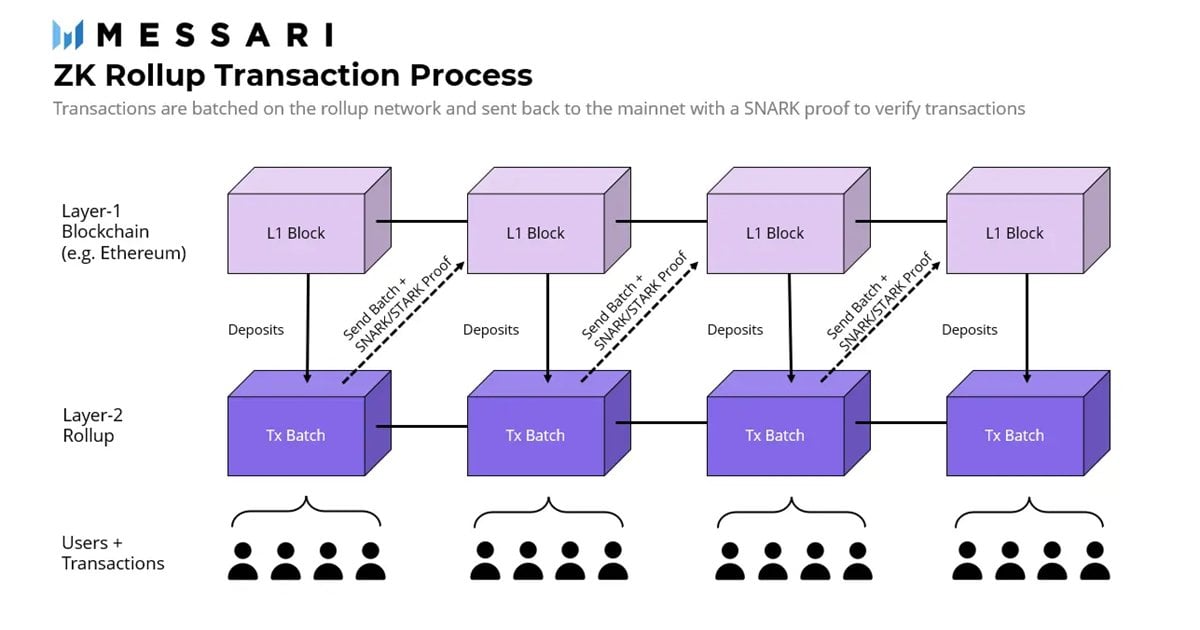
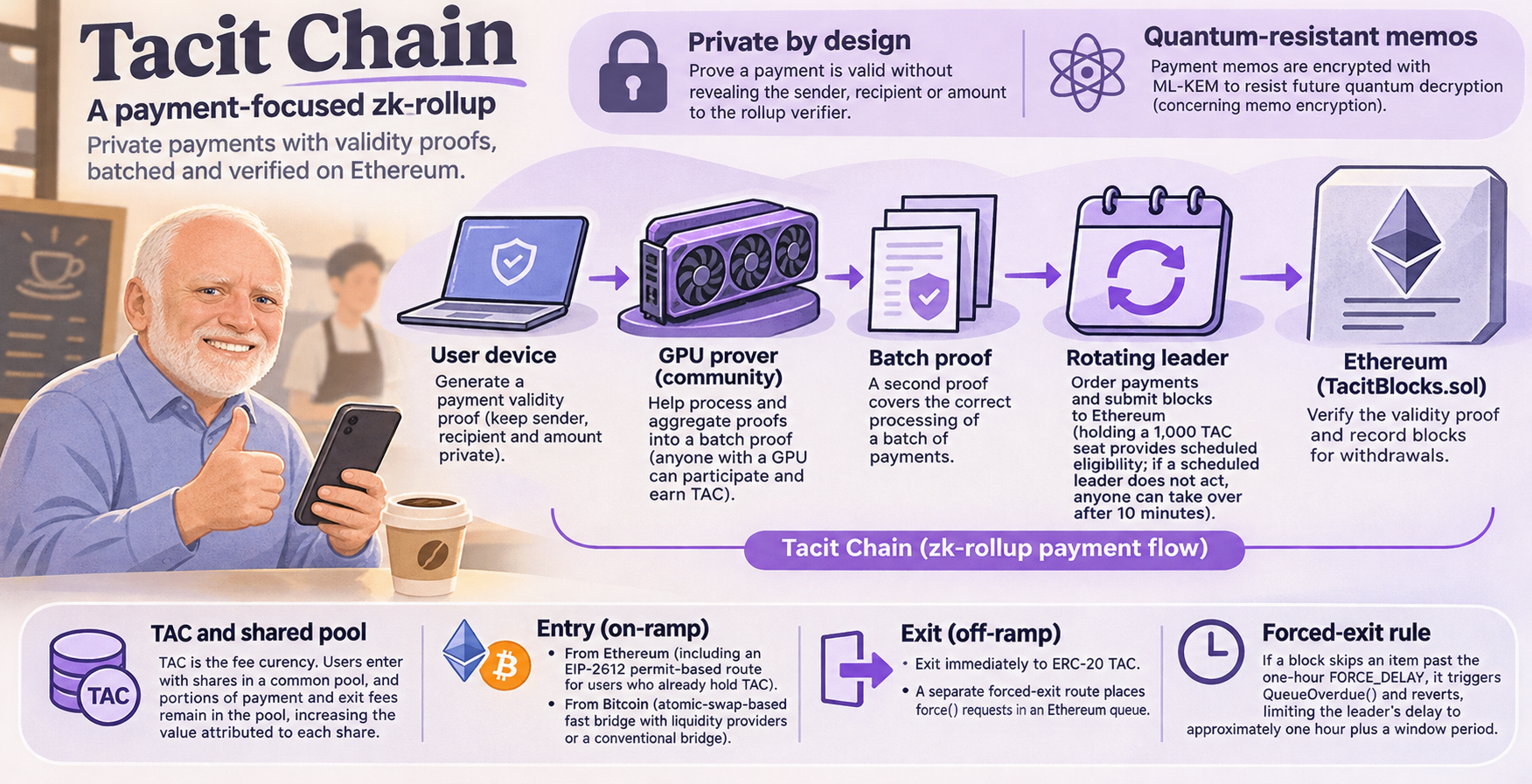
Tacit Chain is presented as a payment-focused zk-rollup: users prove that their payments are valid without revealing the sender, recipient or amount to the rollup verifier, while a second proof covers the processing of a batch before Ethereum accepts it. The design addresses a specific trade-off in crypto payments—quick acceptance without giving an operator unchecked control over balances—but the source does not provide independent measurements or verification of the implementation.

How a payment reaches Ethereum
The source contrasts Tacit’s approach with sidechains, payment channels and optimistic rollups. Sidechains can offer faster transfers but introduce operator or federation trust assumptions. Channels require participants to protect their ability to dispute an outdated settlement. Optimistic rollups allow challenges to submitted batches, which can leave users waiting roughly a week to exit. A zk-rollup instead submits a validity proof for Ethereum to check.

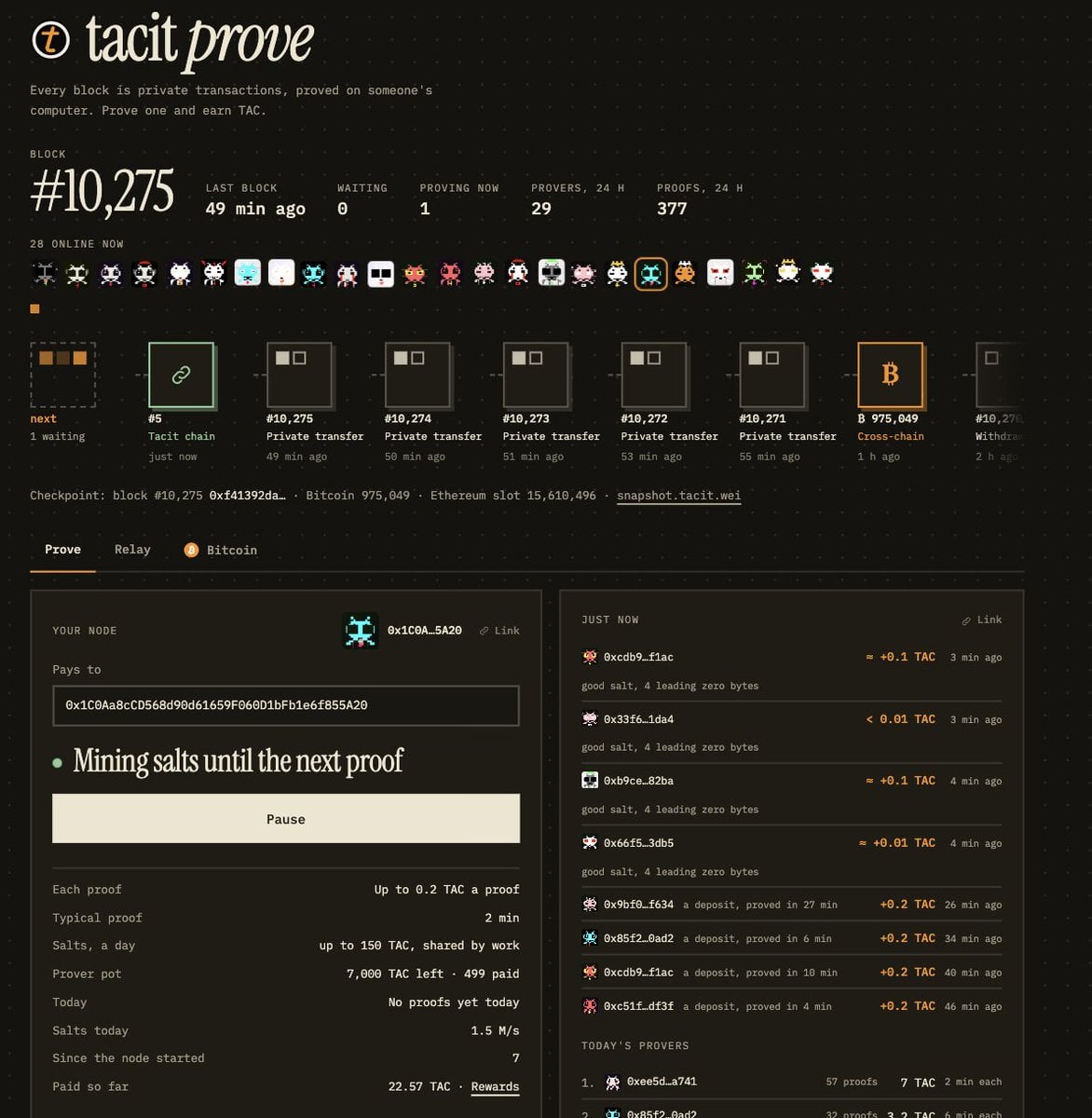
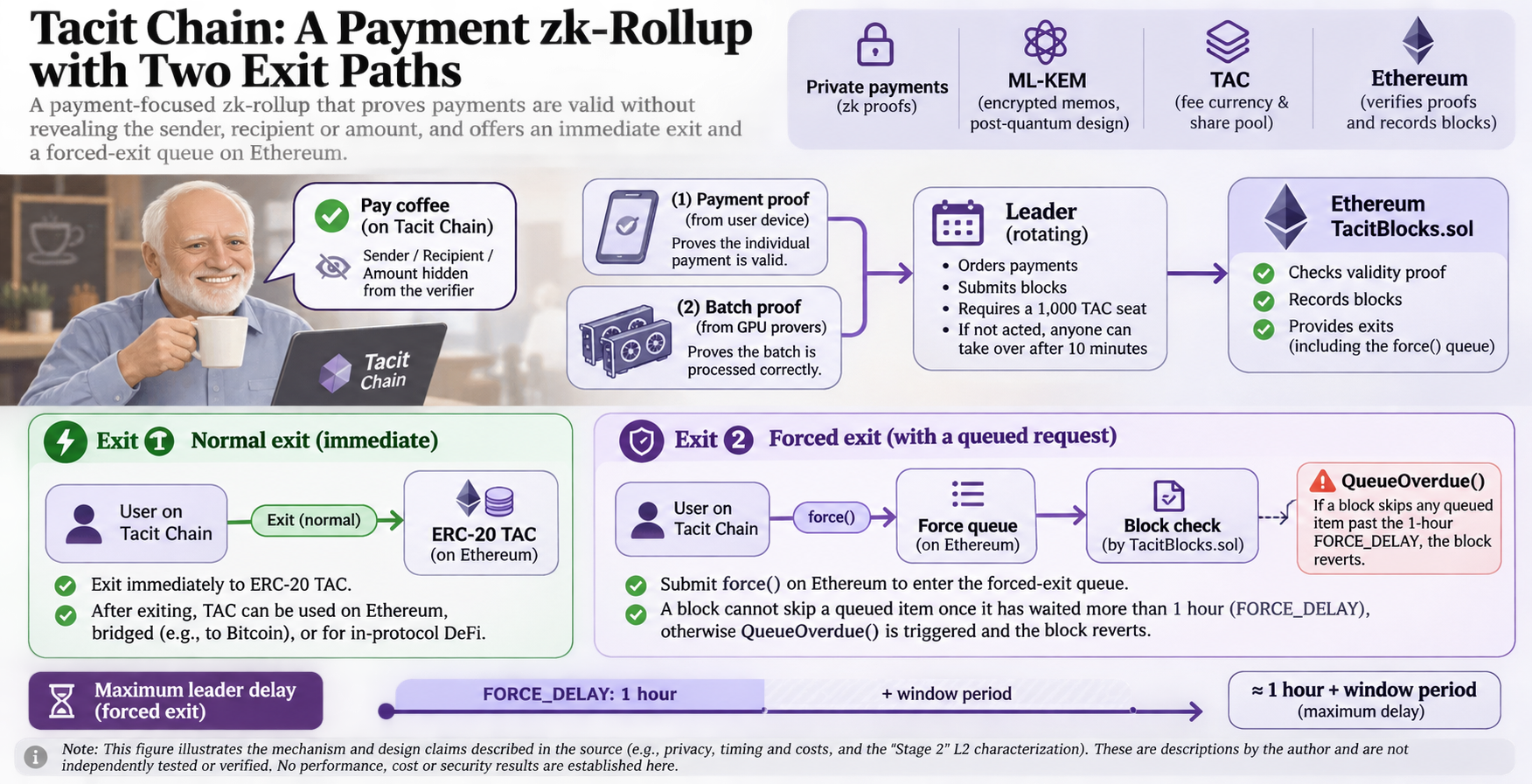
In Tacit’s described design, a user device proves an individual payment, and GPU-equipped provers help process block proofs. A rotating leader orders payments and submits blocks to the Ethereum contract TacitBlocks.sol, which checks validity and records blocks for withdrawals. Holding a 1,000 TAC seat provides scheduled eligibility to lead; if the scheduled leader does not act, anyone can take over after 10 minutes. The source says anyone with a GPU can participate in proving and earn TAC through a reward program. These are descriptions of the proposed mechanism, not independently established participation or throughput figures.
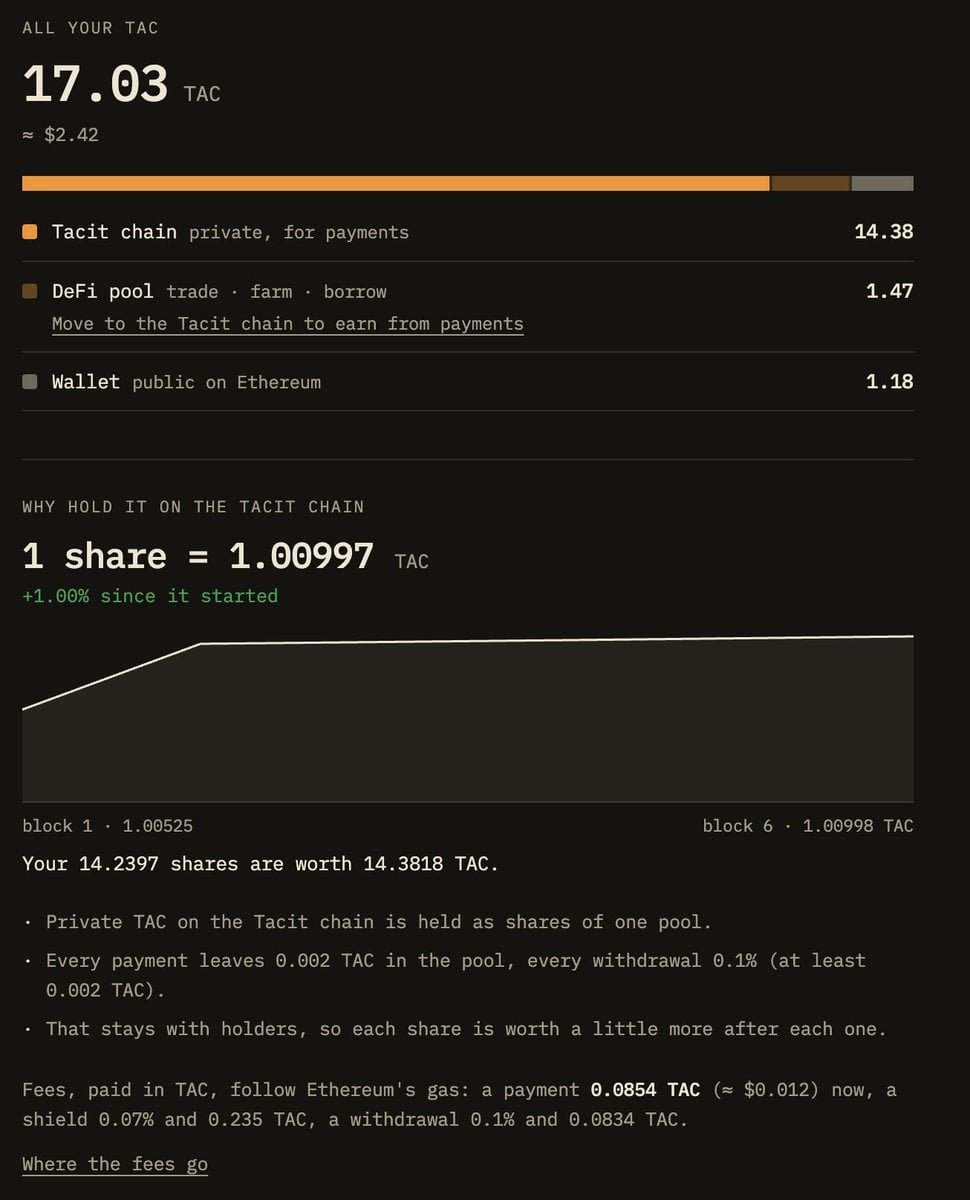
TAC is also the fee currency. According to the source, users entering the system hold shares in a common pool; portions of payment and exit fees remain in that pool, increasing the value attributed to each share. It argues that more payments per block could reduce the Ethereum posting cost per payment. Neither a measured cost series nor a valuation model is supplied.
Entry, exit and the trust boundary
The source describes entry from Ethereum, including an EIP-2612 permit-based route for users who already hold airdropped TAC, and Bitcoin entry through either an atomic-swap-based fast bridge with liquidity providers or a conventional bridge. It says users can exit immediately to ERC-20 TAC. A separate forced-exit route places force() requests in an Ethereum queue: under the described rule, a block that skips an item past the one-hour FORCE_DELAY triggers QueueOverdue() and reverts. The source characterizes the resulting maximum leader delay as approximately one hour plus a window period, rather than an unconditional one-hour withdrawal guarantee.
The author argues that the design meets the criteria for a “Stage 2” L2. The cited grounds include immutable core contracts without owners, upgrade paths or multisignature control; a fixed SP1 Groth16 verifier leaf; transaction data posted as Ethereum calldata; and the forced-exit queue. That classification is the author’s assessment, not an independently verified rating. The source also identifies a narrower dependency: cross-pool transfers and migration pass through a confidential V1 pool and therefore depend on its construction. A withdrawal to Ethereum as an ordinary TAC transfer does not, according to the source, depend on V1.
Privacy claims and open questions
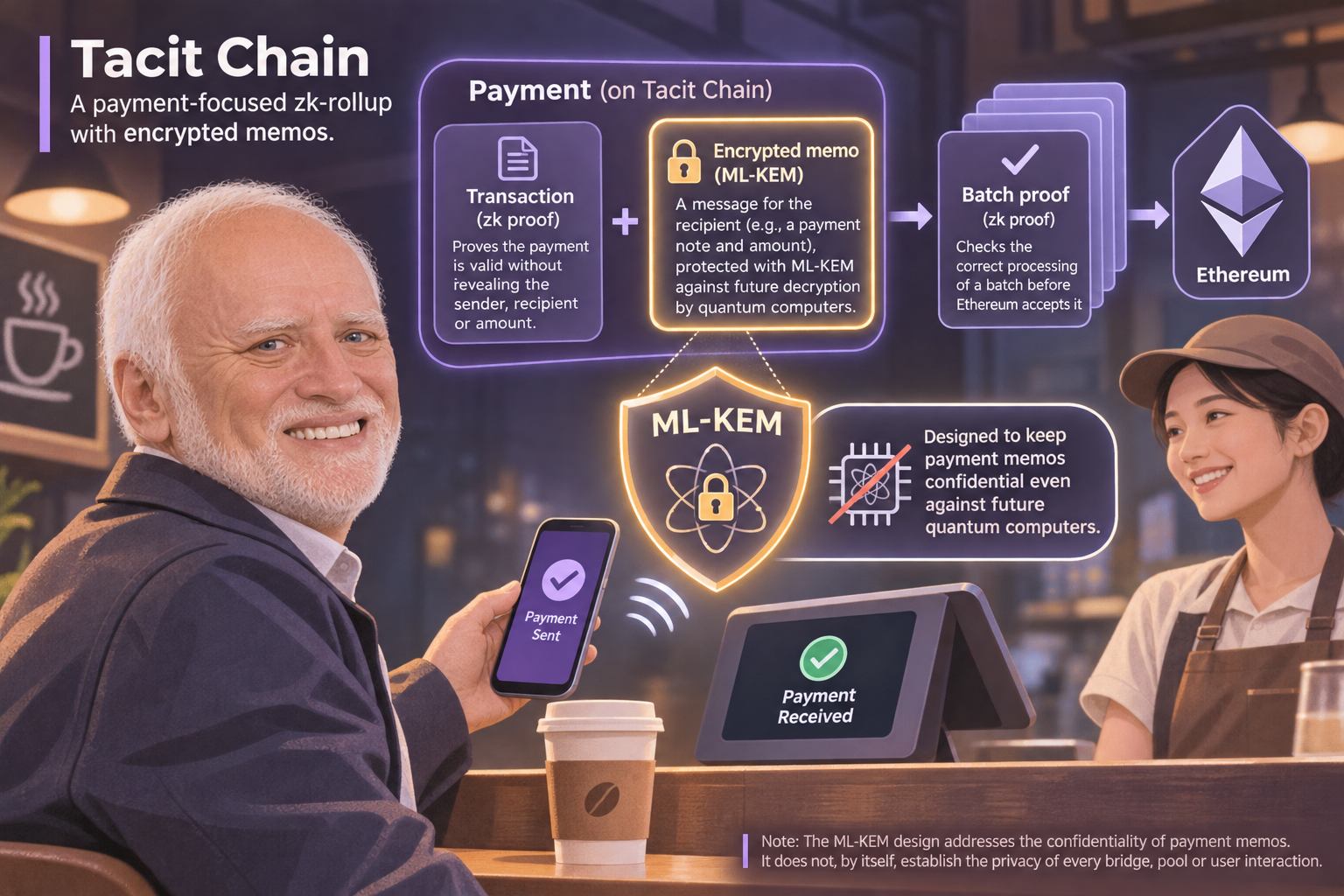
For encrypted payment memos—the messages that tell recipients about a payment—the design uses ML-KEM to address the risk that recorded ciphertext could be decrypted by future quantum computers. That claim concerns the memo-encryption design; it does not, on its own, establish the privacy of every bridge, pool or user interaction.
The source says a merchant can see a payment upon sending, with Ethereum finality in about one minute. It presents confirmation approaching 30 seconds and costs below one US cent with blobs as potential improvements, not measured current results. It also describes optional migration to future versions without exposing which memo moved or its amount. The supplied article includes no reproducible benchmark, audit, on-chain dataset or measurement date for these performance and privacy assertions. They remain design and performance claims to test, rather than demonstrated outcomes.
Source: techflowpost.com (originally published 2026-11-11 19:35 UTC+8)