
Originally reported on November 12, 2026. This article examines the plans and evidence available at that time, not a launched market.
The MegaETH Foundation renamed itself MEGA and announced a $30 million treasury commitment to develop products on MegaETH, led by an AI inference market planned for December 2026. The proposed market would let buyers obtain access to AI models from competing compute providers. Its mechanism, provider roster and launch models had not been disclosed when the article was published.
The shift followed a sharp decline in the chain’s reported total value locked (TVL): the source put it below $10 million, versus a peak above $245 million in May 2026. Co-founder Shuyao Kong said the team needed to change course after building what she called the fastest chain without finding product–market fit. Those TVL figures describe the chain, not demand for the proposed inference market.
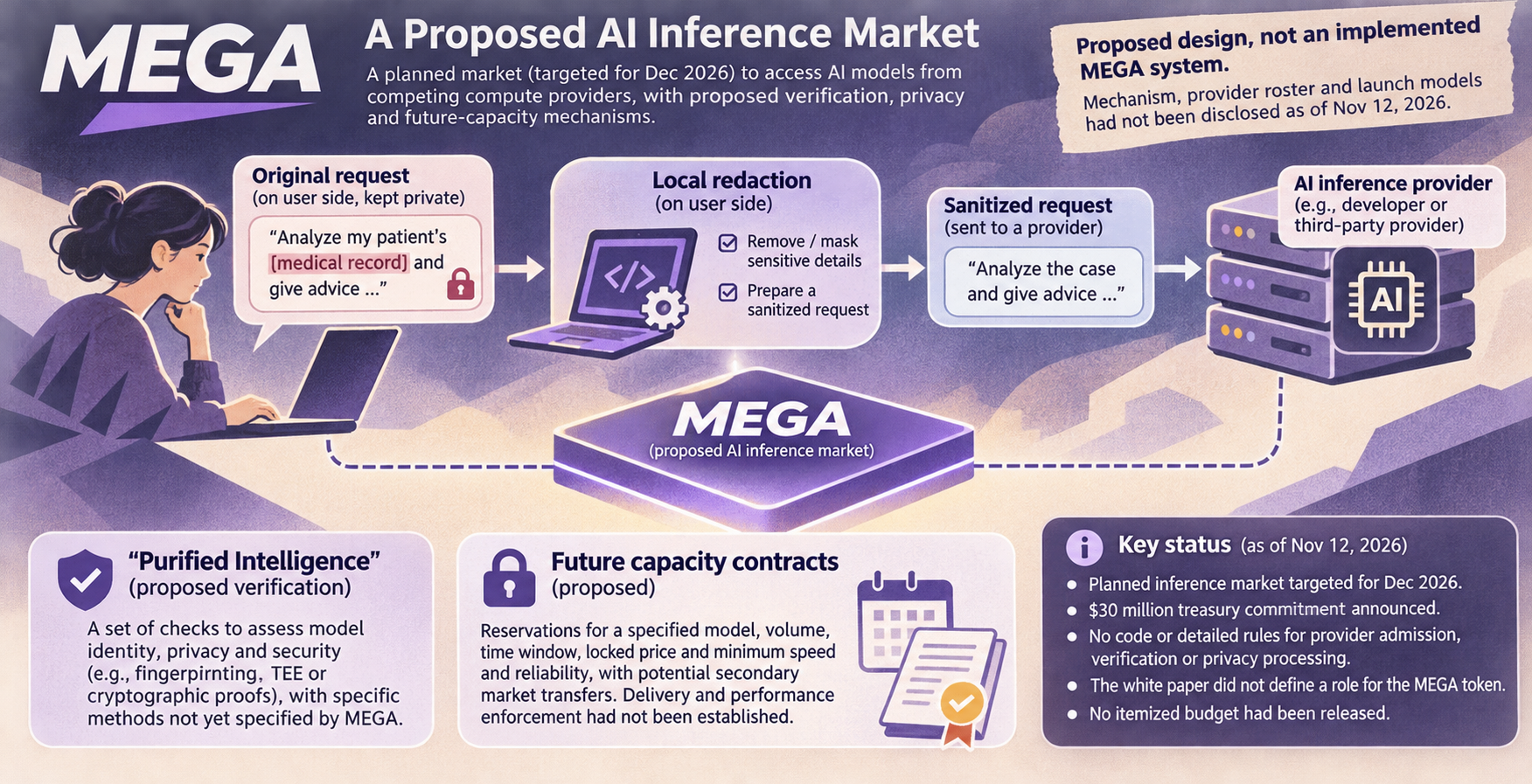
The verification question
MEGA’s white paper frames its opportunity as a trust problem: a third-party provider may offer the same open-source model more cheaply than its developer, yet buyers may prefer the familiar official channel. As an example, the source cited OpenRouter listings of $2.20 per million output tokens for GLM 4.6 from developer Z.ai and $1.75 from third-party provider Venice. These are prices quoted in the November 12 report, not a measured market-wide price gap.
MEGA proposes a set of checks it calls Purified Intelligence to assess model identity, privacy and security. But verification alone may offer limited differentiation. The source describes competing approaches already in use or development: Antseed’s model-fingerprinting checks and optional trusted execution environment (TEE) verification; Anthropic’s FlashProve prototype, which the source says requires 70–95 times the compute of an ordinary inference request; and a proof system Pearl was developing with Attestable. A study published in March 2026 found that up to 46% of identity checks failed across three black-box resellers it tested. That result concerns those tested resellers, not inference providers generally. MEGA’s white paper discussed verification approaches but did not specify which it would deploy.
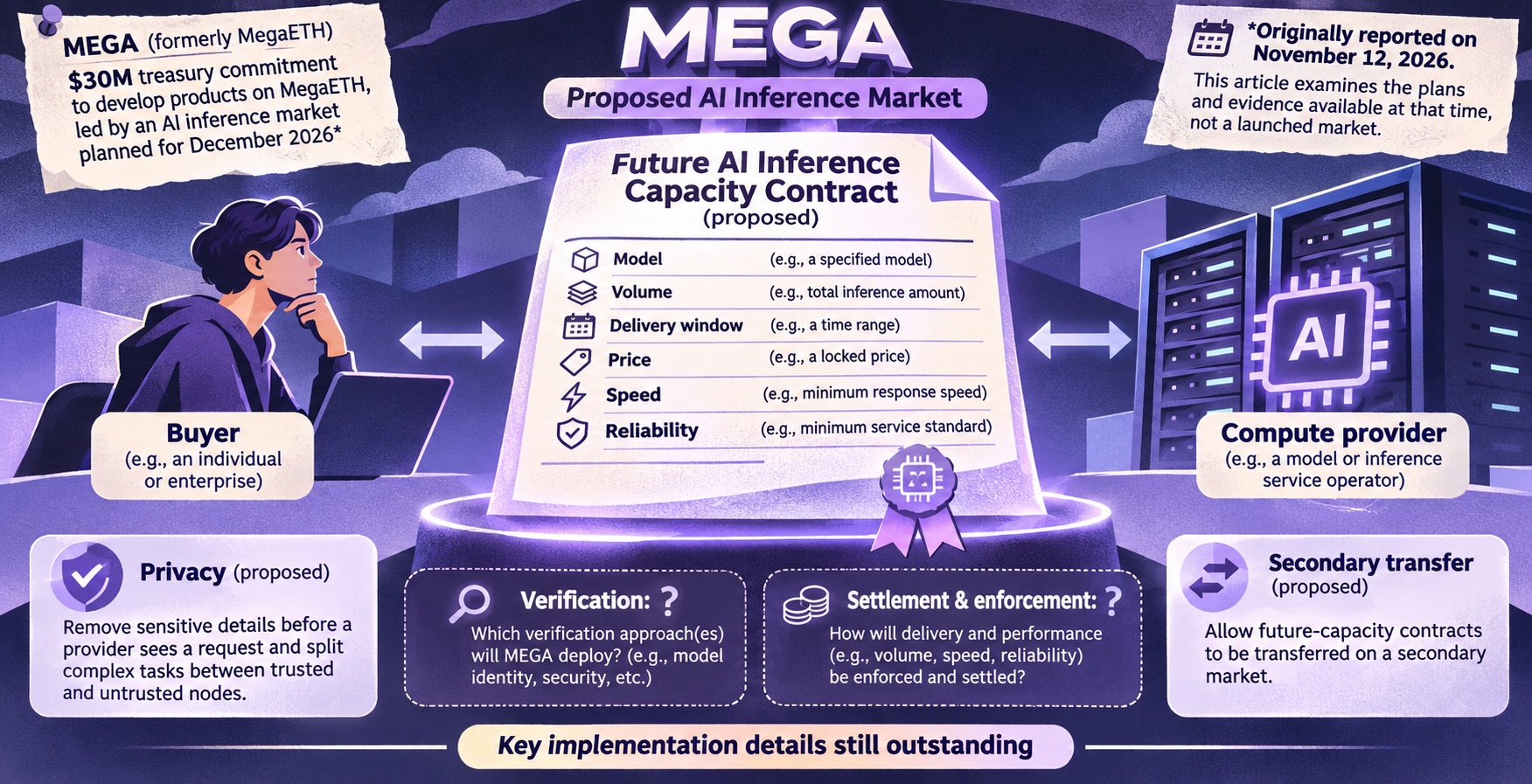
Two proposals that need implementation details
Privacy. MEGA envisages removing sensitive details before a provider sees a request and dividing complex tasks between trusted and untrusted nodes. Where that removal runs is decisive: if MEGA itself can see the original request, the design moves the trust requirement rather than eliminating it. The source points to Freysa’s experience with a comparable feature in its former Enchanted app, now Silo: Freysa said in November 2025 that uneven phone performance had forced processing off mobile devices, while a July iOS update log listed the feature as removed. That example illustrates an implementation difficulty, not a test of MEGA’s proposal.
Future capacity. The white paper also proposes reservations for a specified model, volume, time window, locked price and minimum speed and reliability standards, with eventual secondary-market transfers. Such contracts could give buyers a claim on future inference capacity and providers committed demand. But the white paper had not established how delivery or performance would be enforced. Falling inference costs and model turnover also leave the value of locking in a particular model and price uncertain.
As of the original report, MEGA had published no code or detailed rules for provider admission, verification or where privacy processing would occur. The white paper did not define a role for the MEGA token. Asked by The Block about that role, Kong said the team would use opportunities that could benefit the token. No itemized budget for the $30 million commitment had been released.
The practical tests are therefore narrower than the announcement: named providers and admission criteria, a privacy design that keeps sensitive inputs outside MEGA’s view, and an actual future-capacity contract with a counterparty. Until those details are available, the privacy and capacity mechanisms remain proposals rather than demonstrated market features.
Source: techflowpost.com (originally published 2026-11-12 09:30 UTC+8)