Historical research note: Sparsity’s analysis was published by PANews on November 11, 2026, at 18:43 UTC+8, in a translation by Saoirse for Foresight News. The figures below describe the periods and snapshots cited in that analysis, not current conditions.
Sparsity’s central argument is that Pump.fun earns much of its fee revenue before a token has demonstrated any staying power. That gives the platform, token creators and promoters different incentives from buyers hoping to hold a token over time. The reported figures make the incentive question worth examining, but they do not, on their own, establish that the fee model caused every trading loss or change in the meme-token market.
Where the reported revenue came from
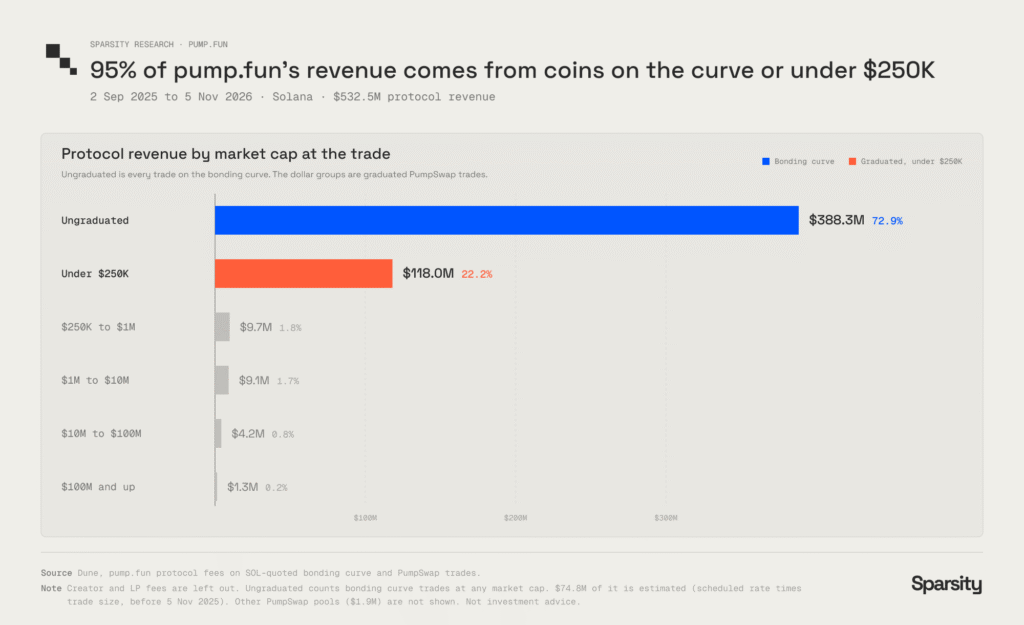
According to the analysis, Pump.fun accounted for 92% of meme-token launches and 84% of launch-sector trading volume across chains in the preceding 30 days. For September 2, 2025, through November 5, 2026, it attributed 95% of Pump.fun’s protocol revenue to tokens still on their bonding curves or below a $250,000 market capitalization. A bonding curve is the mechanism used to price trades during a token’s initial launch phase.
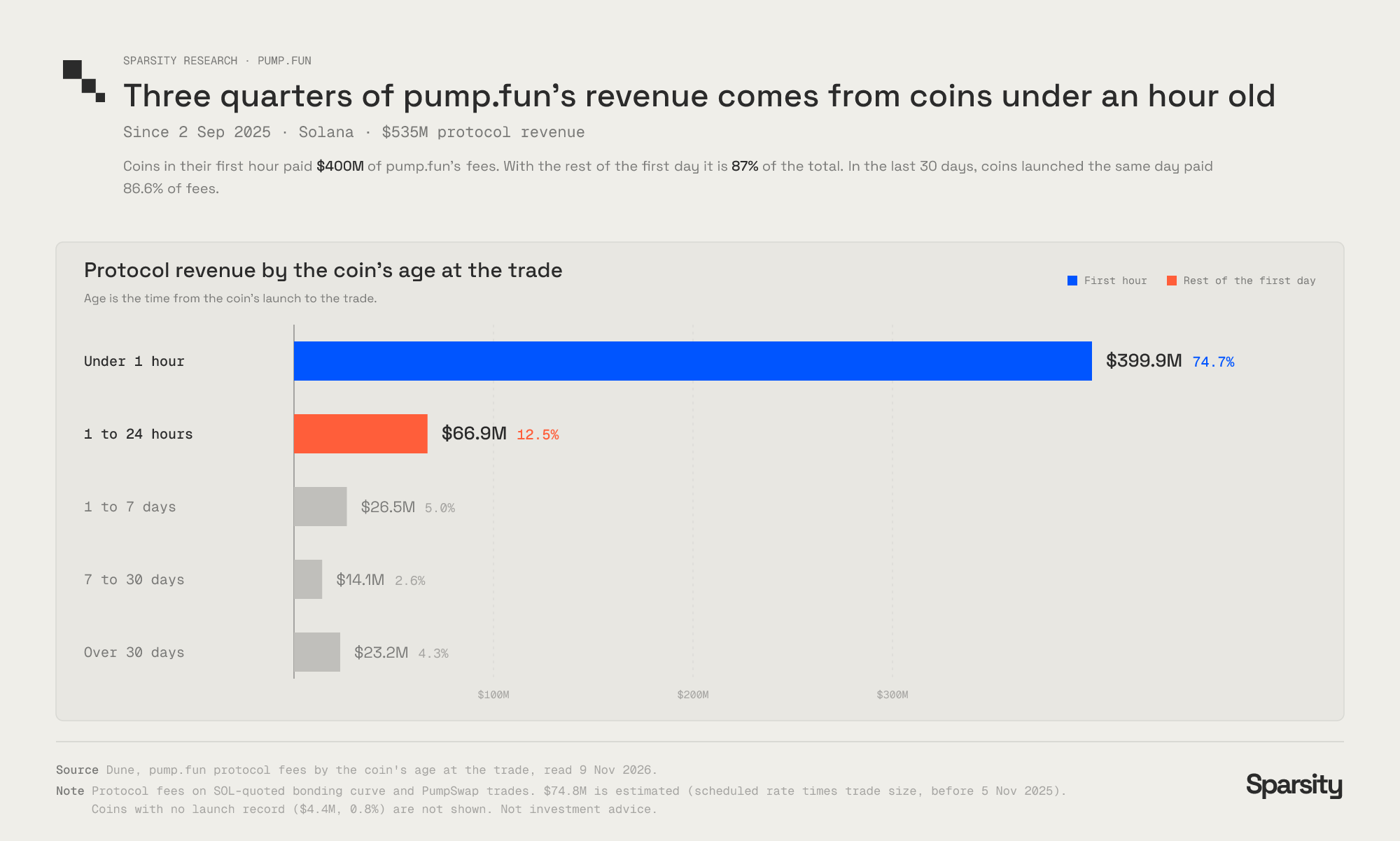
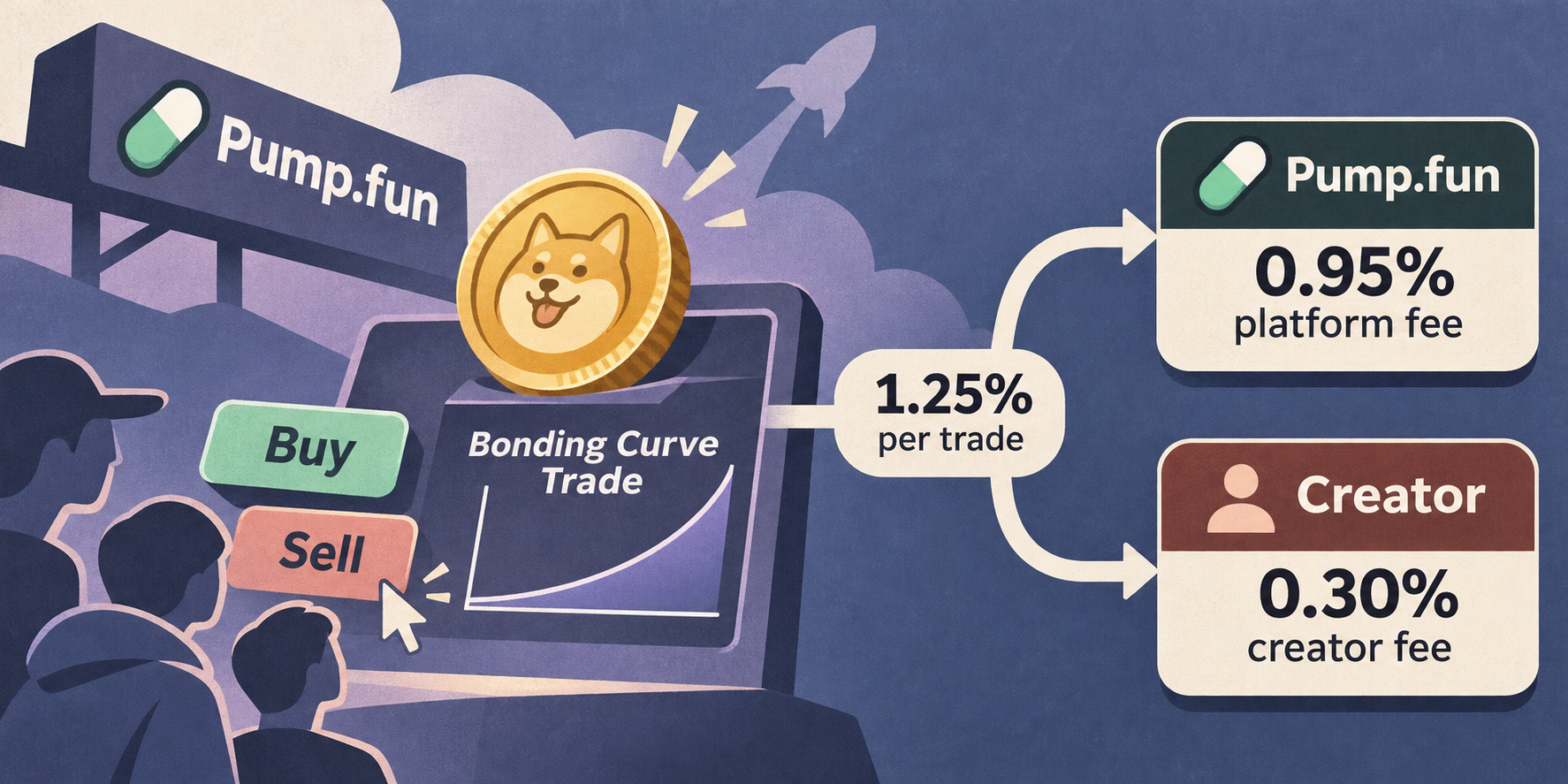
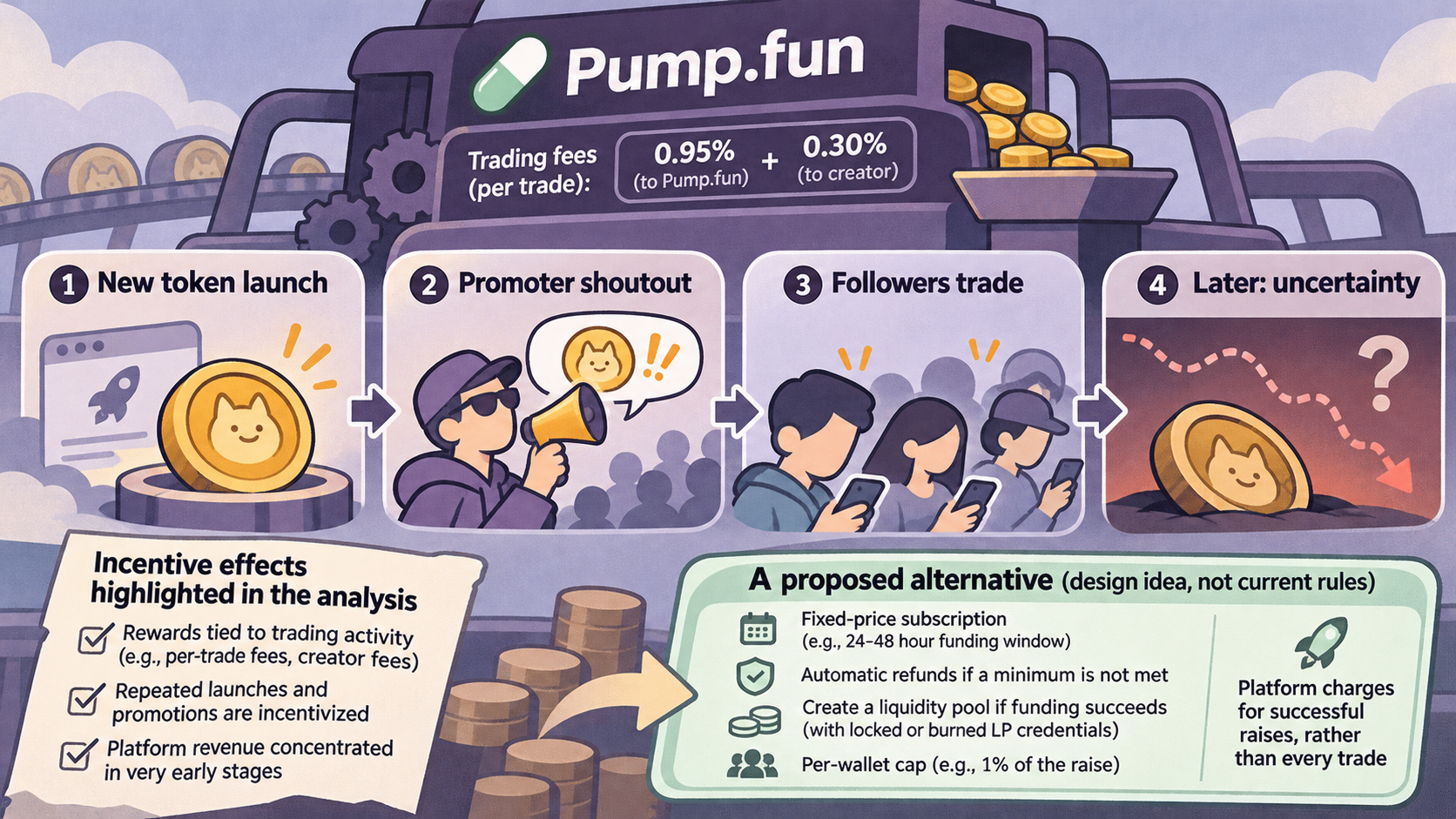
The analysis states that trades on the bonding curve incurred a 1.25% fee: 0.95% for Pump.fun and 0.30% for the creator. At those rates, buying and then selling would incur 2.5% in fees before any price movement. It also reports that nearly three-quarters of platform revenue came from tokens less than an hour old, and 87% from tokens less than a day old, in the period beginning September 2, 2025.
The contrast in the study is between early activity and eventual scale. Fifteen tokens with a combined peak market capitalization of $1.4 billion reportedly generated about $1.5 million in Pump.fun fees. Tokens on bonding curves or below $250,000 in market capitalization generated $506 million. These are reported aggregates, not evidence that any individual launch will follow the same path.
Incentives for creators and promoters
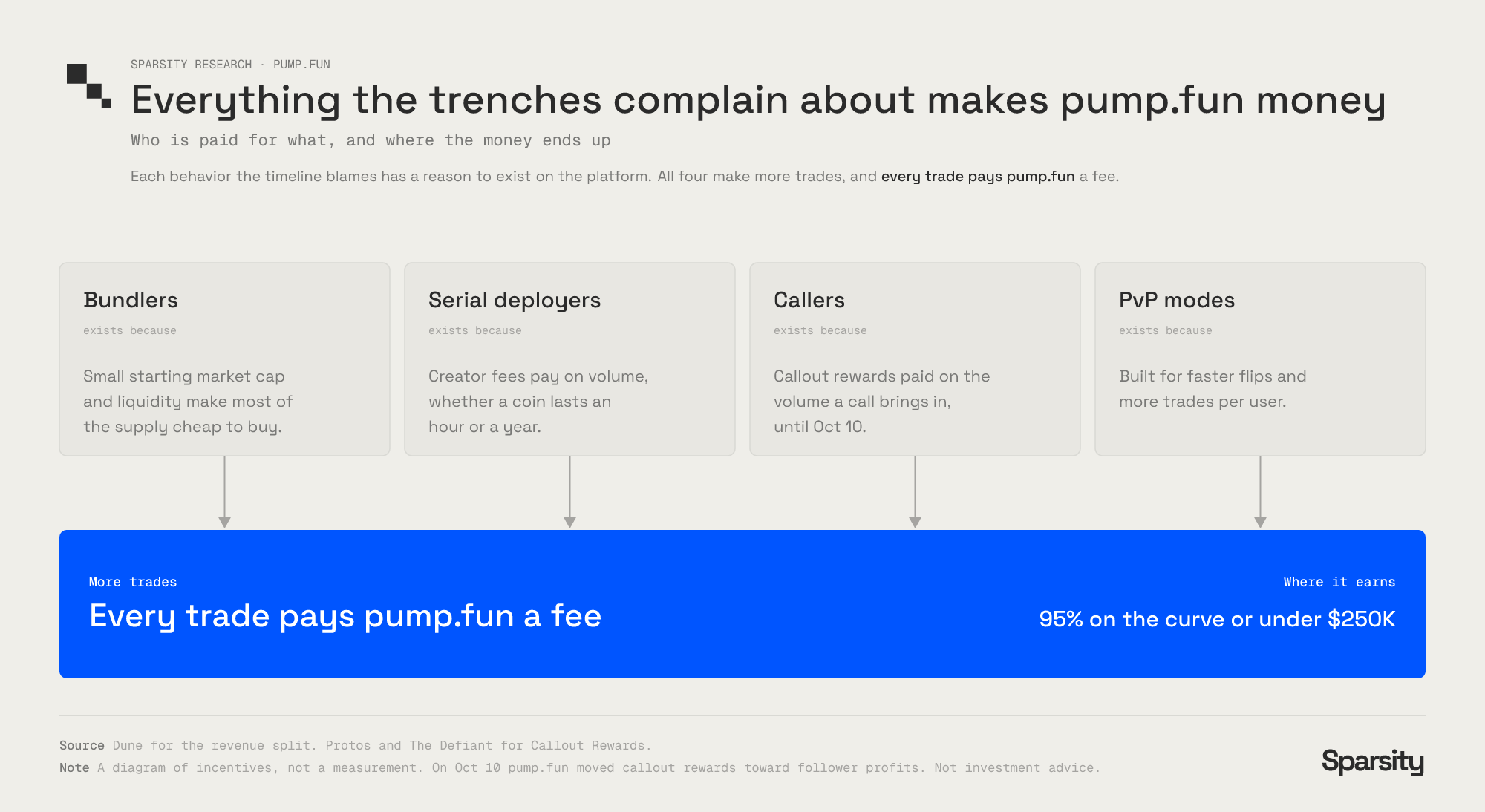
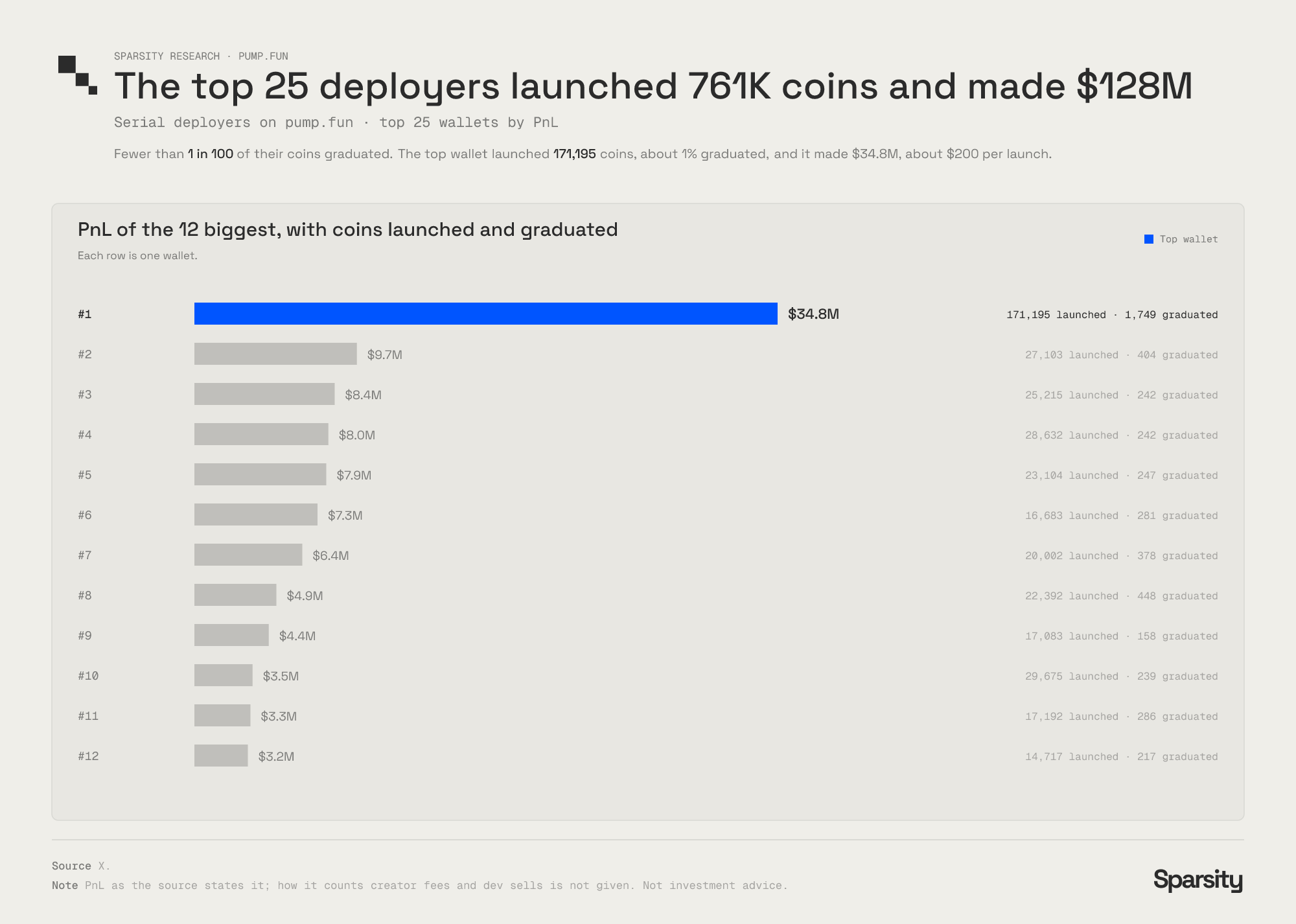
Sparsity links the creator’s per-trade fee to repeated launches. Its 25 highest-volume launching addresses reportedly issued 761,000 tokens, earned a combined $128 million and had a graduation rate below 1%. The leading wallet alone issued 171,195 tokens, with roughly $200 in average earnings per token. Those figures describe the addresses studied; they do not identify every operator or establish why each token was launched.
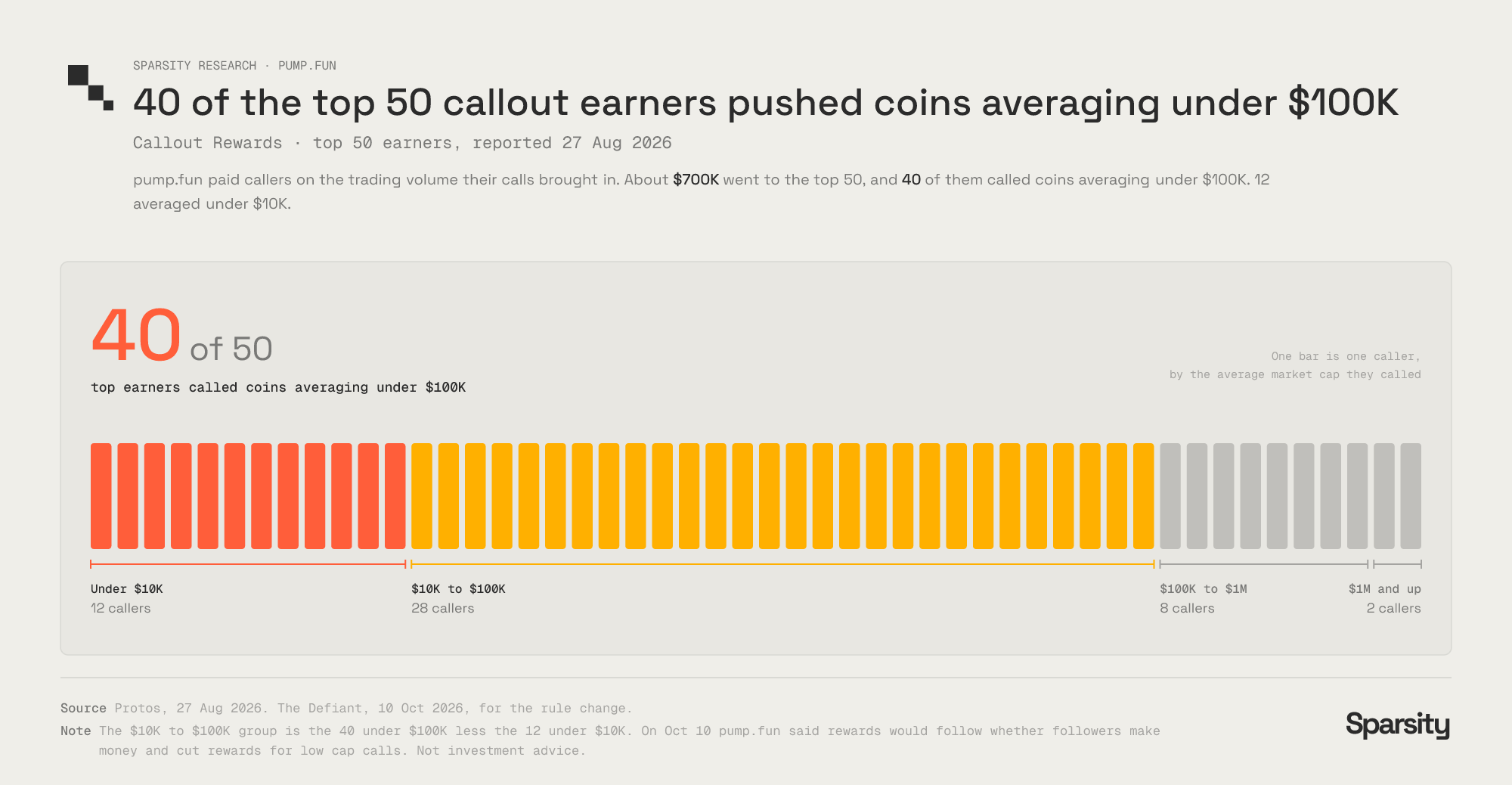
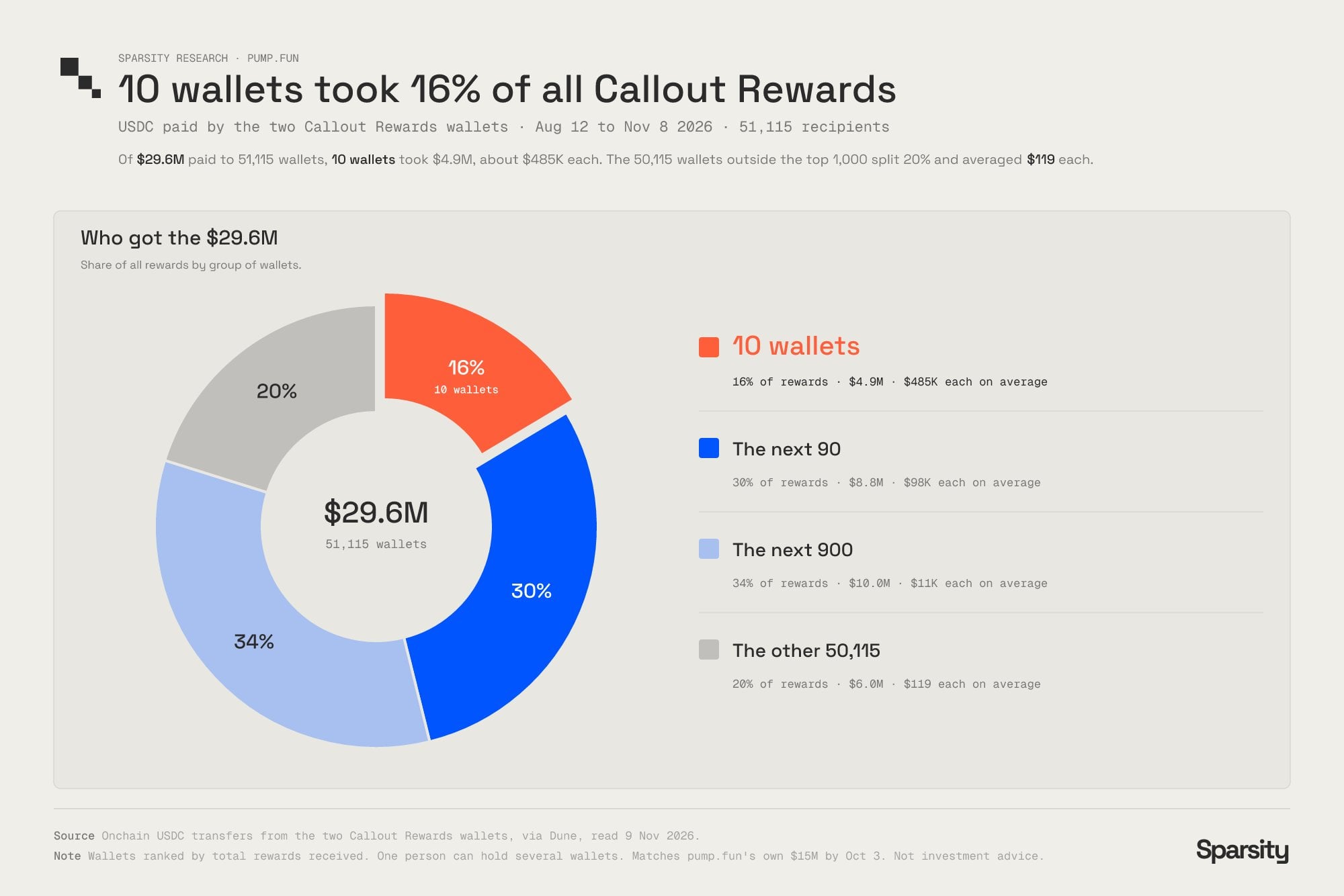
The analysis also examines payments to token promoters. For August 12 through November 8, 2026, it reports $29.6 million in rewards paid to 51,115 wallets, with ten wallets receiving 16% of the total. Among the 50 highest-earning promoters examined for August, 40 primarily promoted tokens whose average market capitalization was below $100,000; for 12, it was below $10,000.
Pump.fun said on October 10, 2026, that future incentives would be tied to followers’ gains and losses and would reduce the reward weight for small-cap promotions. Sparsity reports that, in the following three weeks, the share of rewards received by the top 20 promoters for tokens with a median market capitalization below $100,000 rose from 68% to 94%, while weekly rewards rose 53%. The source does not provide enough methodological detail here to isolate the effect of the announced change from other factors.
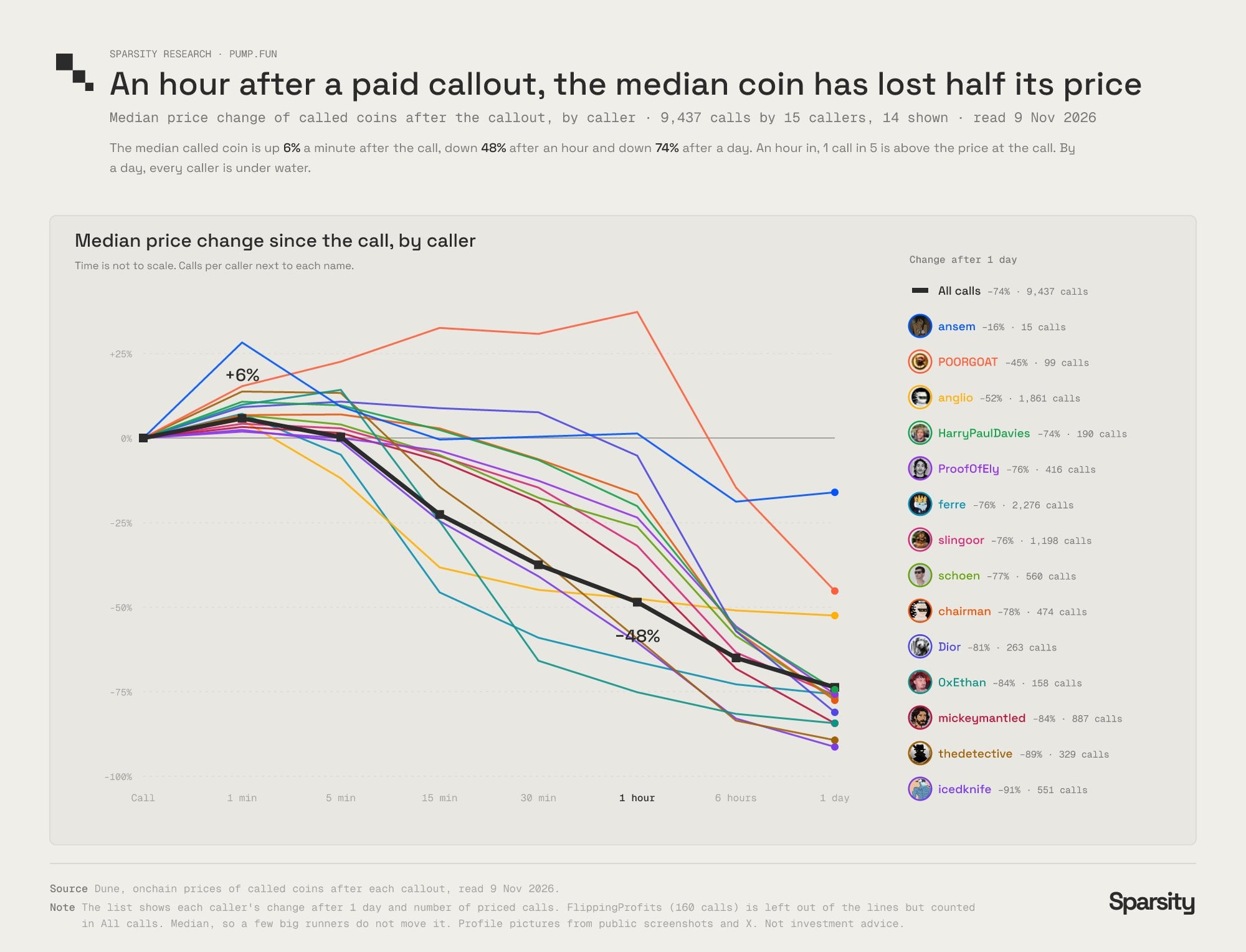
For a tracked group of 14 promoters, the analysis says ten primarily promoted tokens with a median market capitalization below $100,000; their followers collectively lost $926,000 by the next day. It reports a median token-price rise of 6% one minute after promotion, followed by declines of 48% after an hour and 74% after a day. One of the 14 promoters reportedly produced a roughly $10,000 gain for followers. The reported price path and follower results warrant attention, but the source does not establish that the sample represents all promotions.
Launch volume versus lasting tokens
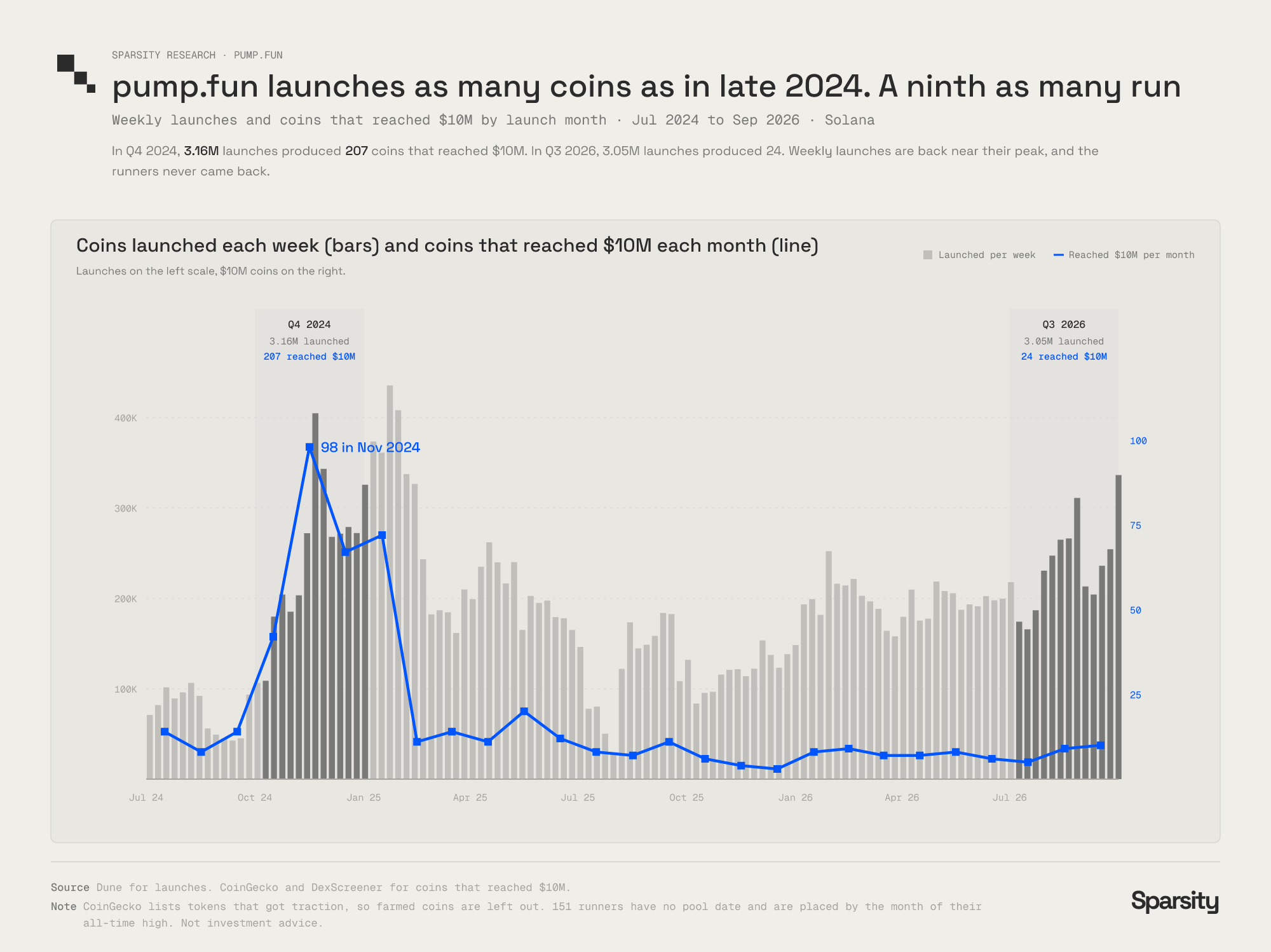
The study compares 3.16 million launches in the fourth quarter of 2024, which produced 207 tokens exceeding a $10 million market capitalization, with 3.05 million launches in the third quarter of 2026, which produced 24. It also reports that combined bonding-curve and PumpSwap monthly trading volume fell from $25–30 billion in the first quarter of 2026 to $13.8 billion in October, despite rising bonding-curve volume since June.
In a separate snapshot whose exact measurement day is not specified, the analysis counted 312 tokens still above a $100,000 market capitalization out of 24.4 million cumulative Pump.fun launches—about 0.0013%, or one per 78,000 launches. That is a snapshot of tokens meeting a stated threshold, not a measured probability that a newly launched token will succeed.
The proposed alternative—and its limits
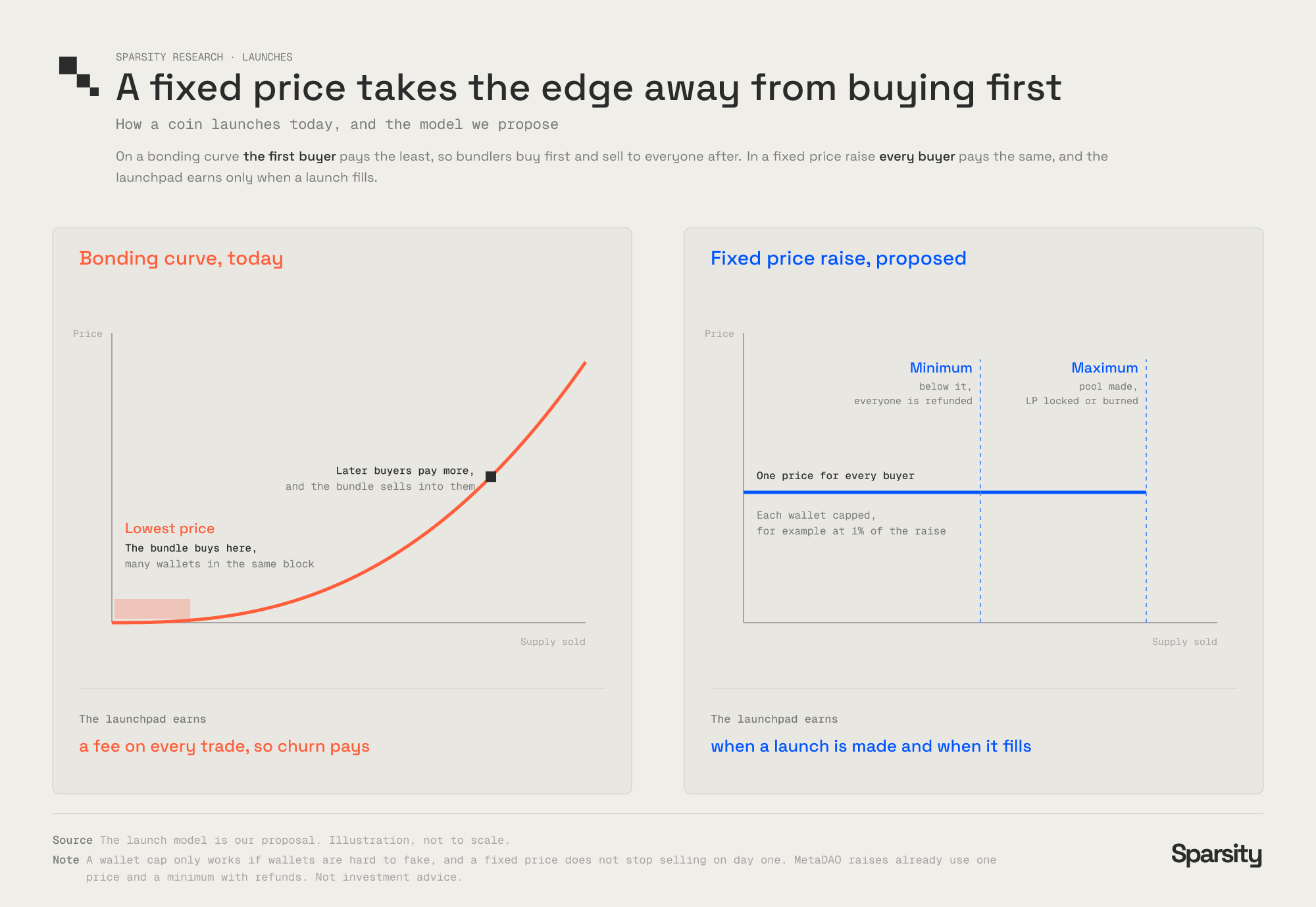
Sparsity presents reforms as design ideas, not implemented Pump.fun rules. They include deeper initial liquidity, creator fees that unlock over time, and promoter rewards dependent on whether followers remain invested and profitable days later. A more substantial proposal would replace the bonding curve with a fixed-price subscription: a 24- or 48-hour funding window, automatic refunds if a minimum is missed, a liquidity pool created if funding succeeds, locked or burned liquidity-provider credentials, and a per-wallet cap such as 1% of the raise. The platform would charge for successful raises rather than every trade.
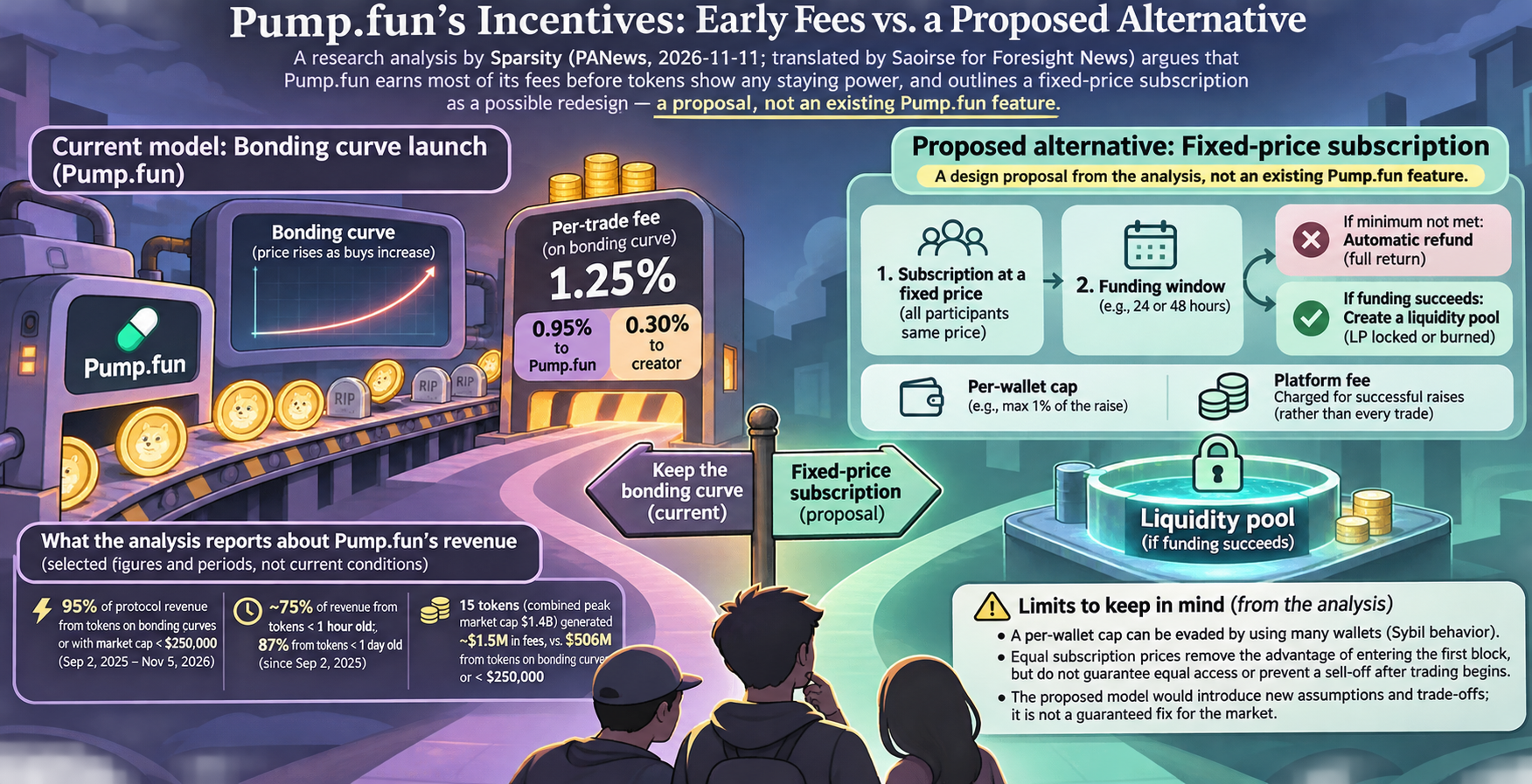
Equal subscription prices could remove a pricing advantage for entering the first launch block, but they would not guarantee equal access or prevent a sell-off after trading begins. The analysis itself notes that someone controlling many wallets could evade a per-wallet cap. The defensible conclusion is narrower than a promise that a new model would repair the market: the reported fee and launch data identify incentives to investigate, while the proposed replacements would introduce assumptions of their own.
Source: panewslab.com (originally published 2026-11-11 18:43 UTC+8)