As reported on April 27, 2026, two security incidents had sharpened a question for DeFi lenders: does a 4%–6% annualized stablecoin deposit yield compensate them for the ways they can lose money? In his analysis, Tom Dunleavy applies a corporate-bond pricing framework to that question. The framework is useful for separating risks, but its resulting yield is an estimate—not a market-validated price.
What the April incidents show
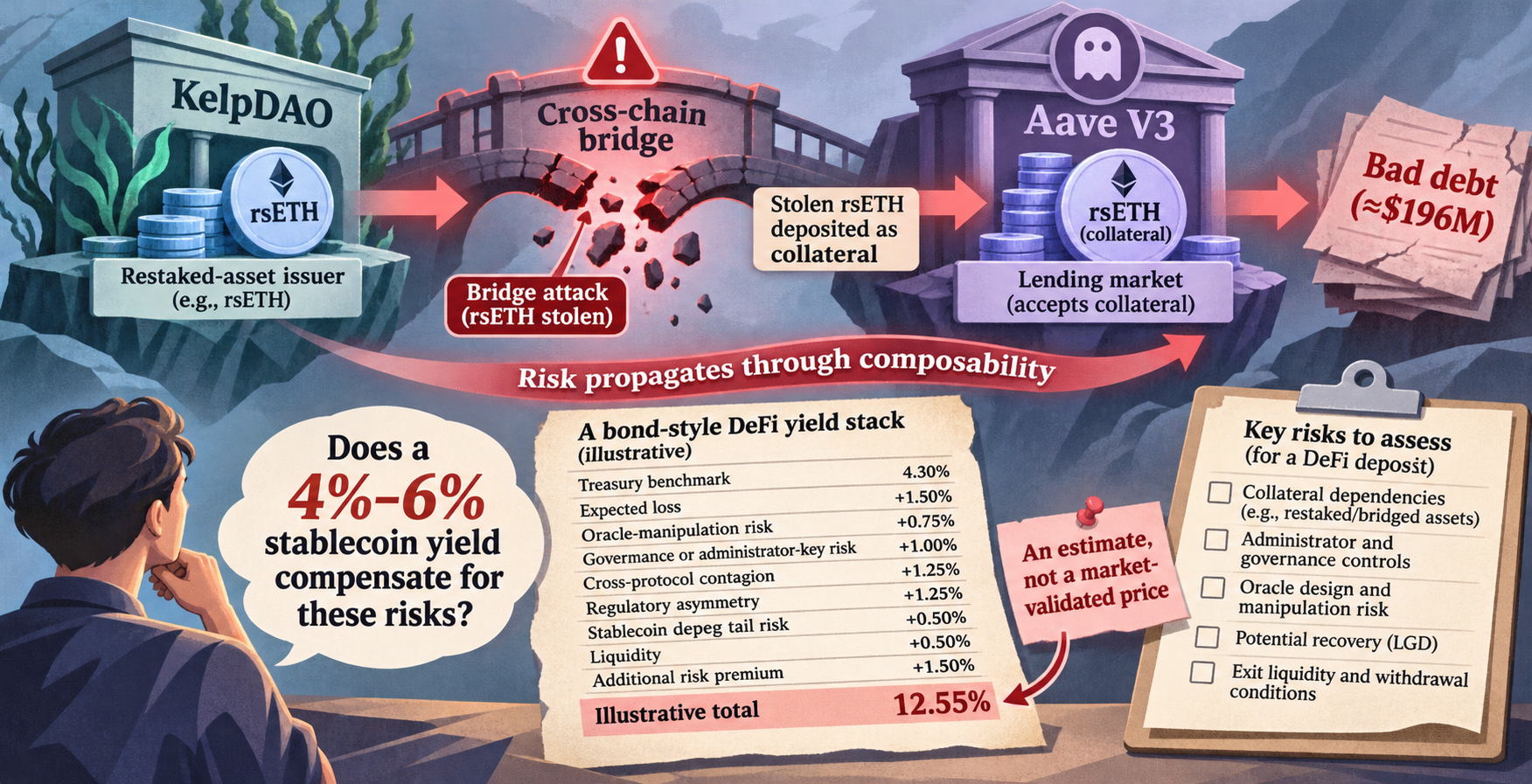
Dunleavy reports that Drift Protocol lost $285 million on April 1 after attackers used social engineering to compromise an administrator’s private key. He says the operation had been planned since at least autumn 2025. On April 18, KelpDAO suffered a $292 million cross-chain bridge attack. According to the analysis, stolen rsETH was subsequently deposited into Aave V3 as collateral, leaving Aave with approximately $196 million in bad debt. Aave’s total value locked fell from $26.4 billion to $17.9 billion over three days.
The two reported thefts total $577 million. The analysis also says DeFi-wide total value locked fell by $13 billion within 48 hours. Neither TVL decline is itself a measure of funds stolen: TVL can change when users withdraw or asset values move. Dunleavy reports that Aave’s USDC market utilization reached 99.87% for four consecutive days and its deposit rate rose to 12.4%. Circle chief economist Gordon Liao proposed quadrupling a borrowing cap to ease withdrawal pressure; the source does not say that change was enacted.
The incidents should not be treated as identical. The account of Drift centers on a compromised administrator key, whereas the KelpDAO account describes losses propagating through an asset accepted as collateral by another protocol. Both matter to a lender, but they call for different security assessments.
Translating the bond framework
Dunleavy starts with a conventional pricing decomposition:
Required yield = risk-free rate + expected loss + risk premium + liquidity premium, where expected loss = probability of default × loss given default.
As reference points, the analysis cites Moody’s long-run speculative-grade default rate of 4.5% and an approximately 40% historical recovery rate for senior unsecured high-yield bonds. Together, those inputs imply a 2.7% annual expected loss. It also cites KBRA’s 3.0% forecast for 2026 direct-lending defaults and approximately 48% average recovery among 2023–2024 default cases. These are comparisons, not observed default rates for DeFi deposits.
For DeFi, the relevant loss paths differ. A smart-contract exploit can remove assets directly. Oracle manipulation or a governance attack can leave a lending market with impaired collateral or drain a treasury; the analysis cites Beanstalk’s $182 million governance-attack loss in 2022. Composability adds a further dependency: a lending protocol may remain operational while a bridged or restaked asset it accepts as collateral fails upstream. The reported rsETH-to-Aave exposure illustrates that mechanism, rather than an exploit of Aave’s own contracts.
How much does the evidence establish?
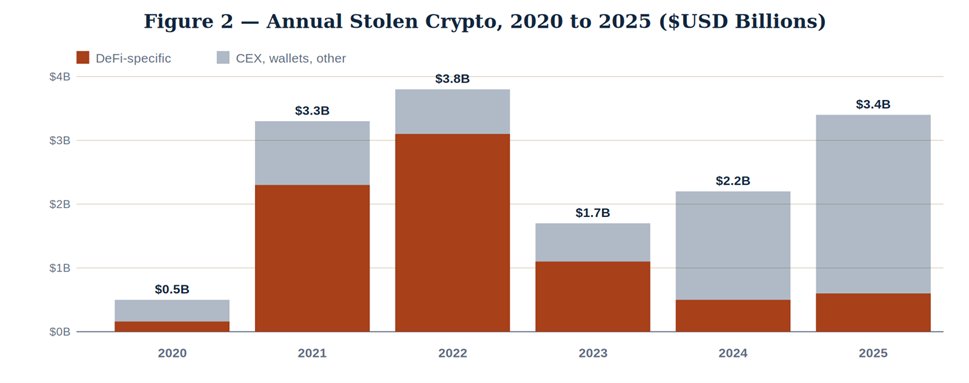
Dunleavy cites a Chainalysis report from mid-December 2025 that described DeFi TVL rising from $40 billion in early 2024 to a peak of $175 billion by October 2025, while DeFi-specific hack losses remained near their lower 2023 range. The analysis states that $3.4 billion in cryptoassets was stolen across 2025, with substantial losses concentrated in centralized-exchange and personal-wallet thefts. That broader total is not a DeFi-lending loss figure.
Using its own approximate annual TVL denominators, the analysis estimates DeFi-specific losses of $500 million against $75 billion of average TVL in 2024, or 0.67%, and $600 million against $120 billion in 2025, or 0.50%. For 2026, it suggests a conditional annualized loss rate of 2.0%–2.5% if the pace represented by the two April incidents persists, using $95 billion as average TVL. This is a scenario, not an observed full-year rate. Nor does dividing sector-wide losses by TVL establish the default probability of a particular USDC lending position.
The analysis then assumes a 1.5%–2.0% forward annual default probability for leading DeFi lenders and a 90% loss given default, yielding 1.35%–1.80% in expected annual loss. Those are model assumptions informed by the author’s loss discussion, not measured probabilities for Aave or Compound depositors.

The proposed 12.55% yield—and its limits
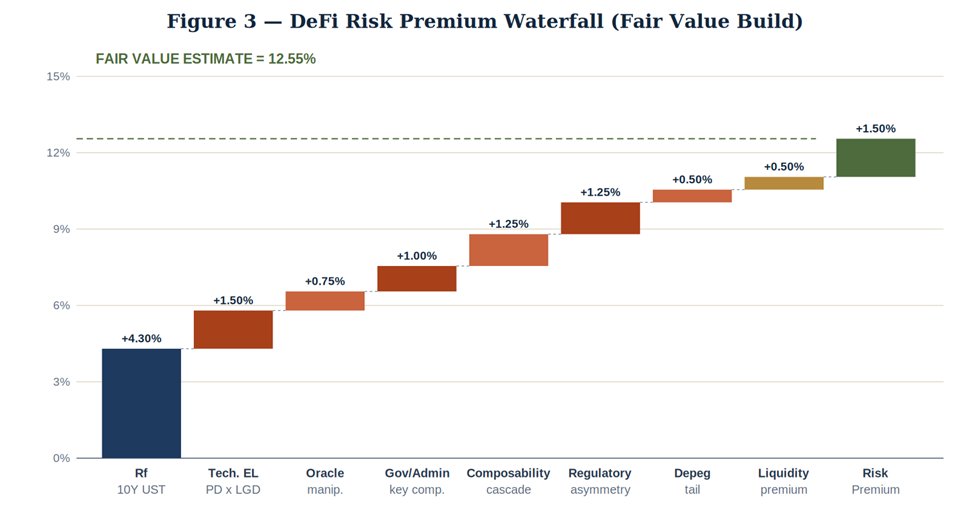
For an overcollateralized, Ethereum-mainnet USDC lending position at a leading protocol, Dunleavy builds the following illustrative yield stack from an approximately 4.30% ten-year US Treasury benchmark:
| Model component | Added yield |
|---|---|
| Treasury benchmark | 4.30% |
| Expected loss | 1.50% |
| Oracle-manipulation risk | 0.75% |
| Governance or administrator-key risk | 1.00% |
| Cross-protocol contagion | 1.25% |
| Regulatory asymmetry | 1.25% |
| Stablecoin depeg tail risk | 0.50% |
| Liquidity | 0.50% |
| Additional risk premium | 1.50% |
| Illustrative total | 12.55% |
The arithmetic supports the stated total, but the source does not supply independent measurements for the individual premiums. Their sum should therefore be read as the author’s required-return scenario, not a demonstrated fair yield. A ten-year Treasury yield also introduces a duration comparison that a withdrawable DeFi deposit does not necessarily match.
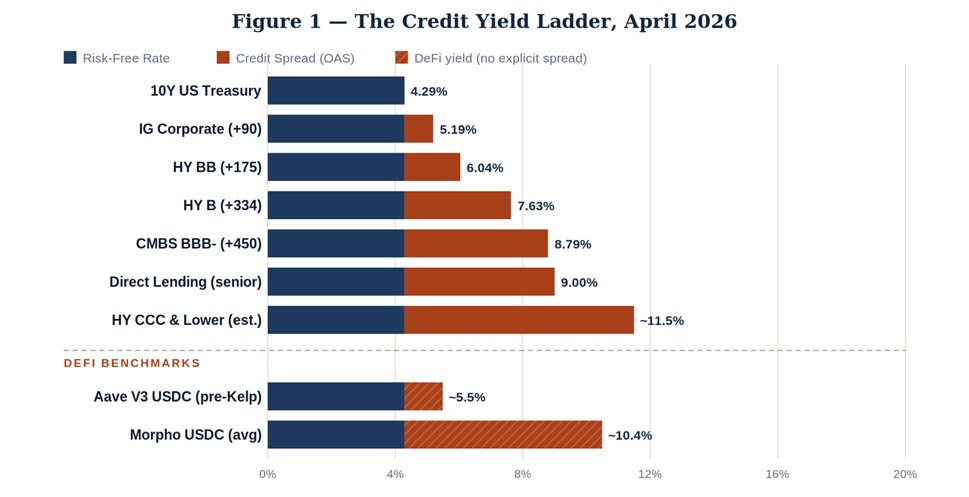
Before the KelpDAO incident, the analysis places Aave’s USDC deposit rate near 5.5% and a curated, actively managed Morpho vault yield near 10.4%; it later describes Morpho-style vault rates as 9%–12%. Those rates do not, on their own, establish that the positions have the same underlying risks. Vault selection, collateral, management and withdrawal conditions would need to be assessed separately.
The defensible conclusion is narrower than a universal 13% minimum: a posted deposit rate omits the assumptions a lender needs to evaluate—collateral dependencies, administrator controls, oracle design, potential recovery and exit liquidity. The April incidents demonstrate why those exposures belong in the analysis. They do not establish one required yield for every DeFi money market.