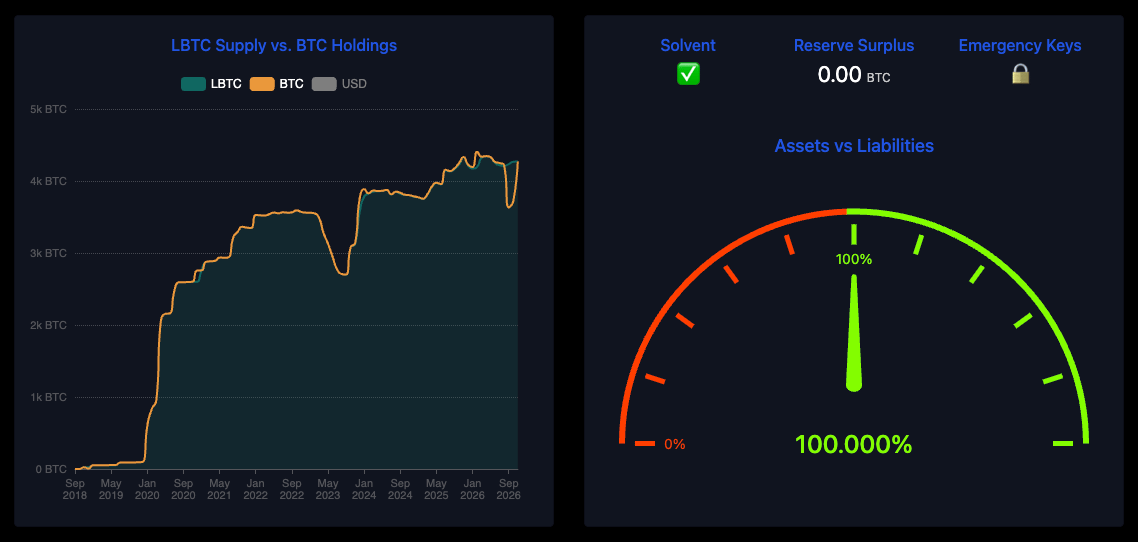
As reported on November 3, 2026, the Liquid Federation said its bitcoin reserves had returned to 1:1 backing for all LBTC. The announcement followed a September 6 exploit in which approximately 4,000 BTC, worth about $320 million at the time, was withdrawn from the sidechain’s Federation wallet. Full reserve backing is the Federation’s stated status; it does not, by itself, establish that every withdrawal restriction has ended.
How the reserve gap closed
The attacker returned roughly 3,400 BTC on September 7 after Blockstream patched the affected bridge nodes, but retained about 600 BTC. Federation board member Samson Mow reported a 50 BTC deposit to the Federation wallet on October 28, leaving 550 BTC outstanding. He then reported deposits of 300 BTC and 250 BTC on November 2. Mow identified Blockstream as the source of the bitcoin used to close the gap.
Reserve balances are published at liquid.network, and Liquid node operators can verify the backing themselves. The Federation’s November 3 announcement did not say whether all remaining restrictions on direct Federation peg-outs had been lifted. BTC–LBTC swaps through participating providers had resumed weeks earlier, and some semi-automated peg-outs had since resumed.
What the incident report attributes the exploit to
Liquid’s September incident report traced the exploit to a bug involving cached range-proof verifications in Elements, the software underlying Liquid. According to that report, the attacker created approximately 4,000 unbacked LBTC and used them to withdraw bitcoin through SideSwap, a Liquid wallet and trading platform that holds a Federation peg-out authorization key. Liquid said network operators were not hacked and no keys were compromised.
Elements v23.3.4 was released on September 9 to address the vulnerability. Liquid resumed block production that day and user transactions on September 10, while Federation peg-outs remained disabled at that stage.
The Federation said on November 3 that it was preparing governance and oversight changes alongside further technical and operational safeguards. It had not yet provided the details, so their scope and effect could not be assessed from that update.