Originally reported on November 11, 2026, at 10:31 a.m. UTC+8. This article examines a proposal by independent researcher hitesh.eth, translated and published by Deep Tide TechFlow. The proposed system is not presented as a deployed protocol.
A liquid market can price a token without establishing whether anyone will deliver the service behind it. That distinction drives hitesh.eth’s proposal for “human commitment markets”: communities in which participants agree on useful work, fund payment before it begins, specify evidence of completion and set the consequences of nonperformance.
The research question is institutional as much as technical. Who can change the rules, seize funds, observe participants, block access or prevent exit? A permissionless token does not answer those questions, and neither does an immutable contract if the rules it enforces are unfair.
From cypherpunk ideas to bounded commitments
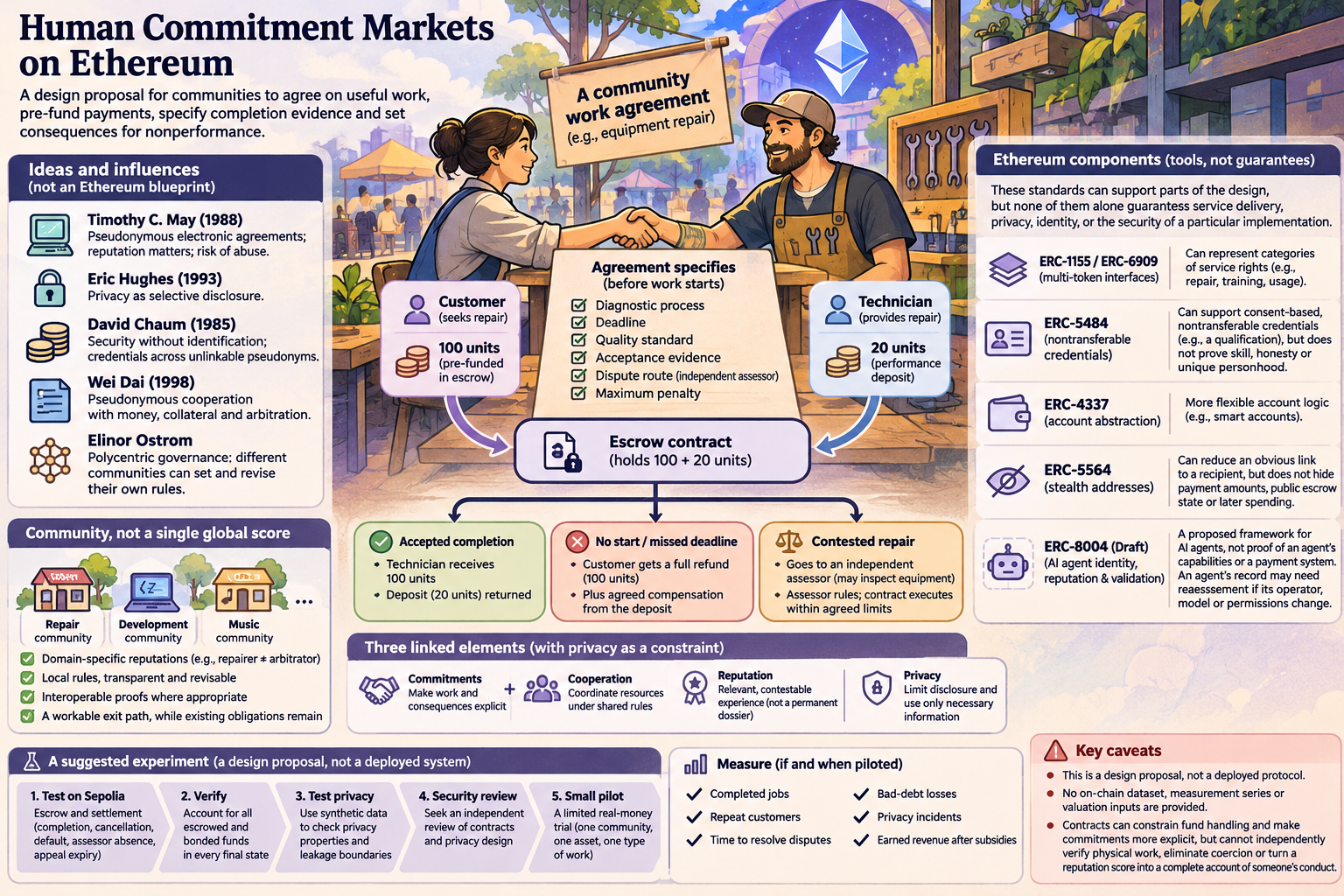
The proposal draws on several earlier strands of thought without treating them as an existing Ethereum blueprint. Timothy C. May’s 1988 Crypto Anarchist Manifesto anticipated pseudonymous electronic agreements while recognizing the importance of reputation and the potential for abuse. Eric Hughes’s 1993 A Cypherpunk’s Manifesto framed privacy as the ability to disclose selectively. David Chaum’s work on security without identification warned that computerized transaction records could enable surveillance and explored credentials across unlinkable pseudonyms. Wei Dai’s 1998 b-money proposal connected pseudonymous cooperation to money, collateral and arbitration.
Hitesh.eth also applies Elinor Ostrom’s work on polycentric governance to this setting. Ostrom was not proposing Ethereum infrastructure: the inference here is that different communities could set and revise rules for their own work rather than rely on one global reputation score. Evidence that someone is a capable repairer, for example, need not establish that they should arbitrate a financial dispute.
The resulting design has three linked elements—commitments, cooperation and reputation—with privacy as a constraint on all three. Reputation should describe relevant, contestable experience, not become a permanent public dossier. Participants also need a workable exit path, although leaving a community would not erase obligations they have already accepted.
What an agreement would have to specify
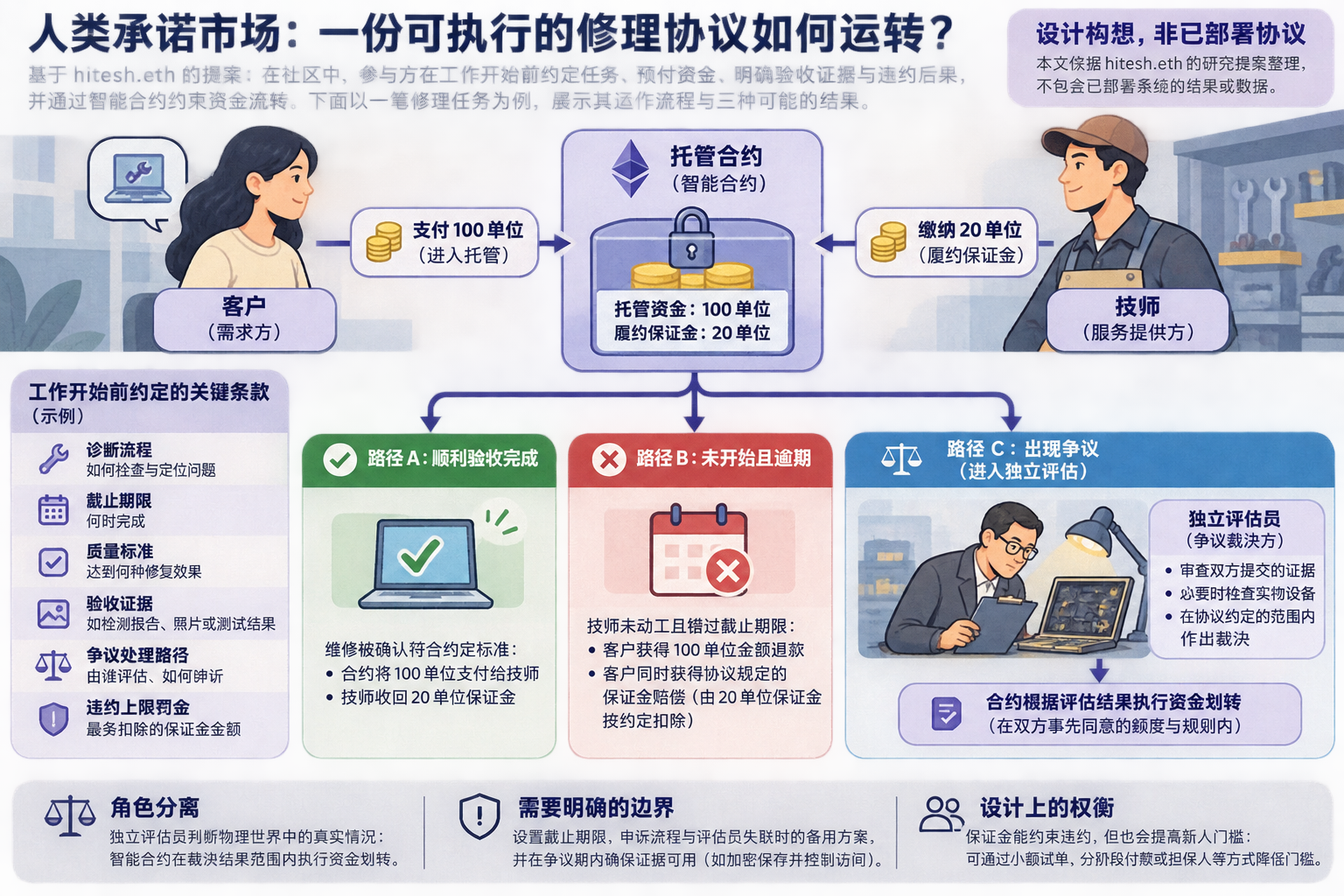
Consider the proposal’s illustrative repair job. A customer places 100 units of payment in escrow, and a technician posts a 20-unit performance deposit. Before work starts, they agree on the diagnostic process, deadline, quality standard, acceptance evidence, dispute route and maximum penalty. These amounts are examples, not observed transactions or recommended parameters; a real deployment would also have to choose a settlement asset and account for its volatility or issuer control.
On accepted completion, the technician receives the 100-unit payment and recovers the deposit. If the technician never starts and misses the deadline, the customer receives a full refund plus whatever deposit-funded compensation the agreement specified. A contested repair instead goes to an agreed independent assessor, who may need to inspect the physical equipment. The assessor judges evidence from the world outside the chain; the contract executes a ruling within the parties’ agreed limits. Neither role substitutes for the other.
That division creates design obligations. The agreement needs deadlines, an appeal process and a fallback if an assessor disappears, so funds cannot remain locked indefinitely. Evidence must remain available to the necessary parties during the dispute period. An unsalted hash of predictable personal information can itself leak information, while a hash alone cannot establish what happened to a piece of equipment.
Deposits also impose a cost on newcomers. Hitesh.eth suggests smaller initial jobs, limited exposure, staged payments or guarantors rather than assuming that everyone can afford the same bond. Conversely, a series of tiny successful trades should not automatically qualify an account to control much larger sums: counterparties could manufacture activity, and an established operator could still default later.
What Ethereum components do—and do not—provide
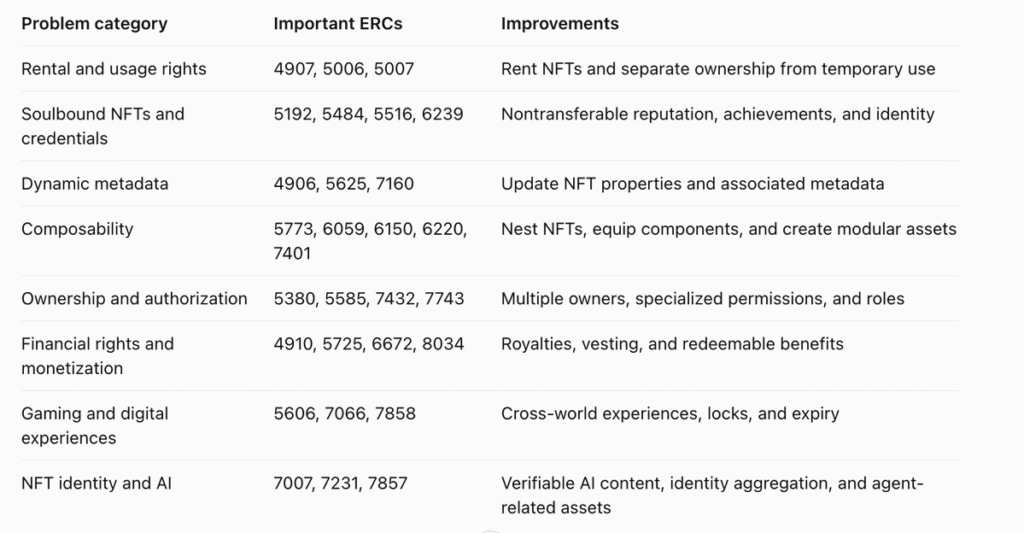
The original article says it checked official standards pages on November 10, 2026. At that check, the Ethereum standards discussed for this design—including ERC-1155, ERC-6909, ERC-5484, ERC-4337 and ERC-5564—were marked Final. That status describes a specification, not the security of a particular implementation.
ERC-1155 and ERC-6909 offer different multi-token interfaces that could represent categories of service rights. Neither establishes that a provider has capacity to fulfill them: selling more training sessions than available places would remain an overcommitment even with flawless token code. ERC-5484 can support nontransferable, consent-based credentials, but nontransferability does not prove skill, honesty or unique personhood. ERC-4337 concerns account abstraction; ERC-5564 concerns stealth addresses, which can reduce an obvious link to a recipient but do not conceal payment amounts, public escrow state or later spending.
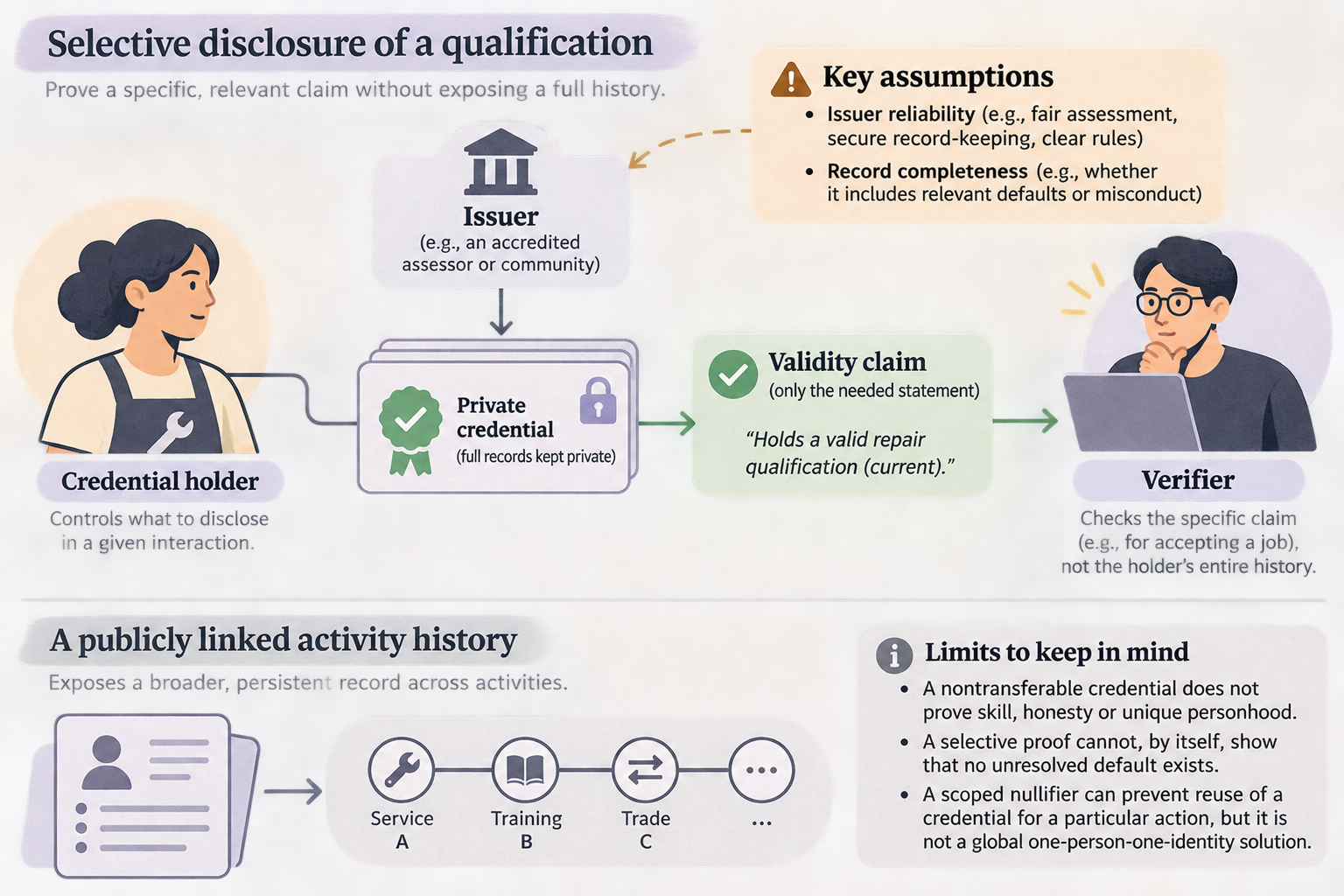
Private credentials would therefore require a separate architecture. A participant might prove a specific qualification without exposing their complete history, but the claim is only as reliable as its underlying records, issuer rules and completeness checks. A proof built from selected favorable reviews cannot establish that no unresolved default exists. A scoped nullifier can prevent reuse of one credential for a particular action; it cannot, by itself, establish one-person-one-identity globally. Cheaper rollup transactions likewise do not automatically make transactions private.
The source also discusses AI agents as possible future participants. ERC-8004 was marked Draft at the original check; its proposed identity, reputation and validation registries are not proof of an agent’s capabilities or a payment system. An agent’s historical record would need reassessment if its operator, model or permissions changed.
An experiment, not a measured result
Hitesh.eth recommends starting with one community, one settlement asset, one type of work and a transparent dispute process—without a speculative governance token. The suggested sequence begins with escrow and settlement tests on Sepolia, including completion, cancellation, default, assessor absence and appeal expiry. Developers would then test that every final state accounts for all escrowed and bonded funds, use synthetic data for privacy testing, and seek an independent security review before a small real-money pilot.
The proposed measures of success are completed jobs, repeat customers, time to resolve disputes, bad-debt losses, privacy incidents and earned revenue after subsidies. The article supplies no deployed-system results, on-chain dataset, measurement series or valuation inputs for those metrics. Its central claim is a design argument: contracts can constrain the handling of funds and make commitments more explicit, but they cannot independently verify physical work, eliminate coercion or turn a reputation score into a complete account of someone’s conduct.
Source: techflowpost.com (originally published 2026-11-11 10:31 UTC+8)