Originally reported November 12, 2026, at 09:20 UTC+8. This is a historical reading of Glassnode’s data, not a current market update.
Bitcoin was trading near $74,000 in Glassnode’s November 2026 report, below the $75,600 short-term holder cost basis. The central tension in the data was that measures of available capital and U.S. demand had weakened, while some derivatives and wallet indicators suggested selling pressure might be becoming less uniform.
Recent buyers face an overhead supply test
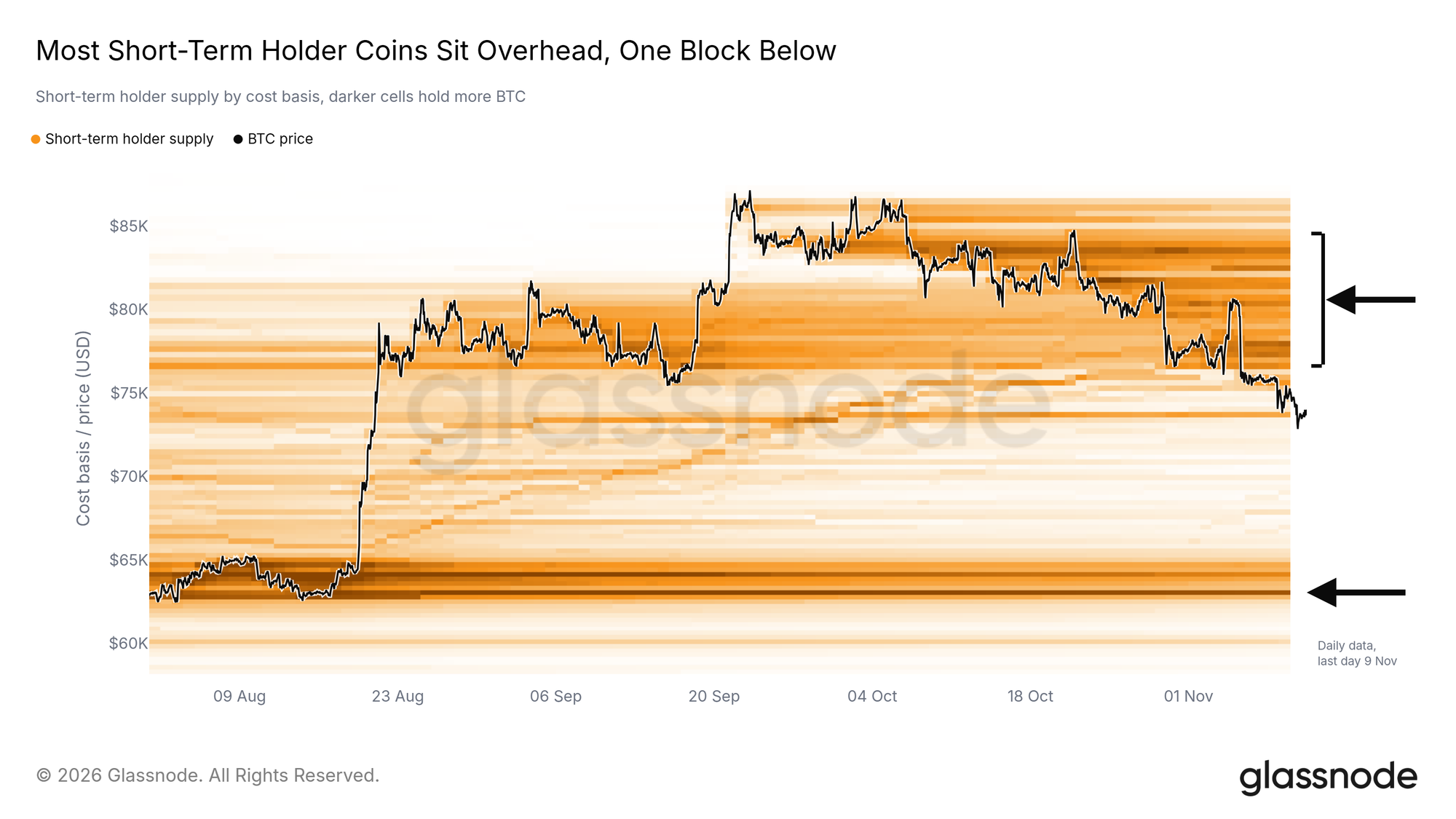
The short-term holder cost basis represents the average acquisition price of coins bought within the preceding 155 days. Glassnode estimated that the share of short-term holder supply in profit had fallen from nearly all of it at September’s peak to roughly 35%. About two-thirds of that cohort’s coins had a cost basis above the prevailing price, concentrated in three bands acquired from August through October and extending to $83,600. Holders seeking to exit at breakeven could therefore add selling pressure to a rebound. The principal dense cost-basis area below price was $62,000–$66,000.
Glassnode identified $77,500 as the “True Market Mean,” a level whose recovery would put about half of short-term holder supply back in profit. Its broader trend test was different: September marked the first higher high since Bitcoin’s 2025 all-time high, and the structure established from August would remain intact while price stayed above June’s $58,500 low, according to the report.
Capital and U.S. demand indicators weaken
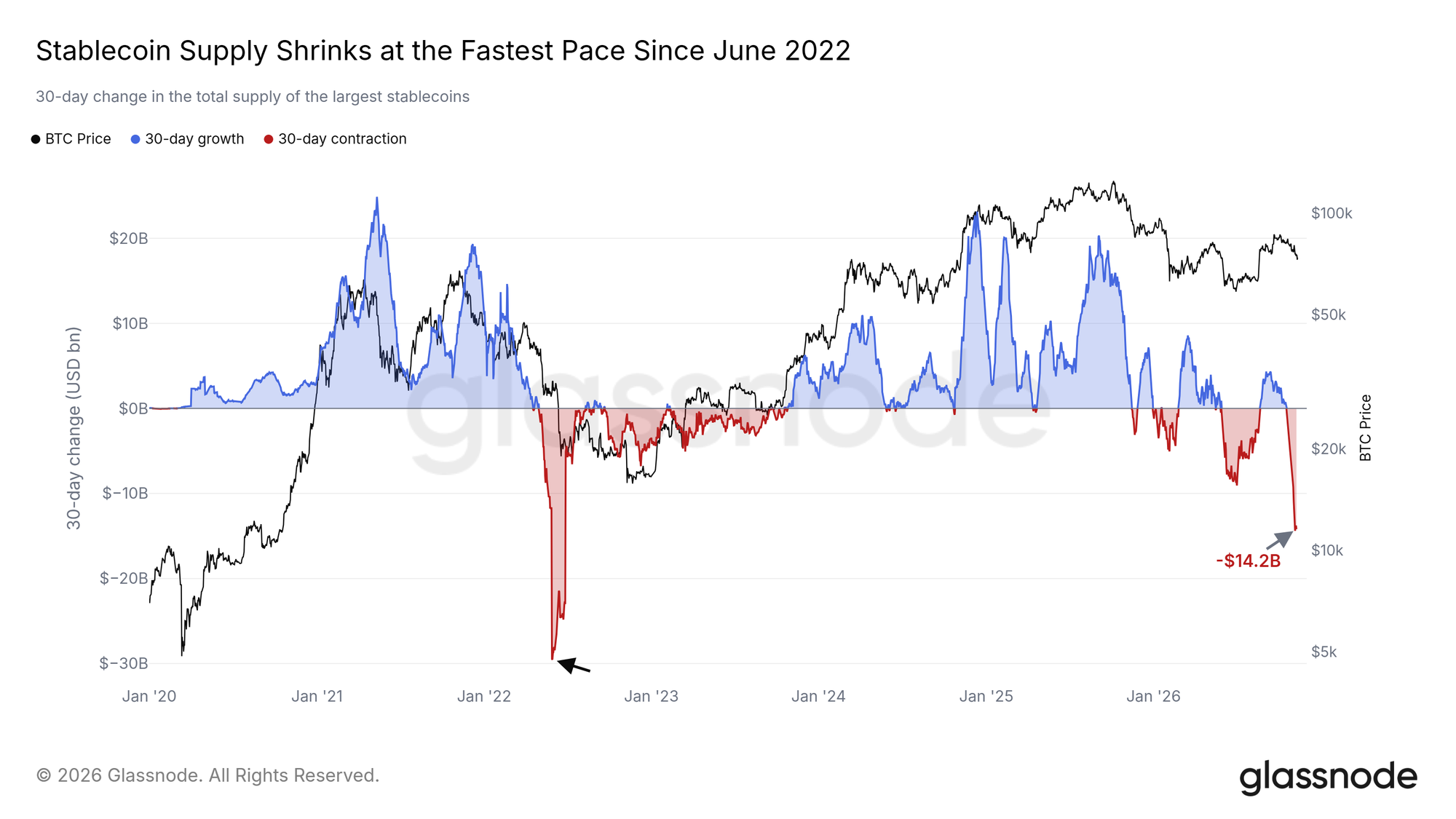
Glassnode reported a $14.2 billion decline in total stablecoin supply over 30 days—the fastest contraction since June 2022. It treated that change as evidence of capital leaving the crypto ecosystem, though supply alone does not establish what every holder did with the proceeds. Tether was also trading slightly below its $1 peg.
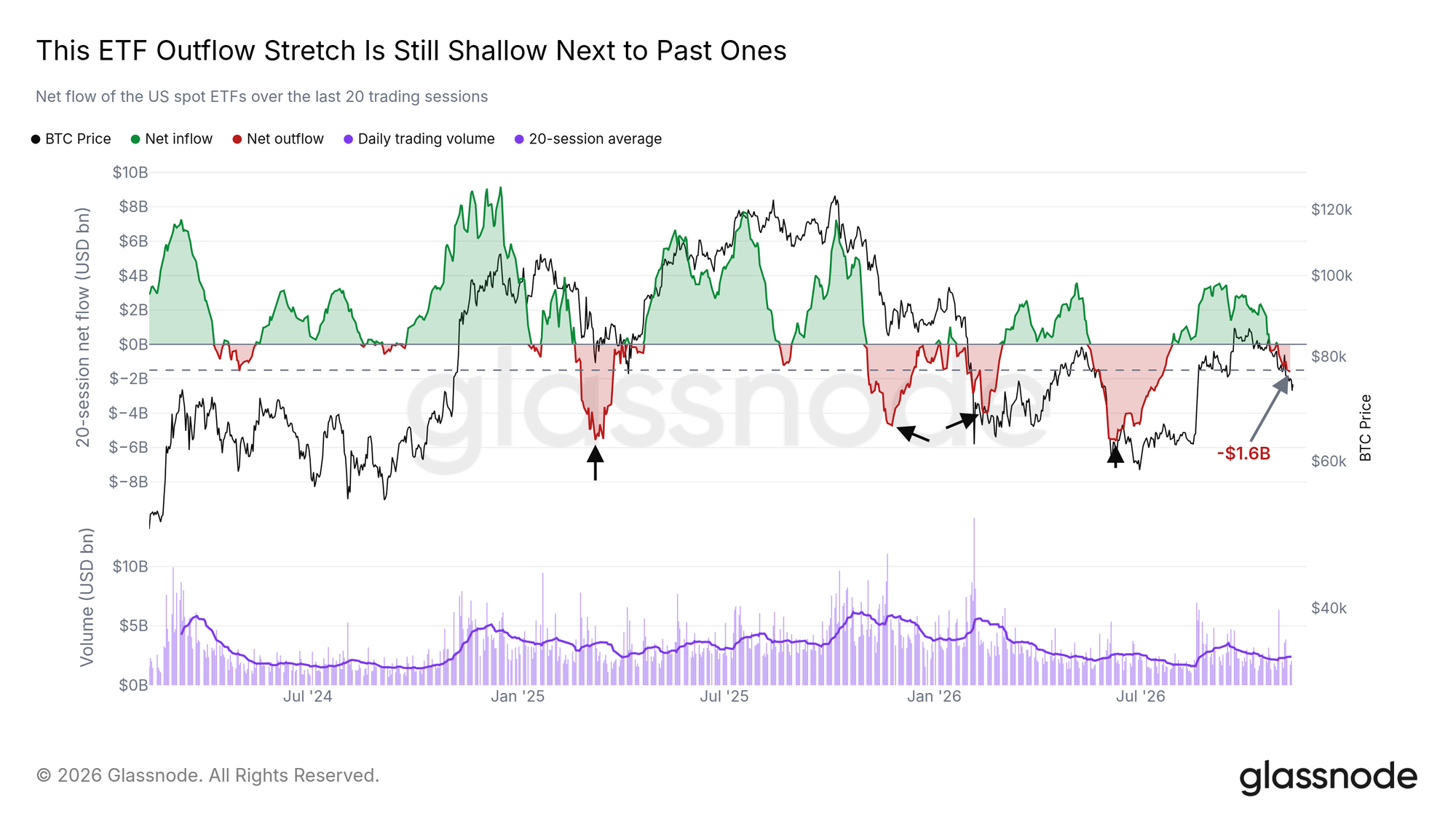
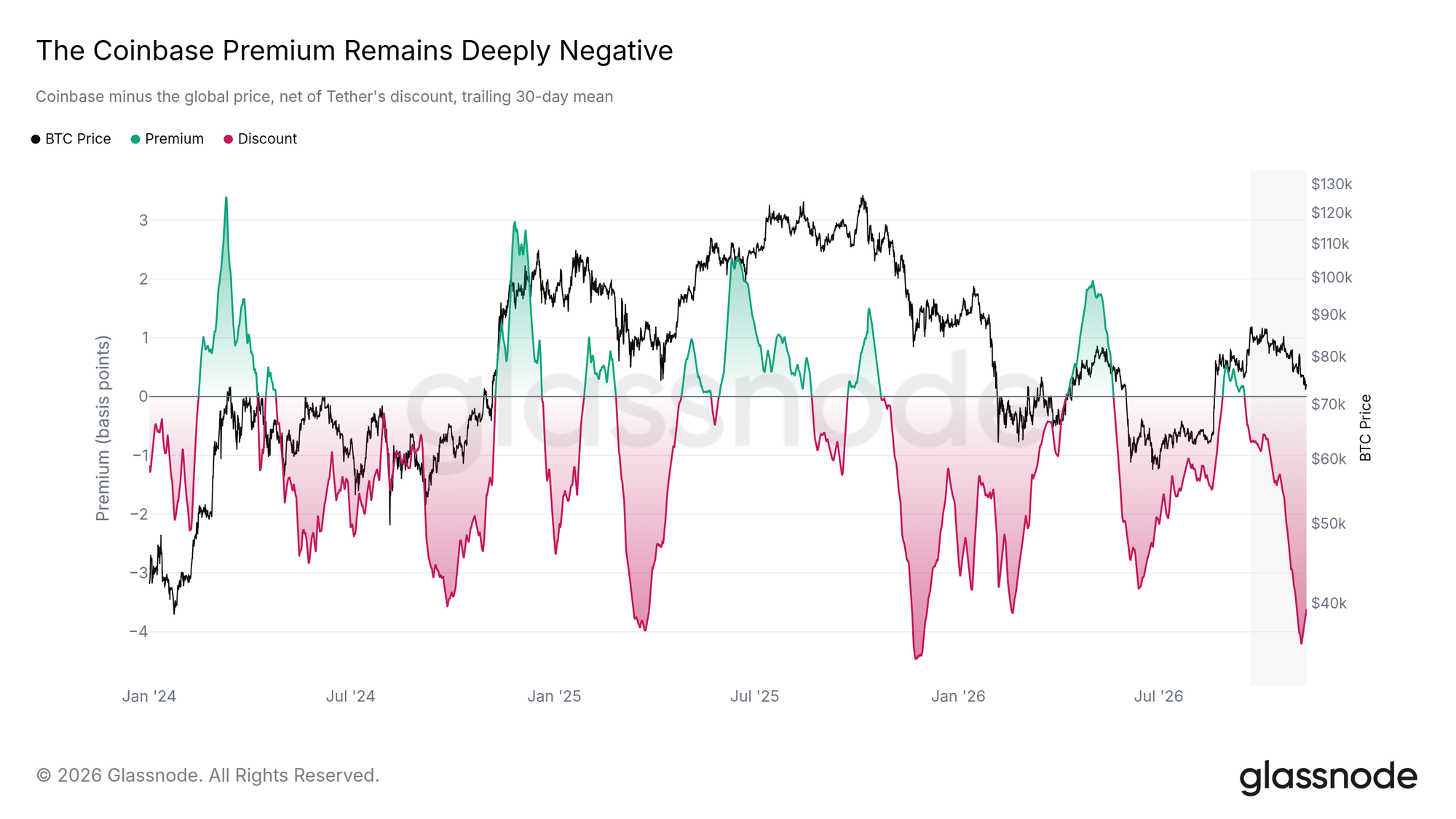
U.S. spot Bitcoin ETFs recorded $1.6 billion in net outflows over 20 trading days. On November 9, those outflows crossed Glassnode’s $1.5 billion threshold for a sustained outflow period; the report said the episode was still shallower than most previous ETF outflow waves. Its 30-day average Coinbase premium, adjusted to avoid exaggerating the discount caused by Tether trading below peg, had remained negative since September’s peak and reached its lowest level since February. Glassnode presented a sustained return to a positive premium as a potential sign of renewed U.S. buying, not an event that had already occurred.
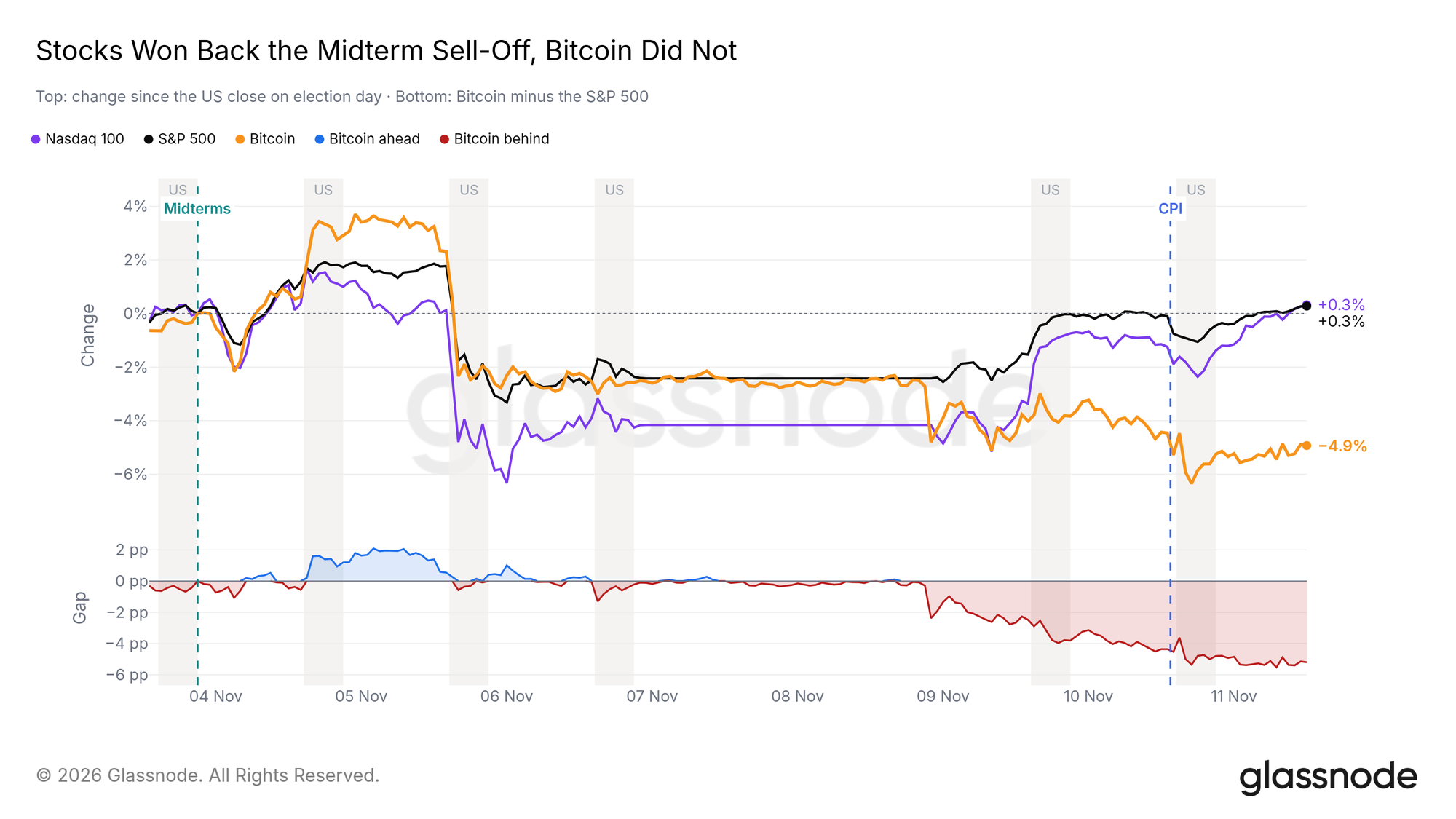
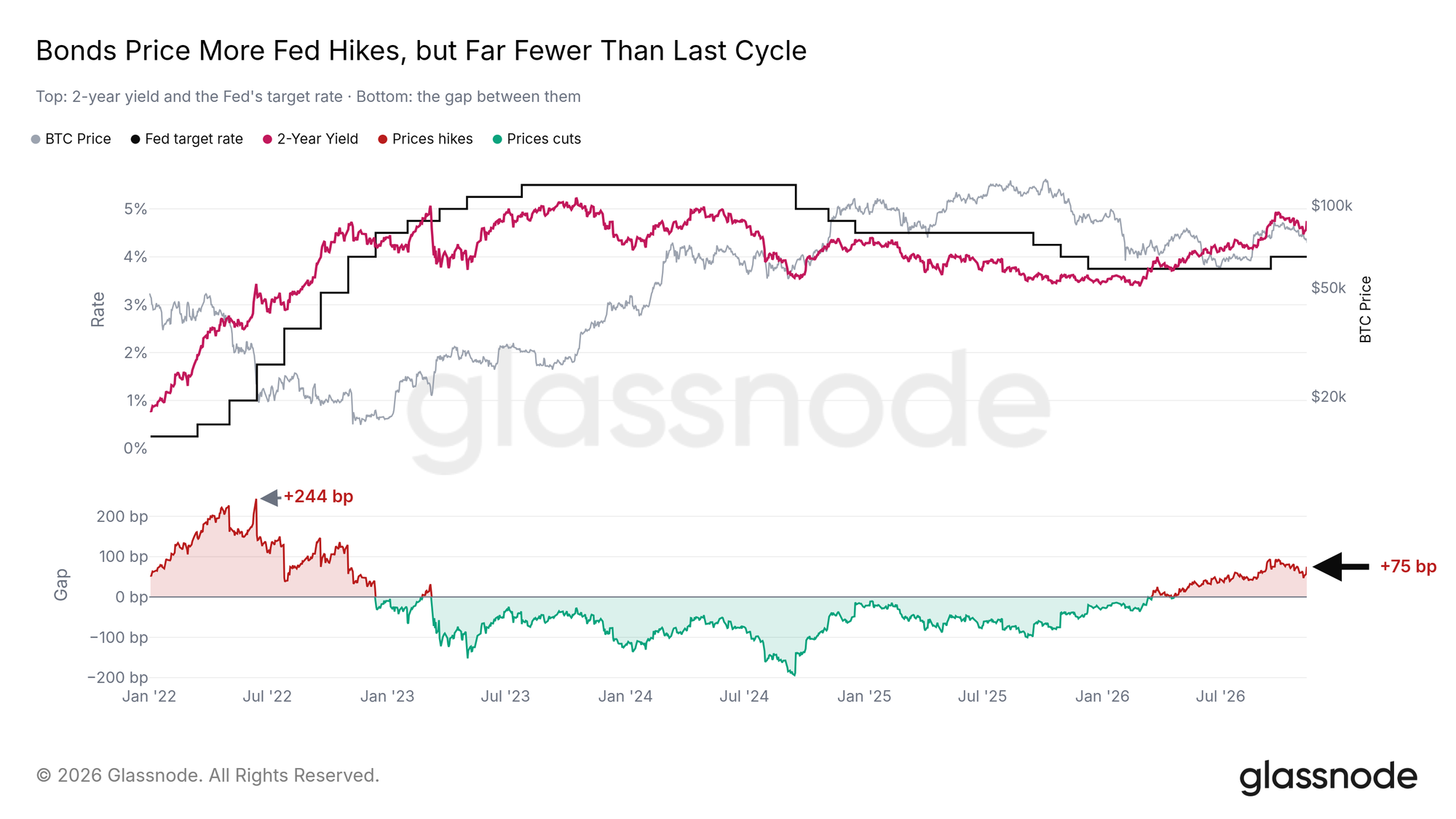
Bitcoin had also underperformed U.S. equities around the midterm election. The S&P 500 and Nasdaq 100 had recovered their election-day closing levels, while Bitcoin remained down about 5%; Glassnode cited Bitcoin’s $77,800 election-day close as a comparison point. The report put the two-year U.S. Treasury yield at 4.75%, 75 basis points above the stated 4% Federal Reserve policy rate. That gap was below the 244 basis points observed in June 2022 and had narrowed since late October.
What the positioning data does—and does not—show
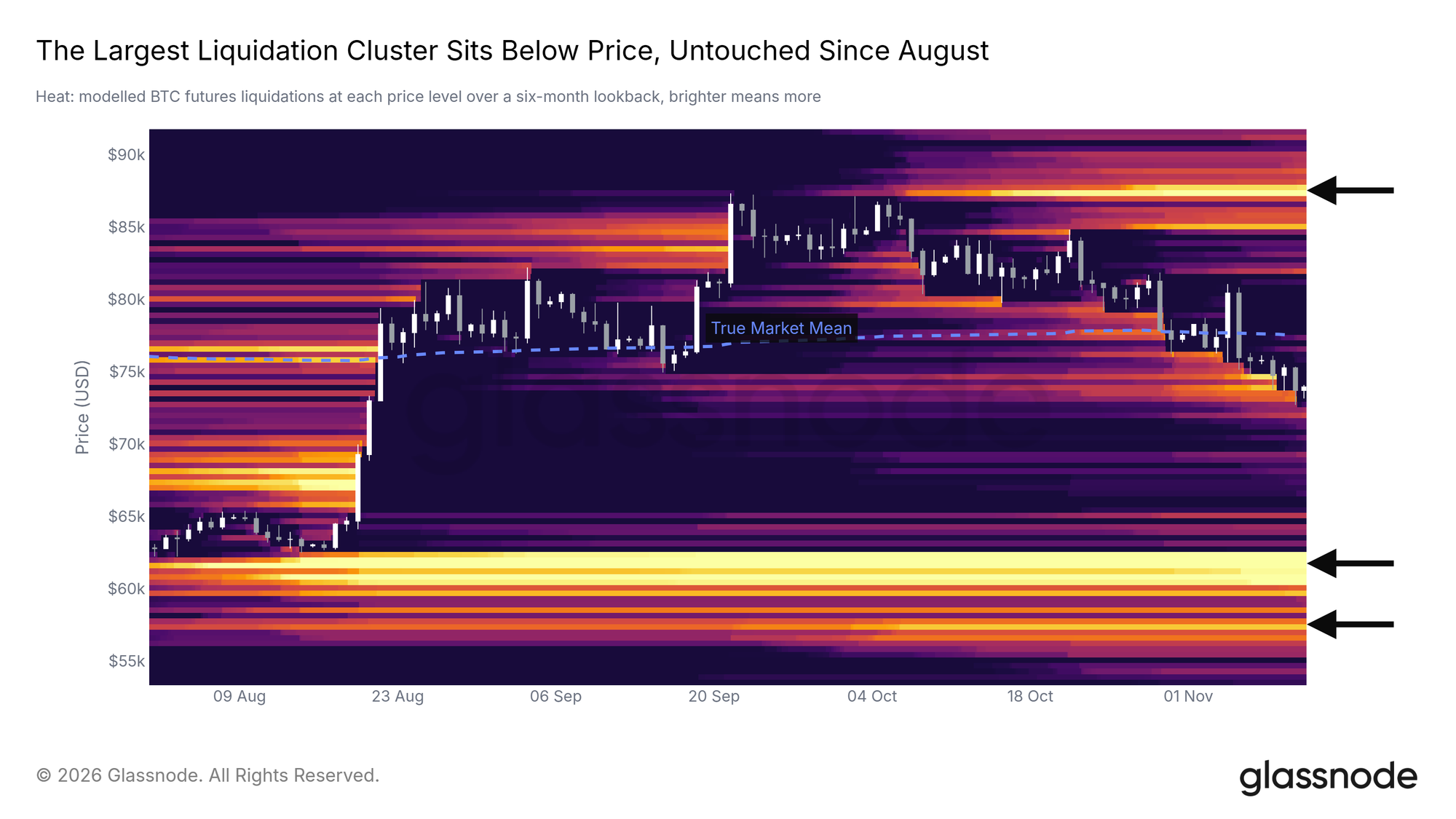
Glassnode’s six-month liquidation heatmap placed the largest concentration of potential liquidations well below price, at $59,500–$62,600, with relatively little liquidation exposure between that zone and the prevailing price. Open interest had nevertheless returned to its September-peak level despite an approximately 15% price decline. Glassnode interpreted this as suggesting that some traders had added shorts; the largest short-liquidation concentration above price was near $87,500.
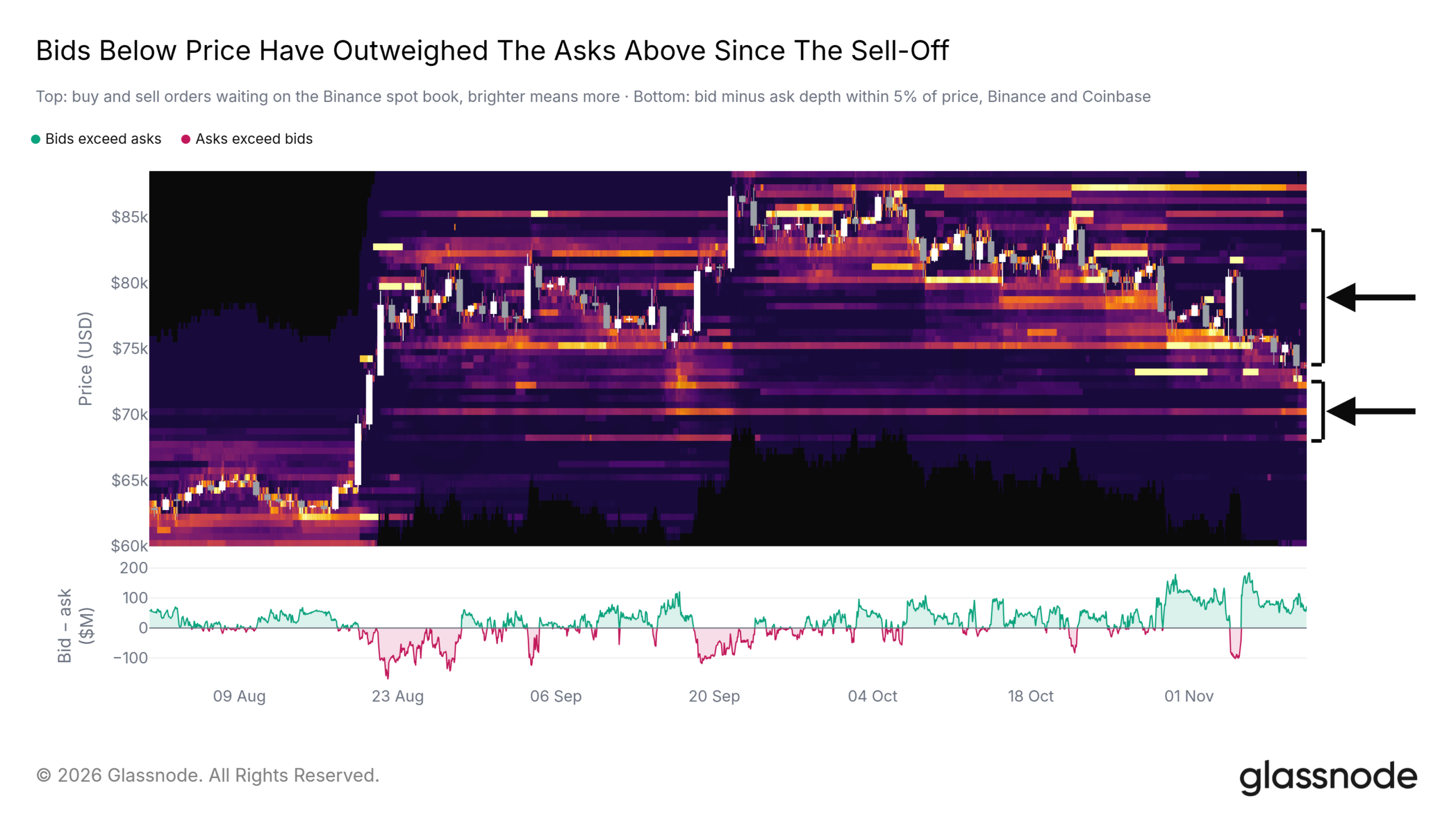
In Binance and Coinbase spot order books, bids within 5% of price exceeded asks in every hourly interval since the November 5 sell-off, according to the report. Concentrated bids lay at $68,000–$72,500, while asks were comparatively sparse beyond the nearest sell-order band up to roughly $84,000. These are visible orders, not committed future purchases: Glassnode noted that some bids were briefly withdrawn during the early-November decline before being reposted.
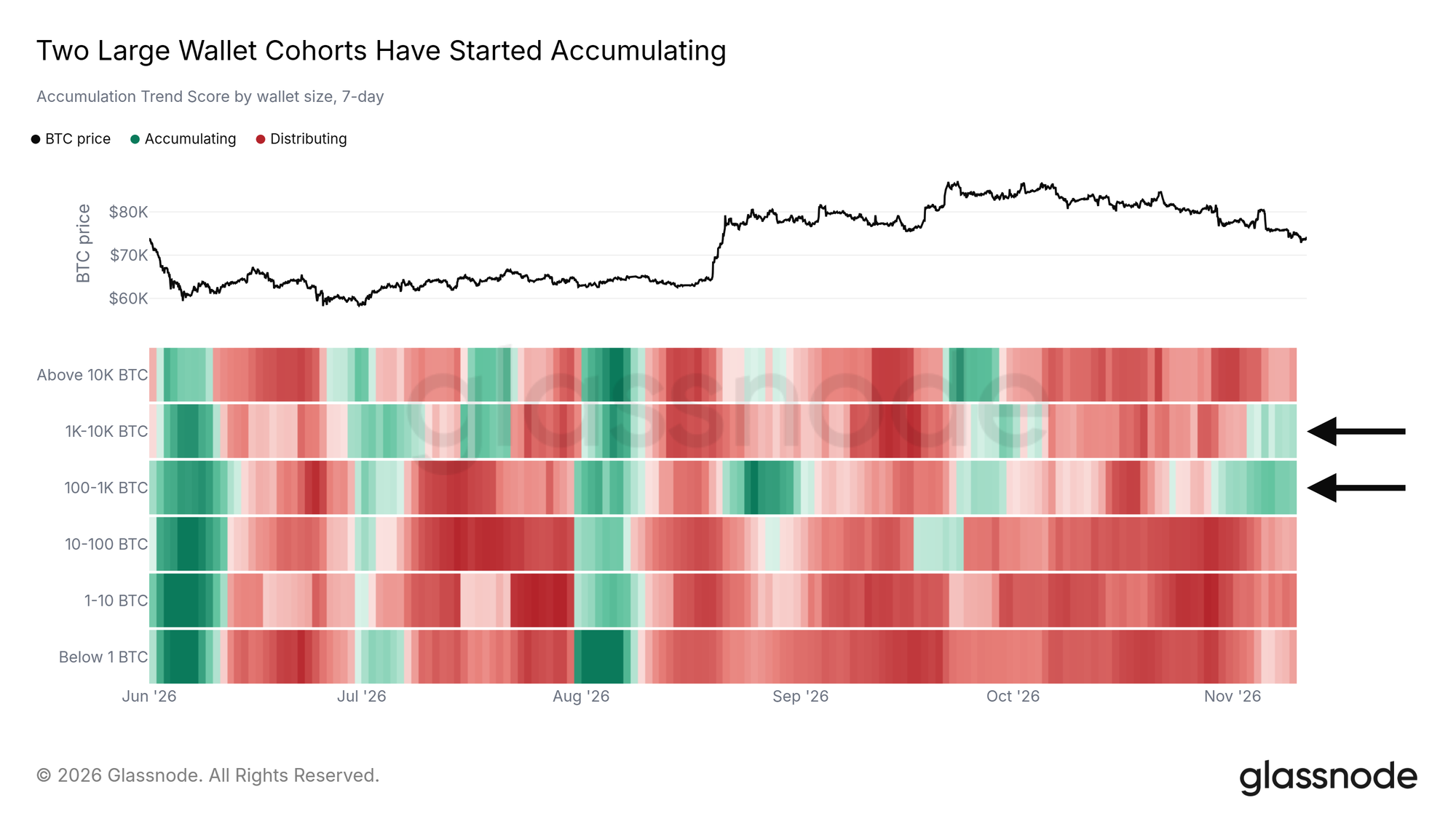
Finally, Glassnode’s size-weighted Accumulation Trend Score rose above 0.5 over the preceding week for wallets holding 100–1,000 BTC and 1,000–10,000 BTC. Both cohorts had largely distributed coins in October. Other wallet-size cohorts were still distributing, and a similar buying turn among the two larger cohorts in late September had not persisted. The evidence thus supported limited accumulation, not a market-wide reversal.
Measurement times: Glassnode’s price and derivatives data ran through November 11, 2026, at 11:00 UTC; spot order-book data through 09:00 UTC that day. ETF flows, stablecoin supply, cost-basis measures and accumulation scores ran through November 9. Glassnode noted that exchange-balance statistics relying on its address-label database may not capture all reserves where exchanges have not disclosed their addresses.
Source: techflowpost.com (originally published 2026-11-12 09:20 UTC+8)