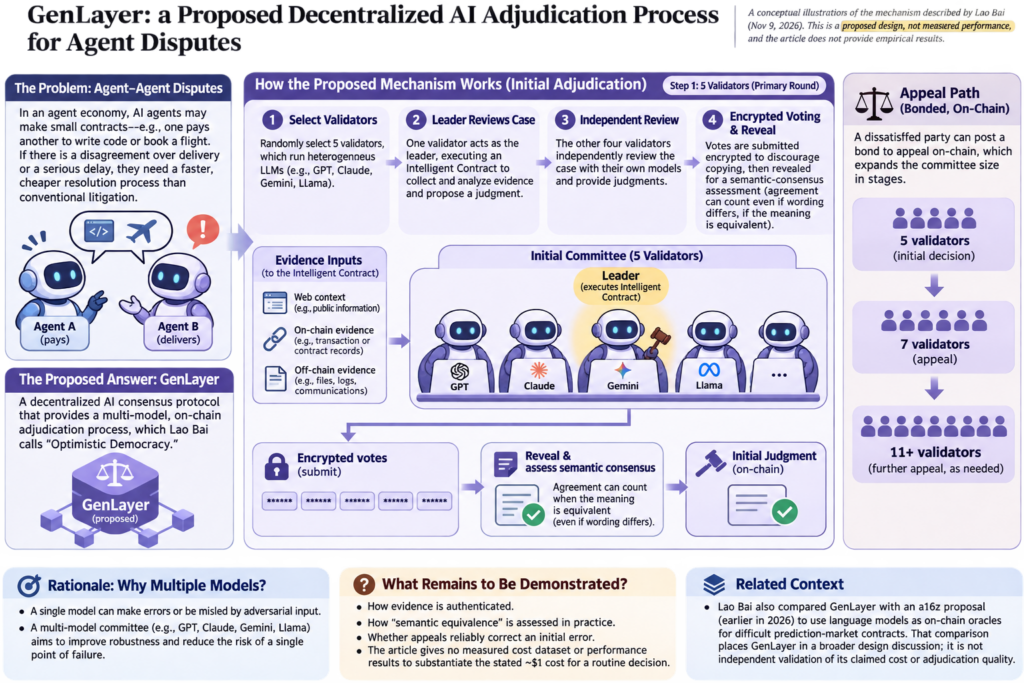
In an article published on November 9, 2026, Lao Bai argued that disputes between AI agents could require a faster, cheaper resolution process than conventional litigation. His example is a small contract between agents: if one pays another to write code or book a flight, how could they resolve a disagreement over delivery or a serious delay? GenLayer, which he described as a decentralized AI consensus protocol, offers a proposed answer. The article does not establish how the system performs in live disputes.
How the proposed process works
According to Lao Bai’s account, GenLayer randomly selects five validators for an initial decision. Each runs a large language model locally, with GPT, Claude, Gemini and Llama given as examples of the heterogeneous models the committee could use. One validator acts as leader, executing an Intelligent Contract that can read web context, examine on- and off-chain evidence, and propose a judgment.
The other validators review the case independently. Their answers can count as agreement even when the wording differs, provided the meaning is equivalent. Lao Bai says votes are encrypted before being revealed to discourage validators from copying one another. A dissatisfied party can post a bond to appeal on-chain, expanding the committee from five to seven, eleven or more validators. He calls this design “Optimistic Democracy” and says a routine decision could cost about $1; the article supplies no measured cost dataset or performance results to substantiate that figure.
What remains to be demonstrated
The case for multiple models is that a single model can make errors or be misled by adversarial input. But agreement among models does not itself prove that their shared answer is correct. The account leaves open how evidence is authenticated, how semantic equivalence is assessed, and whether appeals reliably correct an initial error. Those questions matter most where a ruling has financial consequences.
Lao Bai also compared the approach with an a16z proposal, published earlier in 2026, to use language models as on-chain oracles for difficult prediction-market contracts. That comparison places GenLayer in a broader design discussion; it is not independent validation of its claimed cost or adjudication quality.