This article reflects reporting published on November 1, 2026.
EIP-7702 lets an existing Ethereum wallet use smart-contract code without changing its address or moving its funds. That flexibility enables new wallet features, but it creates a consequential trust decision: the delegated code can control the account’s funds.
How delegation works
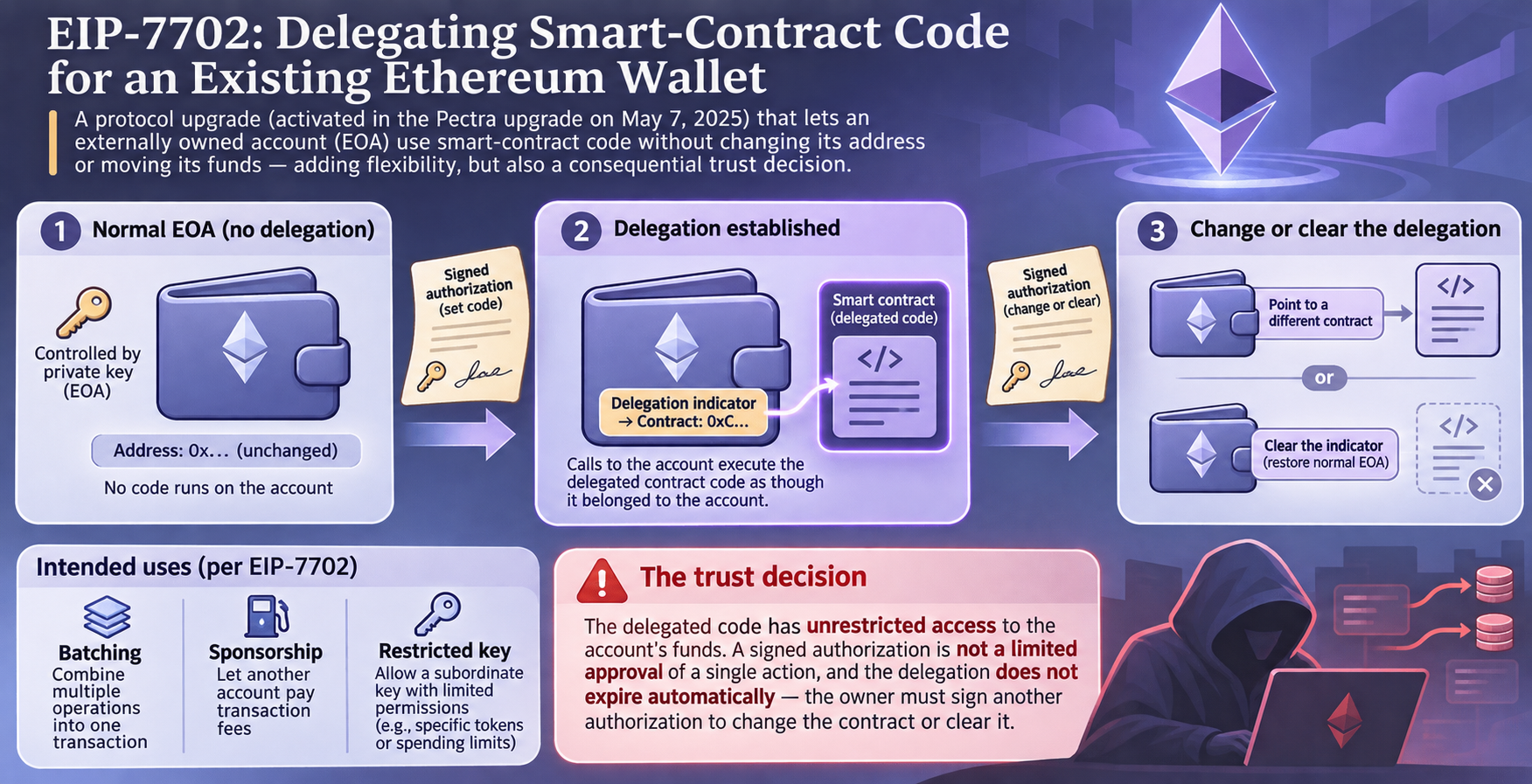
Ethereum’s externally owned accounts (EOAs) are controlled by private keys. Unlike smart-contract accounts, they do not ordinarily run code that can enforce features such as spending limits. EIP-7702, activated with the Pectra upgrade on May 7, 2025, adds a set-code transaction containing authorizations signed by the accounts concerned. Each authorization identifies a contract whose code the account will use.
Once processed, the account stores a delegation indicator pointing to that contract. Calls to the account then execute the delegated code as though it belonged to the account. The delegation does not expire automatically: the owner must sign another authorization to change the contract or clear the indicator.
The EIP identifies three intended uses: combining operations into one transaction, allowing another account to pay transaction fees, and giving a subordinate key restricted permissions. Those restrictions depend on the delegated implementation. The specification warns that delegated code has unrestricted access to the account; a signed authorization is therefore not a limited approval of a single action.
What the reported Binance theft illustrates
The original report describes an October 29, 2026 theft of approximately $6.4 billion from Binance wallets across ten blockchains, with most funds reportedly moved in about 20 minutes. TRM Labs and Chainalysis attributed the theft to TraderTraitor, a group they link to North Korea and to the February 2025 Bybit theft.
For the Ethereum portion, TRM Labs said the attacker used EIP-7702 delegation to turn a Binance hot wallet into an attacker-controlled asset sweeper and had 50 authorizations signed in advance. Chainalysis said an operating wallet funded through Tornado Cash submitted the signed authorizations; the attacker then called the Binance wallet to move its assets to attacker-controlled addresses. These are the firms’ accounts of the attack, not evidence that EIP-7702 itself was breached.
A valid signature from the delegating account is required. TRM Labs said wallets on the other nine chains also sent funds through conventionally signed transfers, pointing to a compromise of Binance’s hot-wallet signing infrastructure rather than an Ethereum protocol flaw. Binance said its investigation began with a compromised engineer’s laptop and had uncovered additional points of intrusion.
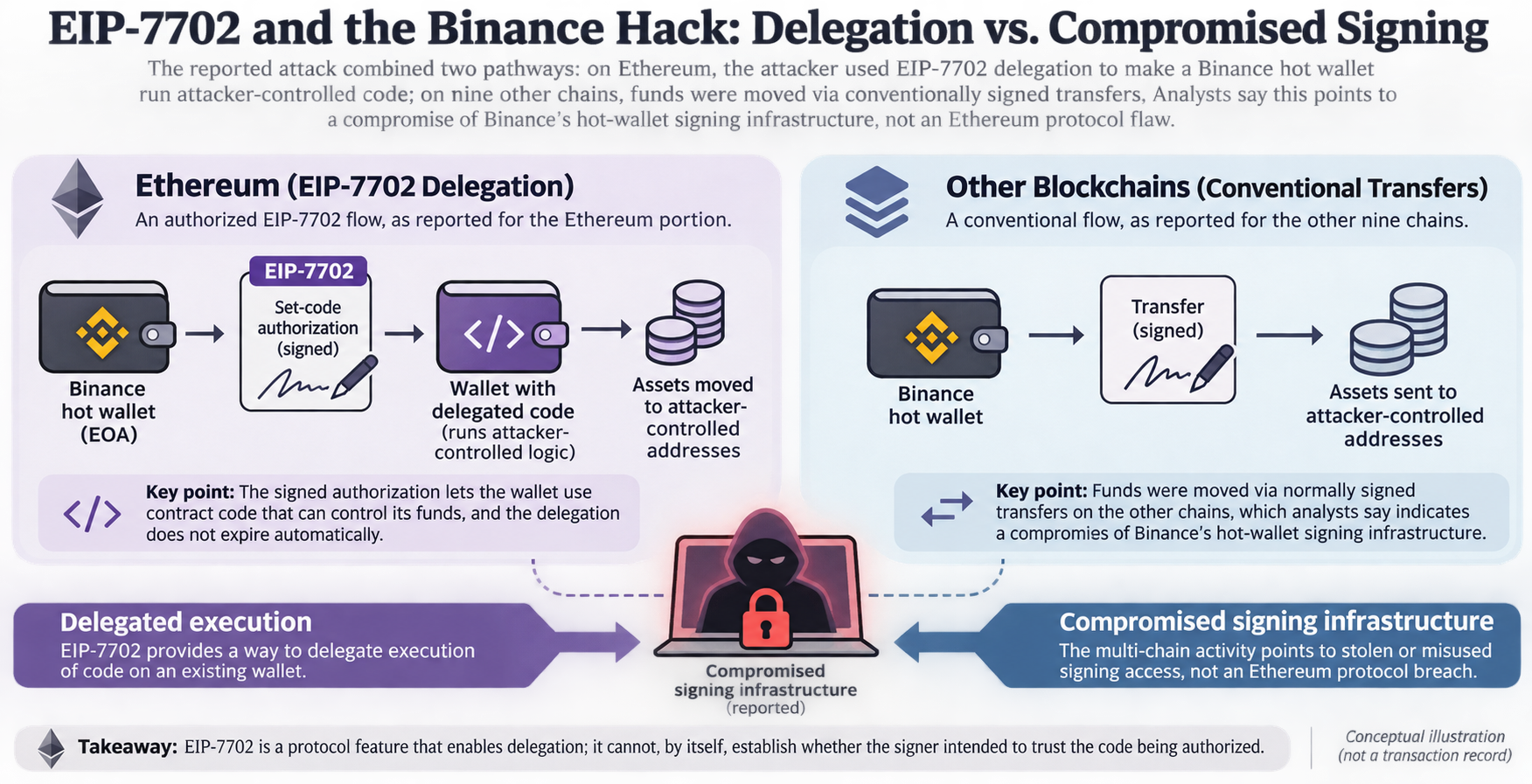
The distinction matters beyond this incident. EIP-7702 supplies a way to delegate execution; it cannot, by itself, establish whether the signer intended to trust the code being authorized. According to a June 2025 report by The Block, Wintermute found that more than 80% of EIP-7702 delegations in the weeks after Pectra pointed to copies of one malicious sweeper contract targeting wallets with exposed private keys.
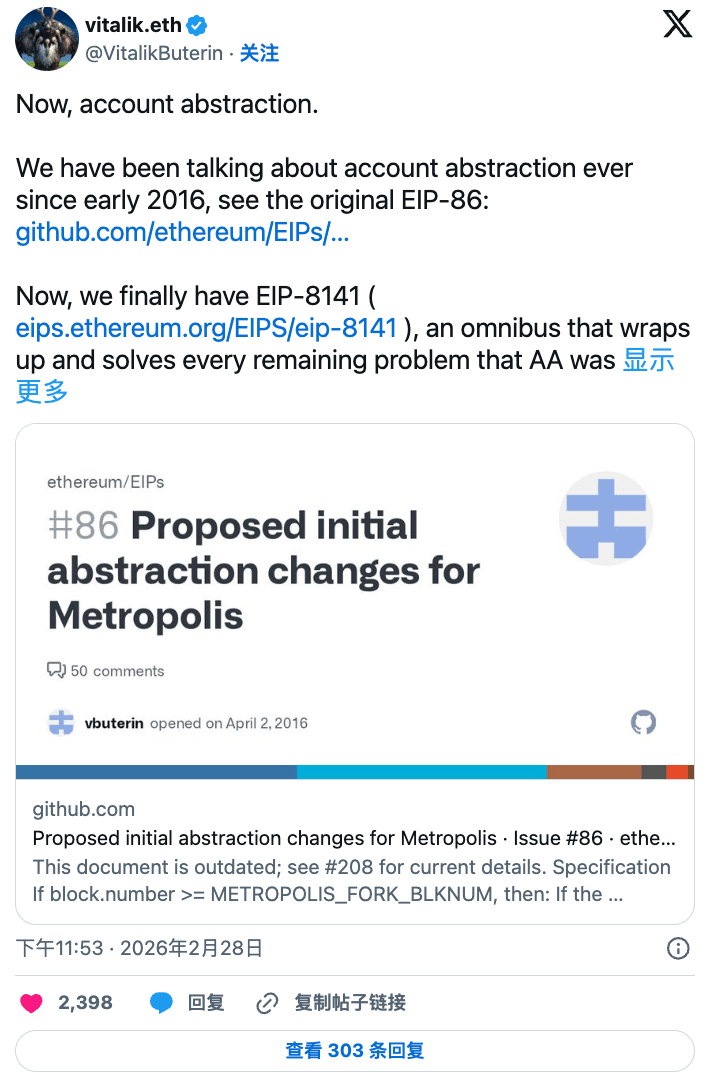
EIP-7702 is a protocol change, not a token. It is intended as a step toward broader account abstraction, while further changes remained proposals as of the original report. In February 2026, Vitalik Buterin said EIP-8141 might be implemented in the Hegotá hard fork within a year; that was a prospective timeline, not an enacted upgrade.