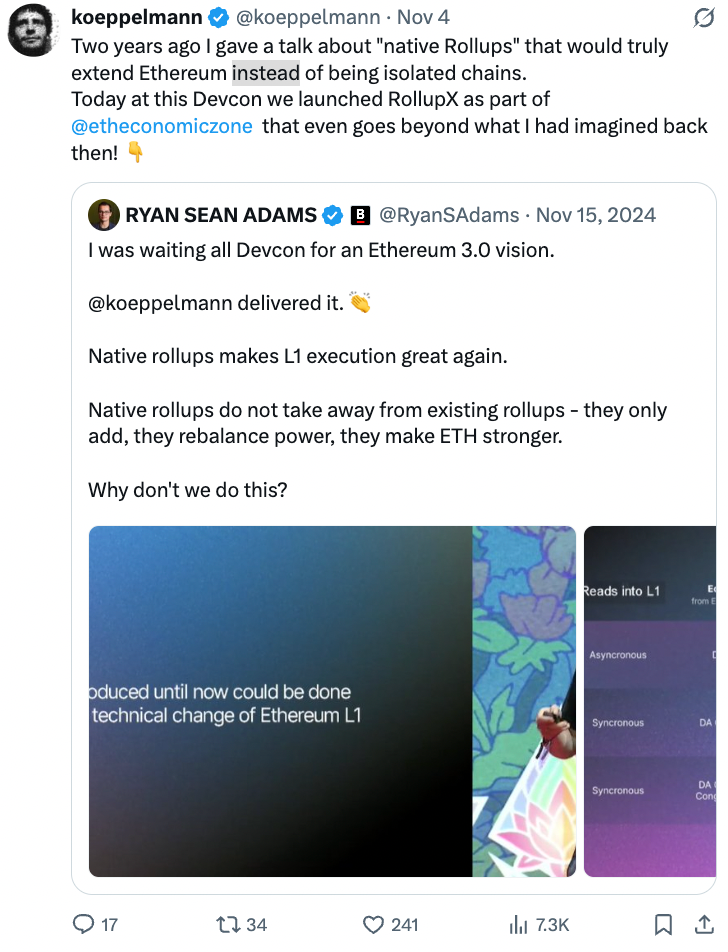
As reported on November 14, 2026, the Ethereum Economic Zone (EEZ) proposed a way for connected rollups to use contracts and liquidity on Ethereum—and on other connected chains—within a single transaction. The design aims to replace some multistep bridge workflows with synchronous calls. It is not a new blockchain or a shared execution environment: each participating chain retains its own virtual machine, transaction ordering and admission rules.
The mechanism: prove the answer before execution
The design depends on a chain proving its new state within one Ethereum slot, or 12 seconds, and rolling back alongside Ethereum if an Ethereum reorganization occurs. The rollback requirement matters because a cross-chain transaction must not survive on one chain after its counterpart disappears from the other. EEZ contracts receive proofs and state roots rather than executing the connected chain’s code.
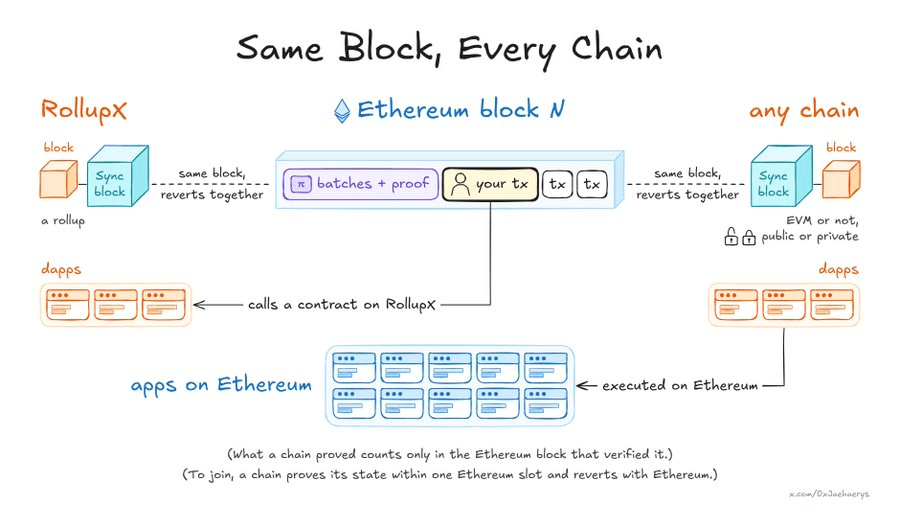
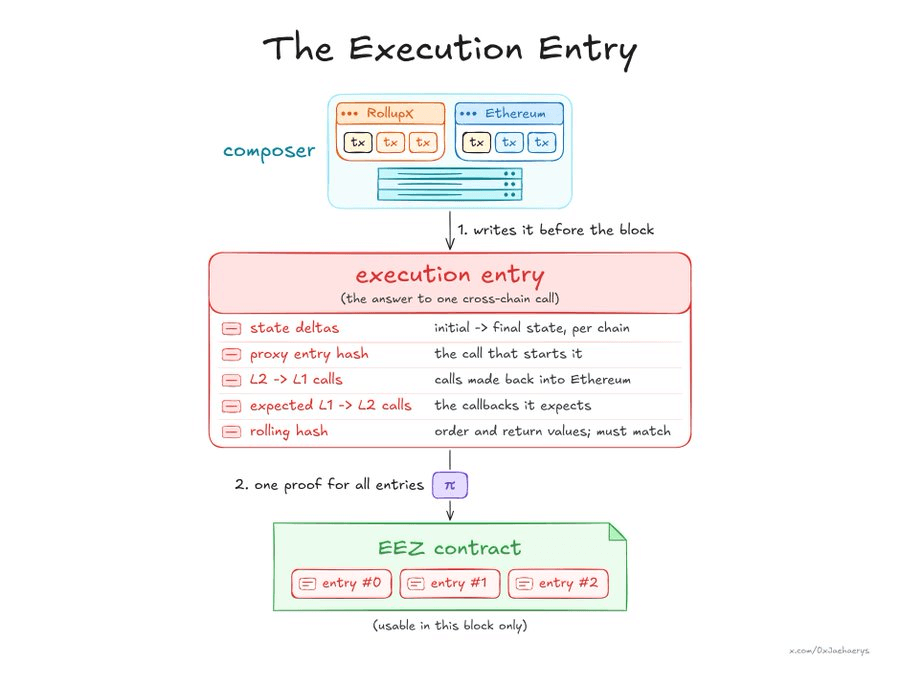
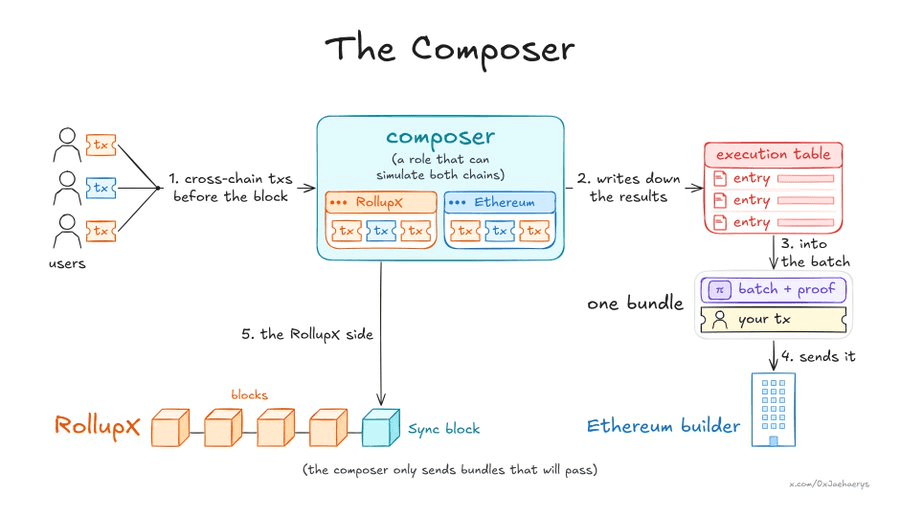
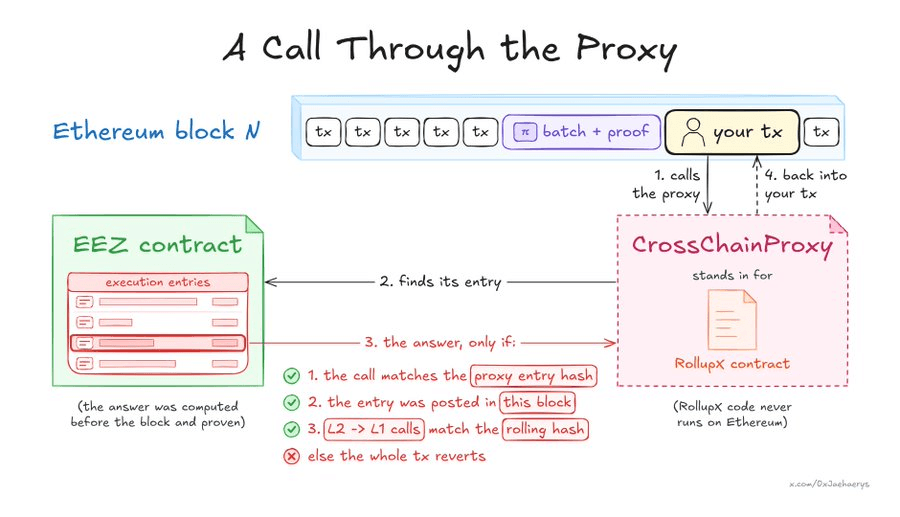
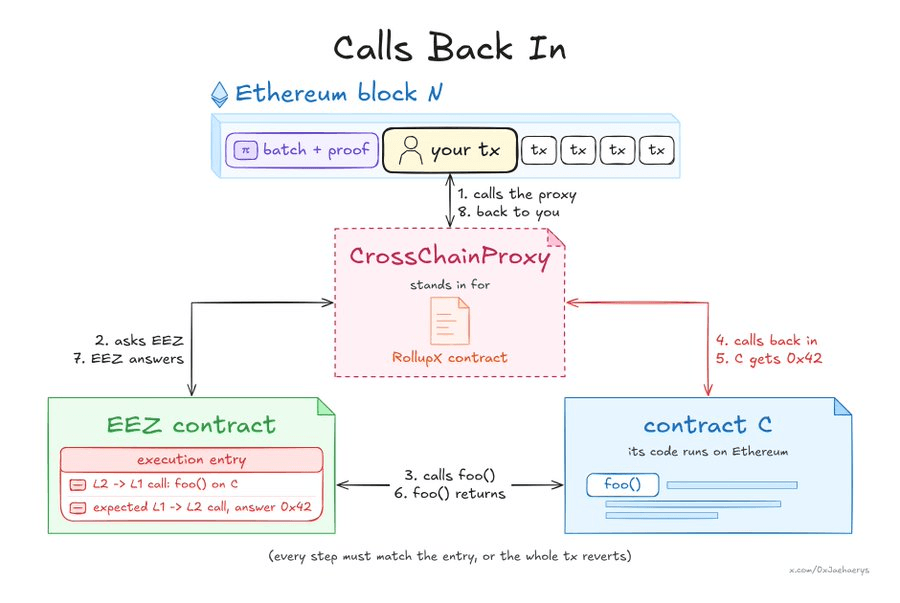
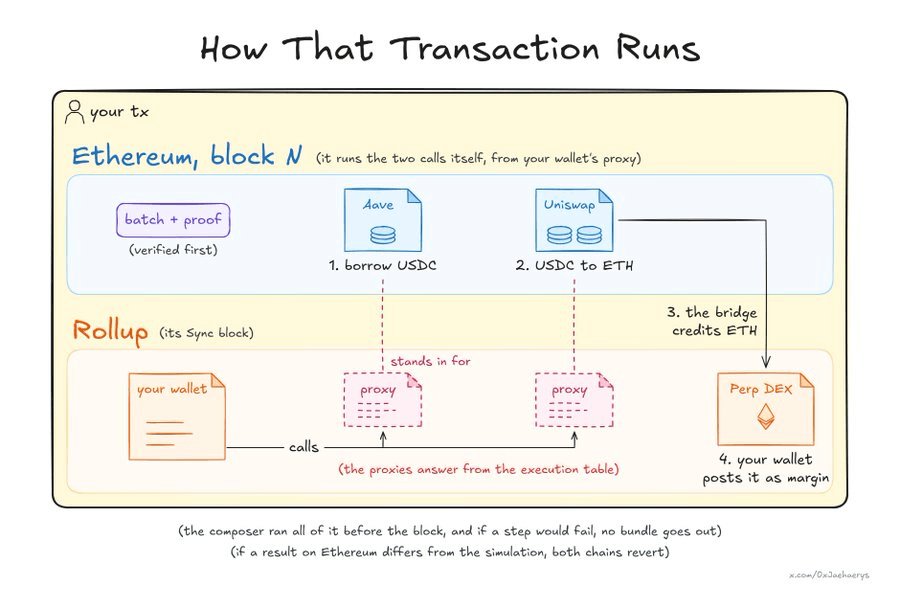
Before a block is built, an operator called the composer simulates the transaction across the chains it touches. It prepares an execution table containing the anticipated answers to cross-chain calls, state roots before and after those calls, any calls back to Ethereum, and a rolling hash of the calls and results. Contracts on one chain reach contracts on another through proxies at predictable addresses.
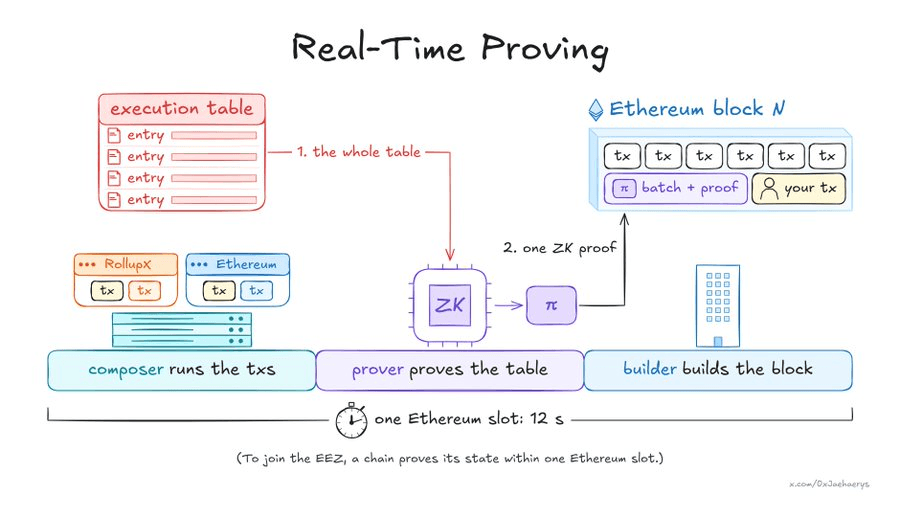
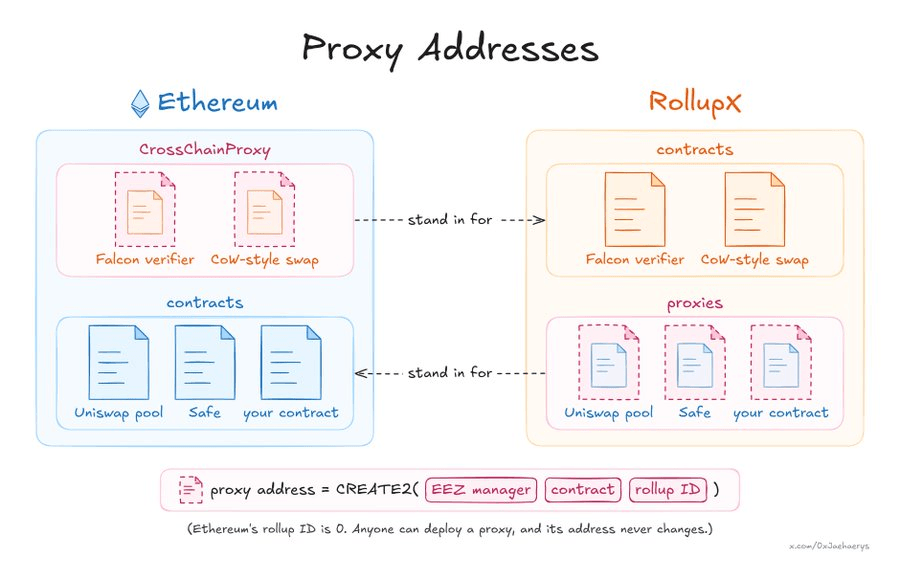
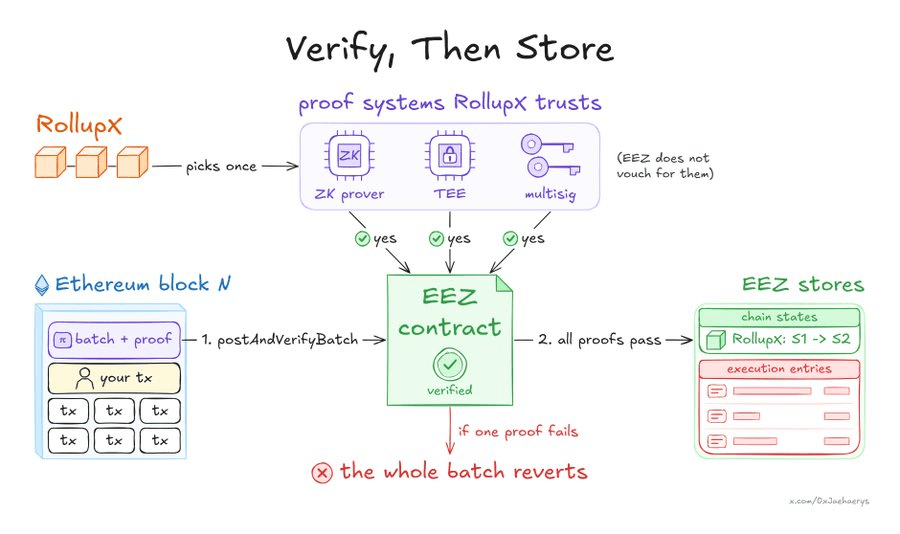
The composer sends a bundle to an Ethereum builder. Its first transaction, postAndVerifyBatch, carries the connected chain’s batch, execution table and proof; the user transaction follows. If the batch is verified, a proxy can return a precomputed answer only when the actual call matches the simulated one, the entry arrived in the same block, and the callback hash matches. The cross-chain portion runs in a sync block tied to that Ethereum block. The account says that if actual Ethereum execution differs from the simulation, the operations on both chains revert.
This is a conditional design, not a claim that every connected chain has identical security. The connected chain’s owner chooses which proof systems to trust—including zero-knowledge proofs, trusted execution environments, multisignatures or combinations—and how many proofs a batch requires. EEZ does not endorse those choices. The account attributes an improvement in real-time proving hardware requirements to Ethproofs: from 24 RTX 5090 GPUs roughly a year earlier to four at the time of reporting. That comparison alone does not establish that every participating chain can meet the full same-slot workflow.
What the reported examples show
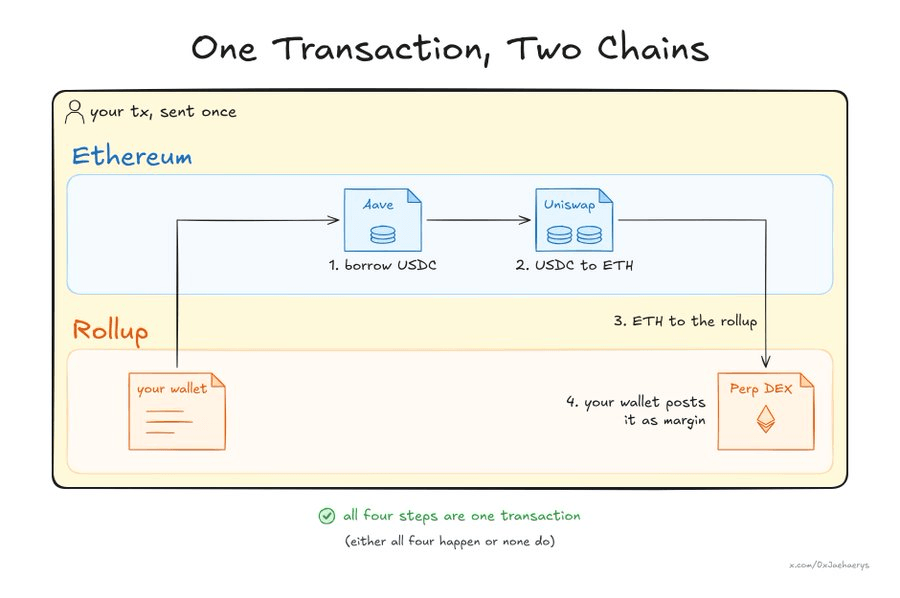
The account describes a transaction beginning on a rollup that borrows USDC through an Ethereum Aave proxy, swaps it for ETH through a Uniswap proxy, bridges the ETH to the rollup and deposits it as trading margin. It specifies that collateral must already be held at the borrower’s Ethereum wallet-proxy address. Ethereum gas is covered through a higher tip to the composer. The composer would not submit a bundle if its simulation found a failing step.
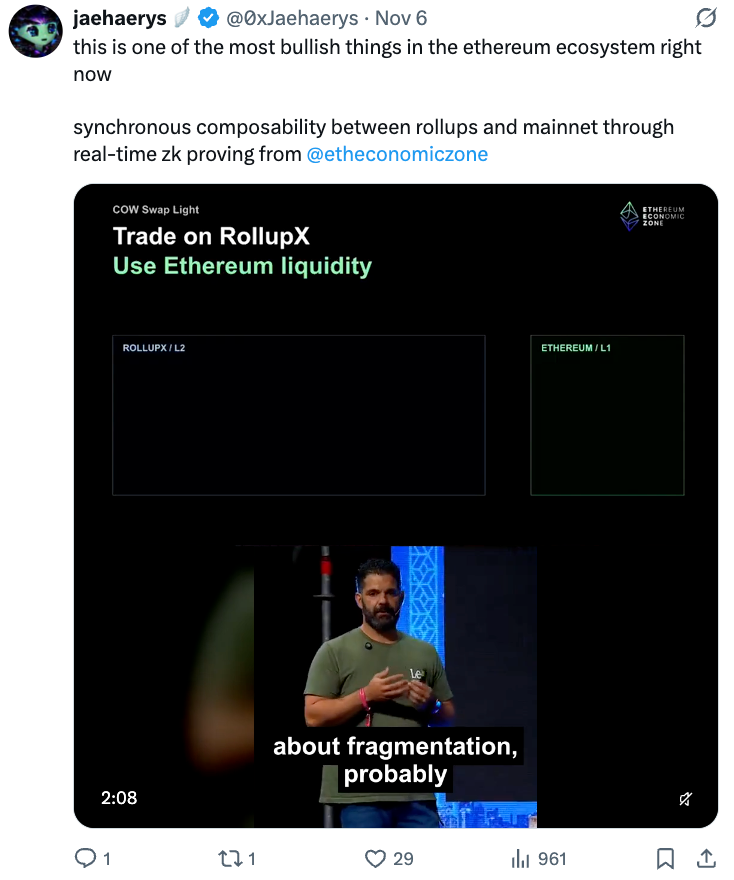
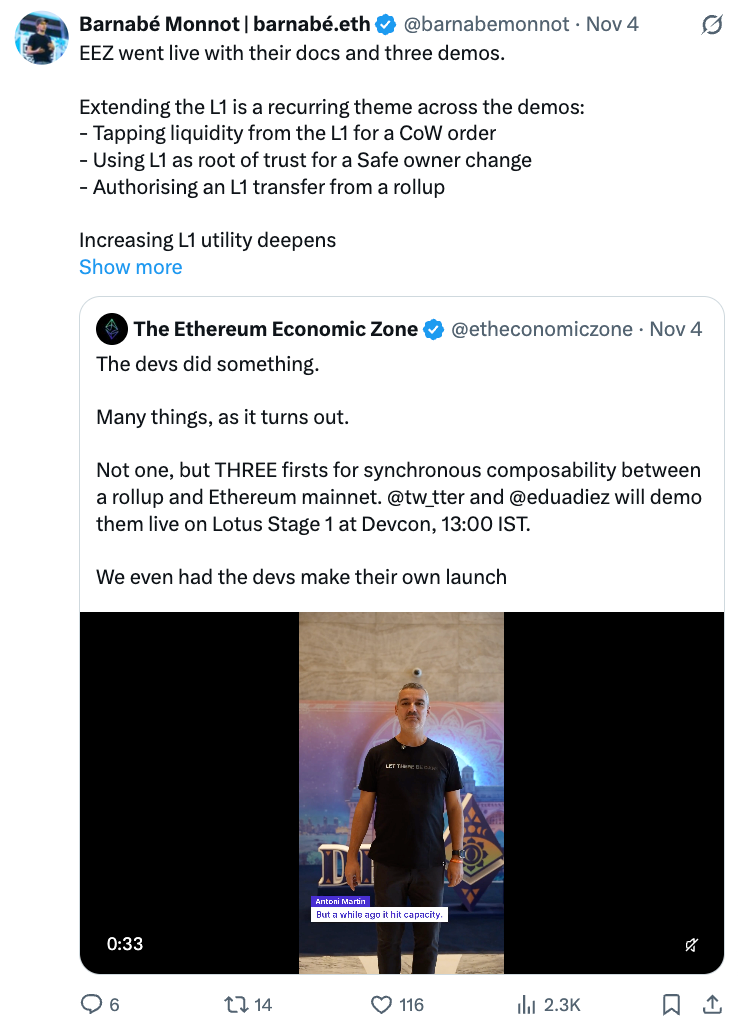
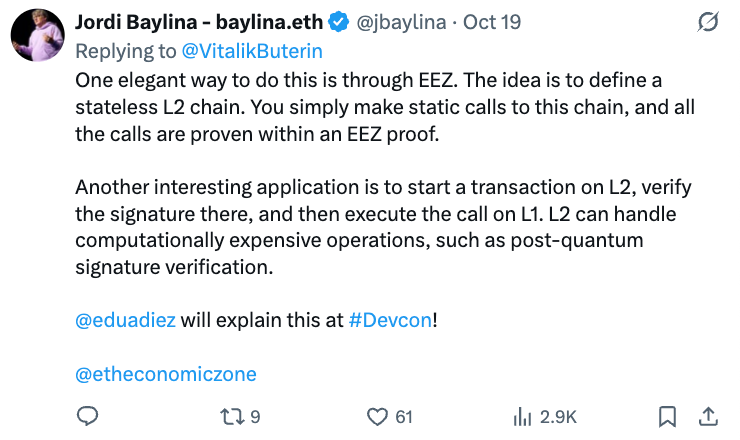
It also reports demonstrations on a mainnet-based test rollup called RollupX: a purchase from an Ethereum Uniswap pool that resulted in wrapped CRV being minted on the rollup; a Safe setup that reads its owner list from Ethereum for each rollup transaction; and Falcon signature verification on the rollup used to authorize an Ethereum Safe payment. These are reported examples, not evidence that all applications or chains can adopt the same pattern without additional trust or operational constraints.
The limiting assumptions
Same-block access still depends on Ethereum block space and the builder accepting the bundle. According to the account, 7% of Ethereum blocks were validator-built rather than built by external builders; synchronous calls would not occur in those slots. It reports that every EEZ batch in its first month landed in a block built by an external MEV-Boost builder, with 56% in Titan-built blocks, compared with Titan’s stated usual 48% share. The account does not specify a separate measurement window for that baseline.
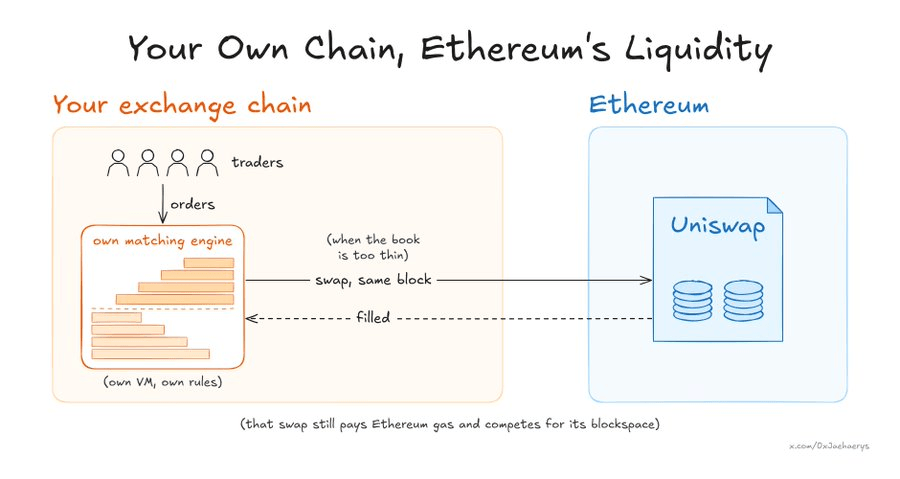
The composer must see an unencrypted transaction before block production, giving it and the builder priority access to potential cross-chain MEV. Speed also imposes a trade-off: the account says a chain targeting 200-millisecond blocks would need centralized sequencing to support these synchronous Ethereum calls, while only one in every 60 blocks would be a sync block. Its cross-chain activity would therefore proceed at Ethereum’s roughly 12-second slot cadence.
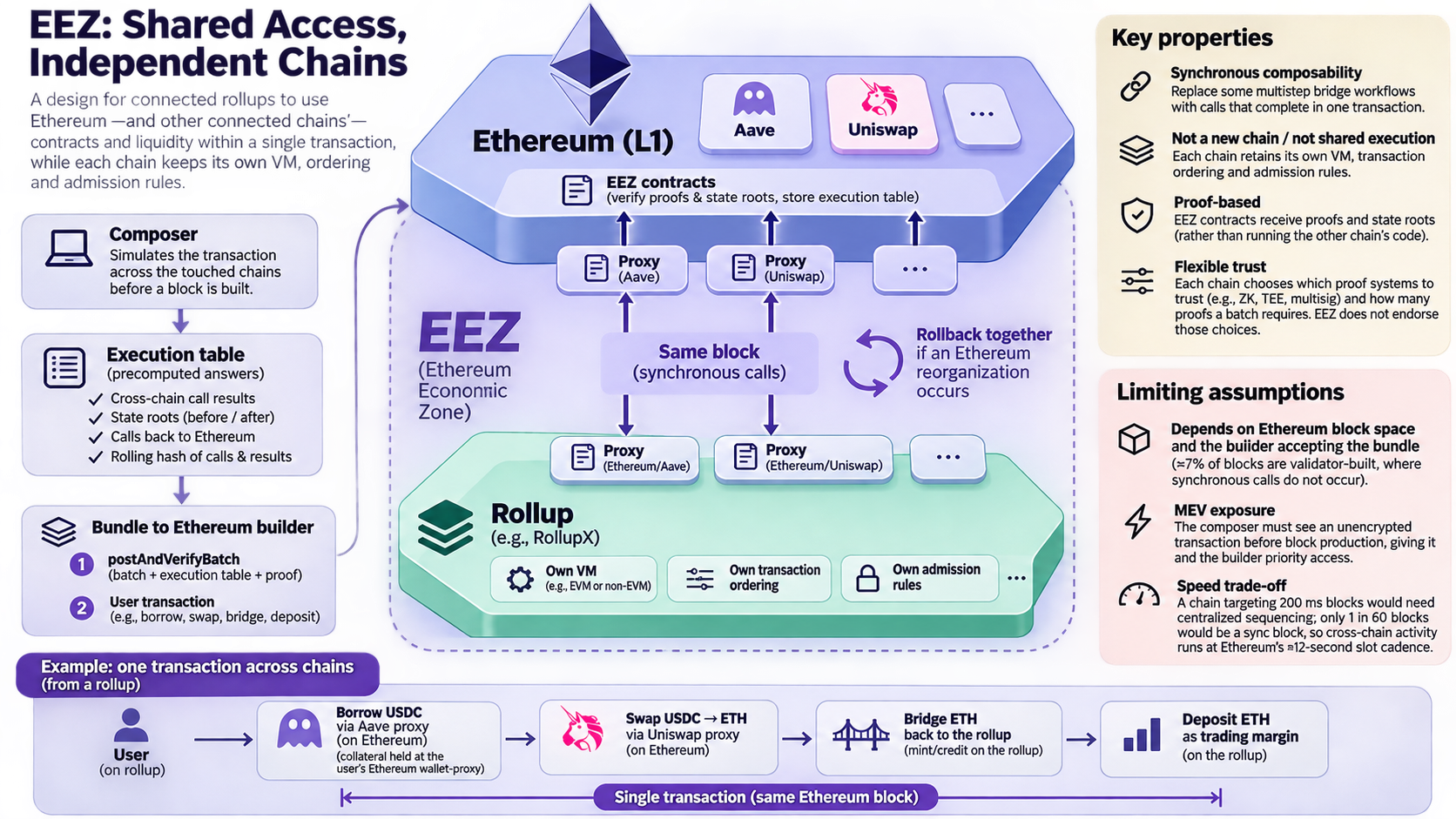
EEZ’s central proposition is narrower than eliminating all fragmentation: participating chains could retain distinct rules while making certain cross-chain calls behave like calls within one transaction. Whether that benefit outweighs the chosen proof assumptions, builder dependence, MEV exposure and L1 costs depends on each implementation.