As of November 6, 2026, two groups had asked the US Securities and Exchange Commission (SEC) to draw a line around DeFi lending—but at different points in the vault’s design.
Aave Labs, the Kamino Foundation and vault infrastructure provider Veda Tech Labs released a 16-page summary on November 2 arguing that decentralized lending protocols and noncustodial vaults fall outside federal securities law. They had submitted a more detailed, confidential version to SEC staff on October 26 and requested a meeting. Separately, an approximately 238-page report titled Under Control, published in October by the Crypto Council for Innovation (CCI), set out conditions under which a vault should not be treated as a security. The report was advanced by a vault coalition led by Morpho, Bitwise and Galaxy and drafted by law firm Chapman and Cutler.
These are proposals for regulatory treatment, not SEC rulings. The SEC had not publicly responded to the Aave group’s request by the original reporting date.
Where the arguments agree
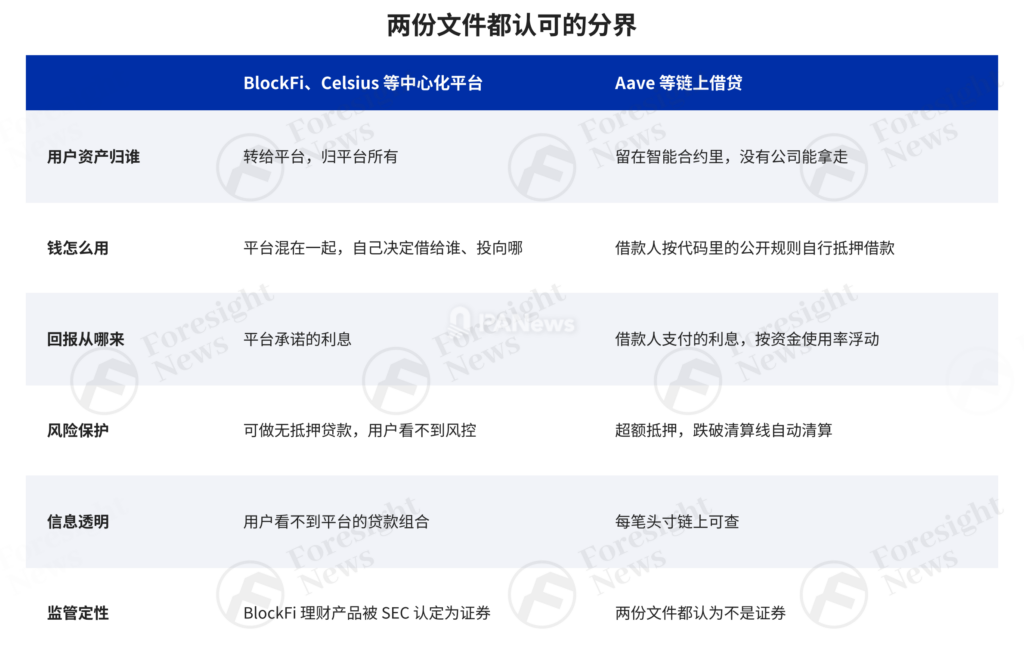
Both groups distinguish overcollateralized on-chain lending from centralized interest accounts. In the latter model, a platform can take ownership of deposited assets, pool them and decide how to use them while owing customers repayment. The SEC treated BlockFi’s interest accounts as securities in a 2022 settlement under which BlockFi agreed to pay $100 million to the SEC and multiple states. After Celsius entered bankruptcy, a court ruled under its customer terms that the platform owned assets deposited in the relevant accounts, leaving those customers with unsecured claims.
By contrast, the two DeFi frameworks point to collateral requirements, automated liquidation, formula-based interest rates and on-chain visibility. Both argue that an ordinary overcollateralized lending position should not be a security. That shared conclusion does not resolve the harder question: what changes when someone can choose where a vault sends depositors’ assets?
The legal tests address different parts of that question. The Howey test concerns whether an arrangement is an investment contract, including whether expected profits depend on others’ efforts. The Reves test concerns whether a lending arrangement is a security in the form of a note. The Investment Company Act and Investment Advisers Act raise separate questions about the vault and its manager.
CCI’s line: constrain managerial discretion
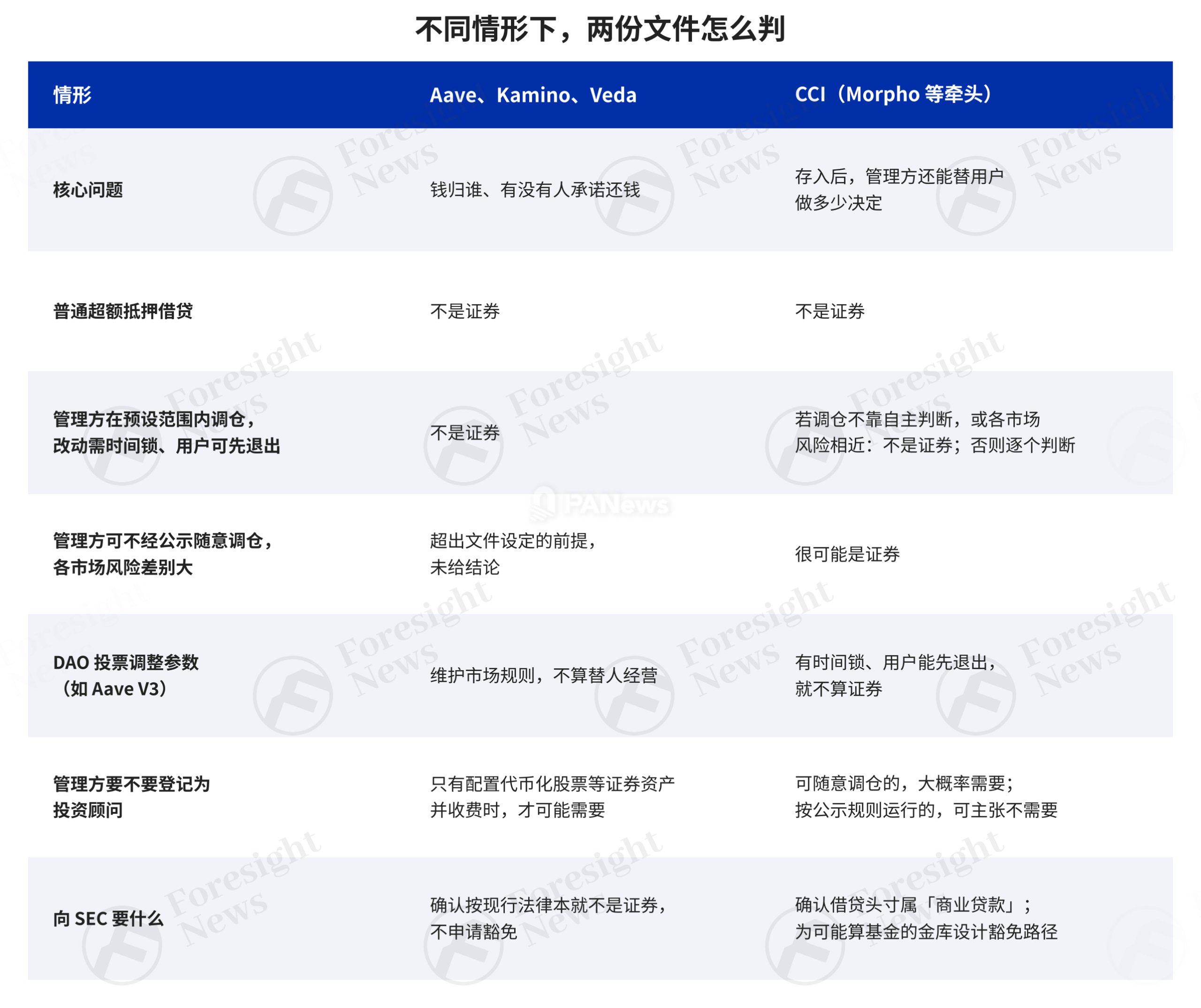
CCI focuses on what a manager can do after a deposit. Its report proposes ten conditions that can be checked against code and operating arrangements. They include restricting asset destinations, separating vault and manager assets, recording user shares on-chain, permitting withdrawals without a manager’s cooperation, and limiting changes to material parameters. It also calls for advance notice, timelocks and an exit opportunity for relevant changes; independent protective roles; public independent audits; disclosure of conflicts; and qualified custody for assets that cannot be verified on-chain.
Under CCI’s approach, allocation governed by immutable code or preset objective parameters is materially different from a manager freely moving funds among markets with different risks. CCI argues that a vault meeting all ten conditions should not be treated as a security. It allows that limited choices among similar-risk markets, affecting only small interest-rate differences, may not amount to the significant managerial effort relevant under Howey. Where discretion is consequential, CCI contemplates securities-law compliance or a proposed exemption route, including a designated company responsible for SEC-facing obligations. Neither route had been adopted by the SEC.
Aave’s line: ownership and the structure of the arrangement
The Aave group puts more weight on whether depositors retain ownership and whether any entity owns the underlying assets and issues claims against them. It argues that a vault manager’s ability to direct permitted reallocations does not itself create a Reves note or the common enterprise required under Howey, even if active management could satisfy the test’s “efforts of others” element. On its reading, there is also no entity that would make such a vault an investment company.
That argument has design limits. In the group’s proposed framework, a manager must operate within a preset scope and cannot unilaterally expand its powers with immediate effect. Material changes to strategy or permissions require independent approval and a timelock that gives users a chance to leave. The group asks the SEC not to treat upgradeability or continuing DAO governance, by itself, as evidence that a protocol is a security. It seeks confirmation under existing law rather than an exemption.
The group separately argues that an adviser managing stablecoin lending positions that are not securities would not be providing advice about securities under the Investment Advisers Act. A manager paid to allocate to securities such as tokenized stocks could face different adviser obligations. These remain the group’s legal positions, not established classifications for every vault.
Why the boundary matters to these protocols
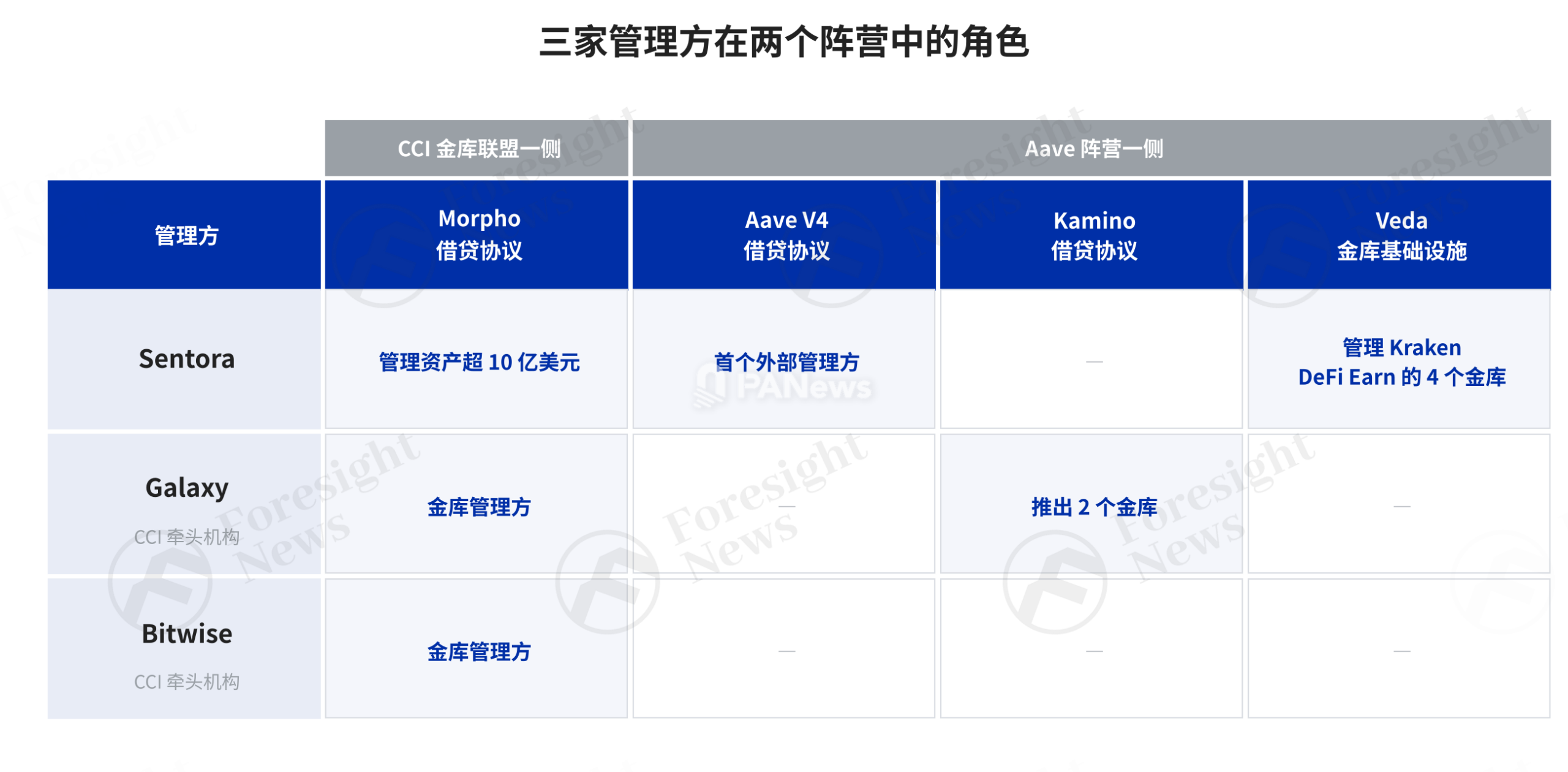
The frameworks intersect with different product designs. Aave’s V3 lending largely uses public pools with DAO-set parameters, while Morpho provides lending markets that managers can select and package into vaults. Kamino V2 also has market and vault layers with managers reallocating across markets. Veda supplies multi-protocol vault infrastructure. The choice is not a clean division between firms with and without managers: according to the source’s account, Sentora manages assets on Morpho, provides risk management for Veda vaults and became Aave V4’s first external manager in October.
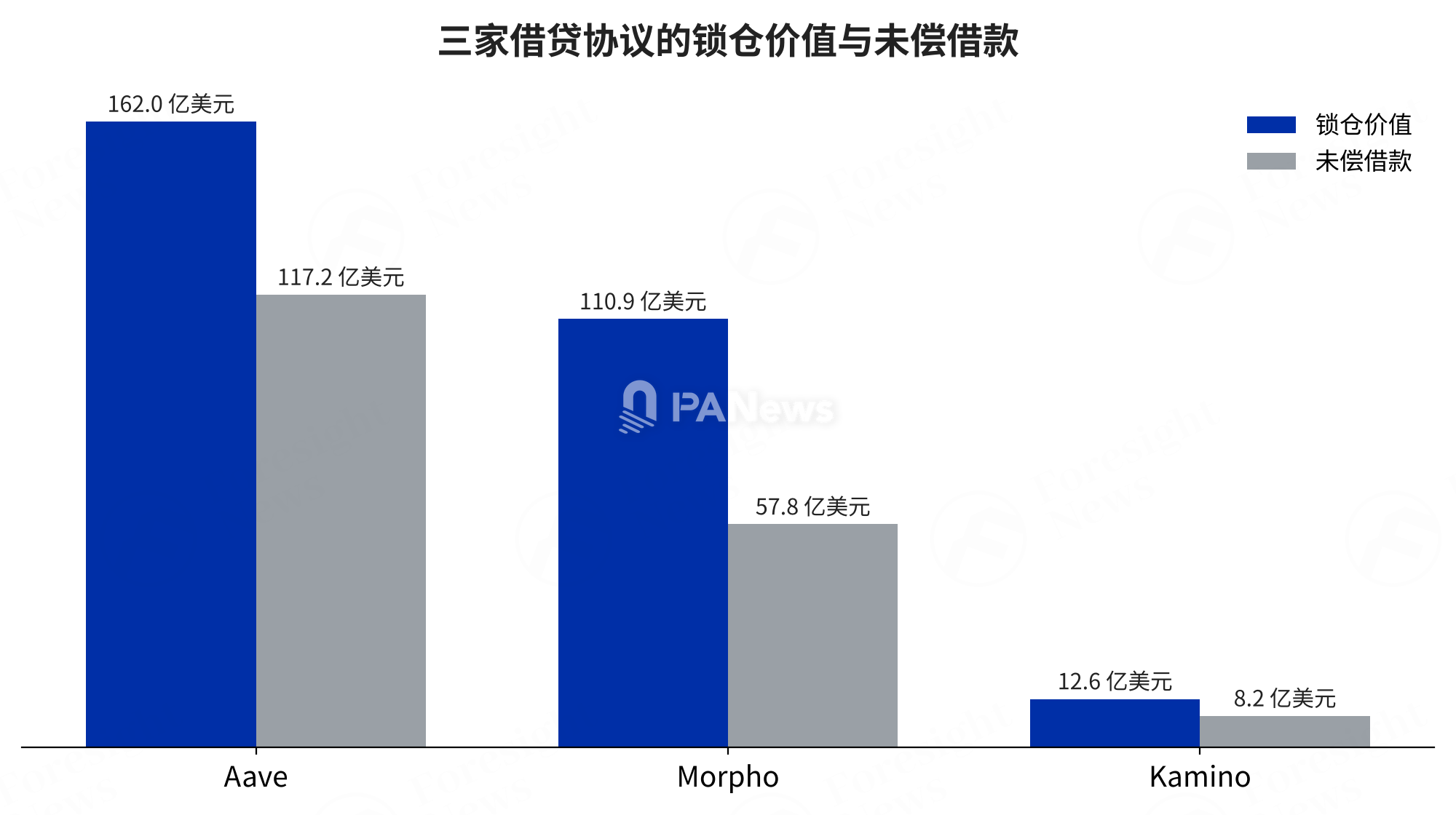
For scale, DefiLlama figures cited as of the original November 6, 2026 reporting put Aave’s total value locked at about $16.20 billion and outstanding borrowing at about $11.72 billion. The corresponding figures were about $11.09 billion and $5.78 billion for Morpho, and $1.26 billion and $820 million for Kamino. These are protocol activity measures, not evidence that either legal framework is correct. Morpho said on October 29 that manager-run assets had grown from zero to more than $11 billion over two years; that figure is Morpho’s disclosure, rather than an independent legal or risk assessment.
The unresolved issue lies between fixed code and unconstrained management. CCI offers a more specific checklist but potentially leaves more actively managed vaults needing a compliance path. The Aave group argues for a broader exclusion but depends on the SEC accepting its account of ownership, common enterprise and managerial authority. Neither submission settled where the SEC would draw that line.