A November 16, 2026 report argues that traditional-asset trading is becoming a larger part of crypto exchanges’ business. Its strongest evidence is a set of reported volume comparisons. Those figures show substantial activity in stock- and commodity-linked markets, but do not establish that traders moved money out of altcoins to fund it.
Hyperliquid: a broader market on shared collateral
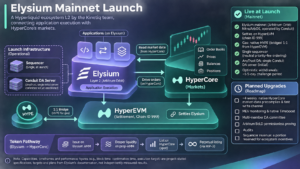
Following its HIP-3 upgrade, Hyperliquid allowed third-party deployers to offer perpetual contracts tied to stocks, indices, commodities and foreign exchange. These markets can use the same USDC margin account as Bitcoin contracts—a design that lets traders access both categories without moving collateral between accounts.
Citing Datawallet and on-chain statistics, the report says Hyperliquid recorded $216.9 billion in perpetual volume over the preceding 30 days as of the end of the third quarter of 2026. It separately puts cumulative volume in externally operated stock, commodity and index markets above $548 billion. These are different measurement windows and should not be compared as though they describe the same period. The report also says non-crypto assets accounted for roughly 30% of volume, reached 51% during a July 2026 peak, and rose from 6% to 24% of open interest from the start of the year. It does not provide a common measurement window for every share.

What the Binance comparison measures
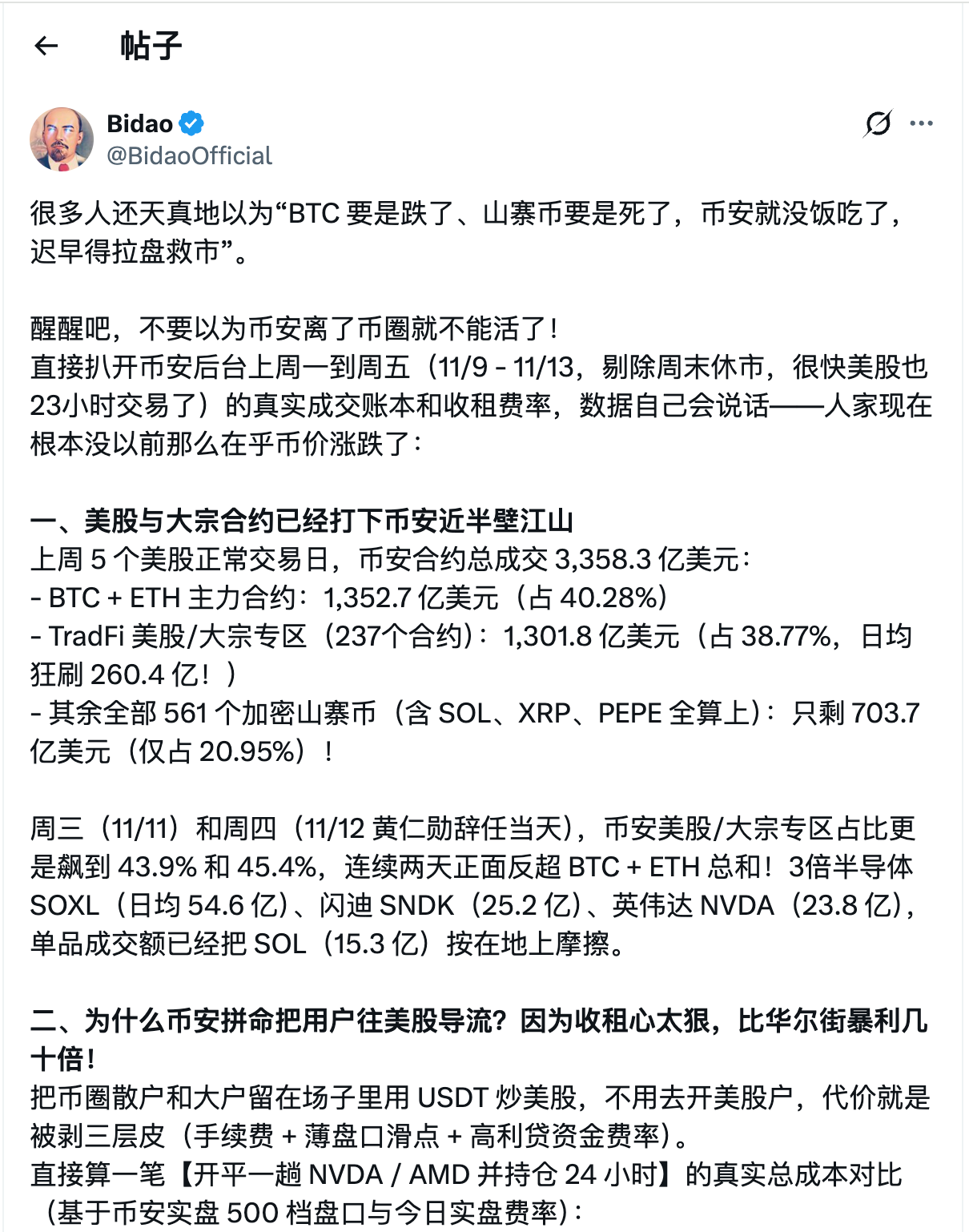
The report cites CryptoQuant for an estimate of approximately $676 billion in Binance tokenized-stock volume from late February through late October 2026, representing nearly 60% of the market’s average daily share over that period. That estimate is distinct from a shorter comparison of Binance contract volumes compiled by crypto commentator Bidao.
For the five US-stock trading days of November 9–13, 2026, Bidao’s figures put Binance contract volume at $335.83 billion: BTC and ETH contracts contributed $135.27 billion (40.28%); 237 contracts in its traditional-finance stock and commodity section contributed $130.18 billion (38.77%); and 561 other crypto contracts contributed $70.37 billion (20.95%). On November 11 and 12, the traditional-asset section’s reported shares were 43.9% and 45.4%, respectively—above the combined BTC and ETH share on those days.
The report also describes an expansion of traditional-asset offerings at OKX and Bybit. That supports the narrower conclusion that exchanges are making these markets more accessible. Trading volume, however, is not a measure of fee revenue or profitability, and the cited comparisons do not track individual traders’ transfers between markets. They therefore cannot by themselves establish the report’s broader claim that exchanges no longer need altcoins.