The question
Tokenized gold is often described as bullion that happens to sit in a wallet. For price exposure, that shorthand is close to how the product is built. For anyone whose plan depends on taking metal, the relevant test is the exit, not the token balance.
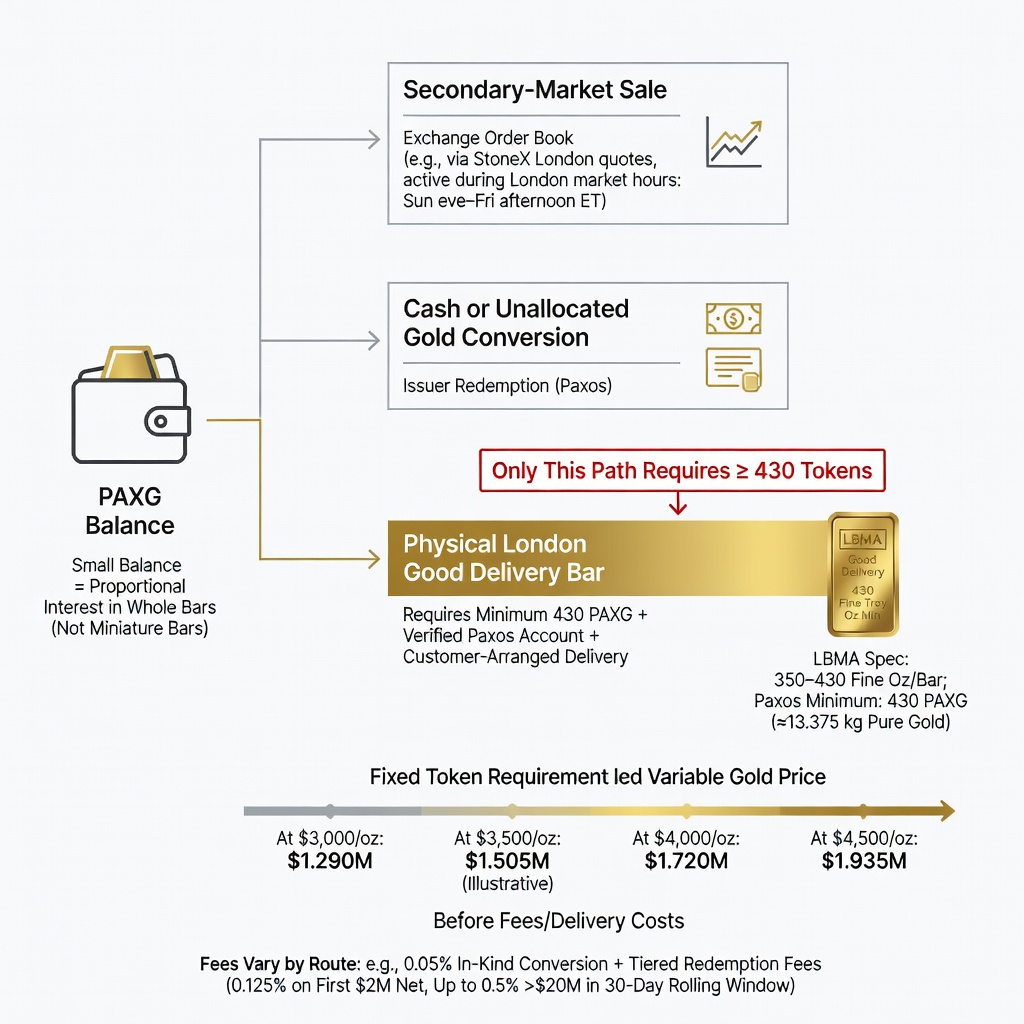
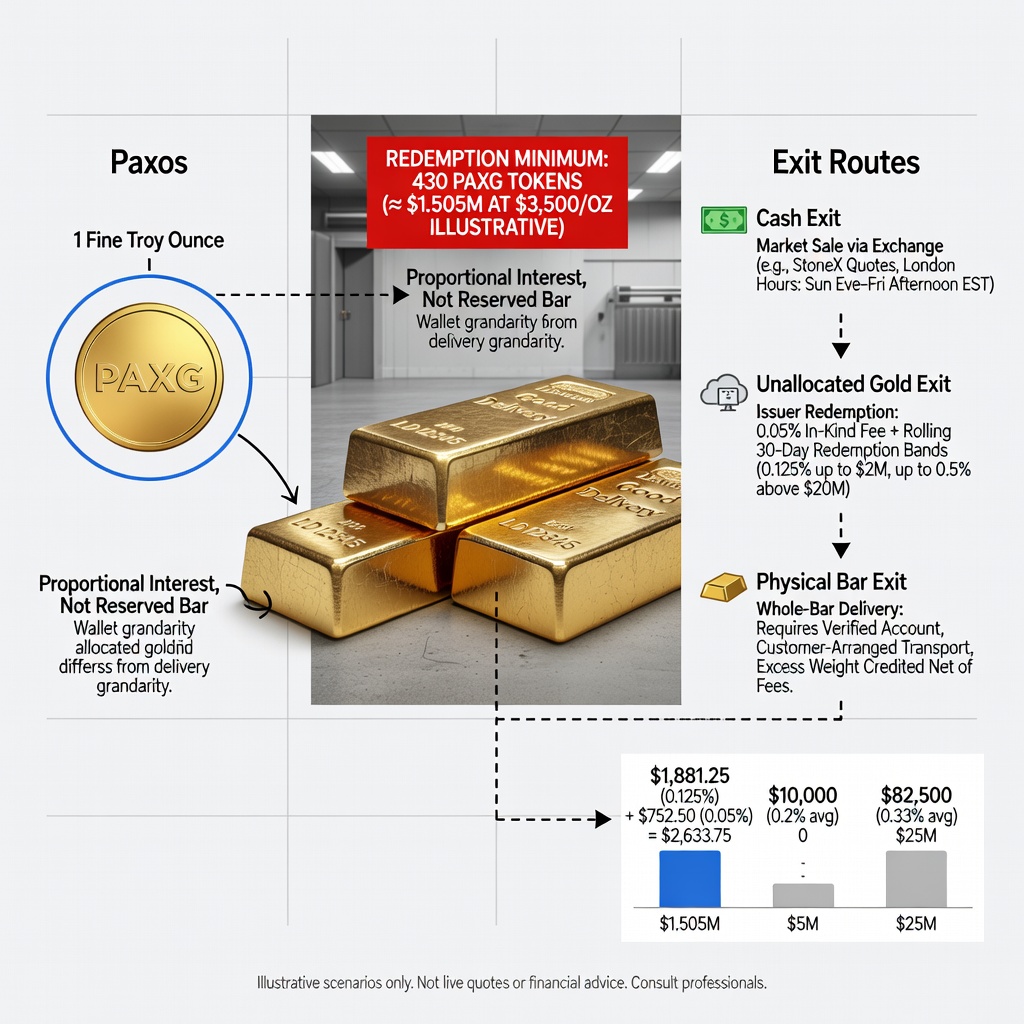
Under Paxos’s redemption terms, redeeming one physical London Good Delivery bar requires a minimum of 430 PAXG, a verified Paxos account, and delivery arrangements that stay with the customer. Crypto.news reported that threshold on Nov. 23. Each PAXG token represents one fine troy ounce of allocated gold, so 430 tokens are 430 fine ounces. At an illustrative $3,500 an ounce, that is about $1.505 million of gold before charges. The figure is a scenario, not a live quotation, and it is not itself a fee.
What one token settles
Paxos describes PAXG as beneficial ownership of allocated gold held on a segregated basis, with the metal sitting in whole bars in professional custody. A small balance is a proportional interest in those bars, not a miniature bar set aside for that wallet.
LBMA Good Delivery specifications allow gold content between 350 and 430 fine troy ounces per bar. Paxos applies the top of that range as the submission minimum: at least 430 PAXG per bar, with any excess over the selected bar’s actual fine weight credited back net of fees. Using 31.1034768 grams per troy ounce, 430 fine troy ounces equal about 13.375 kilograms of pure gold content. A 400-fine-ounce bar contains about 12.441 kilograms, so a holder submitting 430 tokens against a lighter eligible bar would have the difference credited before applicable fees.
The ounce requirement stays fixed while value moves with the gold price. At illustrative prices of $3,000, $4,000, and $4,500 an ounce, the same 430 tokens are worth $1.290 million, $1.720 million, and $1.935 million, all before fees or delivery costs. Crypto.news put smaller balances in terms of the submission requirement: one token is roughly 0.23% of 430, and ten tokens about 2.33%. Those positions still represent the corresponding ounces under the product’s structure. They do not reduce the delivery minimum. Holders below that size must sell on a supported market or convert to cash instead.
Three exits are not one mechanism
Paxos’s documents set out three exits — cash, unallocated gold, or a physical bar. Each ends in a different asset, with its own counterparty, schedule, and cost. A market sale never asks the vault for metal. A cash or unallocated conversion is an issuer redemption. A bar is a whole-bar delivery on top of that eligibility.
Paxos’s PAXG overview says direct pricing uses StoneX’s London gold market quotations, with purchases and sales during London market hours from Sunday evening to Friday afternoon in US Eastern time, including a daily closure and applicable holidays. An exchange order book can stay open outside those hours, at whatever price bids, offers, and liquidity allow. That price is a secondary-market outcome, not the issuer’s redemption schedule.
Fees follow the route. In-kind conversion into allocated or unallocated gold carries a 0.05% charge, separate from a rolling 30-day redemption fee schedule revised from Sept. 1, 2026. The redemption bands start at 0.125% on the first $2 million of net redemptions and rise to 0.5% above $20 million in that rolling window. They apply marginally, so activity already booked in the trailing 30 days can push part of a new request into a higher tier.
The report’s worked examples, still illustrative, are these. For an account in the first band, 0.125% of the $1.505 million position is $1,881.25, and a further 0.05% in-kind charge on the same value is $752.50, or $2,633.75 combined before delivery. A $5 million redemption from a zero starting point is given as $10,000, a 0.2% average. A $25 million redemption is given as $82,500, a 0.33% average. The source states those results and the floor and ceiling of the schedule; it does not list every intermediate band, so the averages should not be treated as a complete tariff.
A matching ounce count is not a reserved bar
Paxos offers a bar lookup tool. Its support page notes that exchange wallet structures can prevent the tool from identifying an individual customer’s allocation. Paxos senior software engineer Jayden Thompson, citing the company’s engineering account, describes an event-driven system that can move a holder’s interest between bars while total ounces stay unchanged. On that description, a specific serial number is not a permanent reservation for delivery.
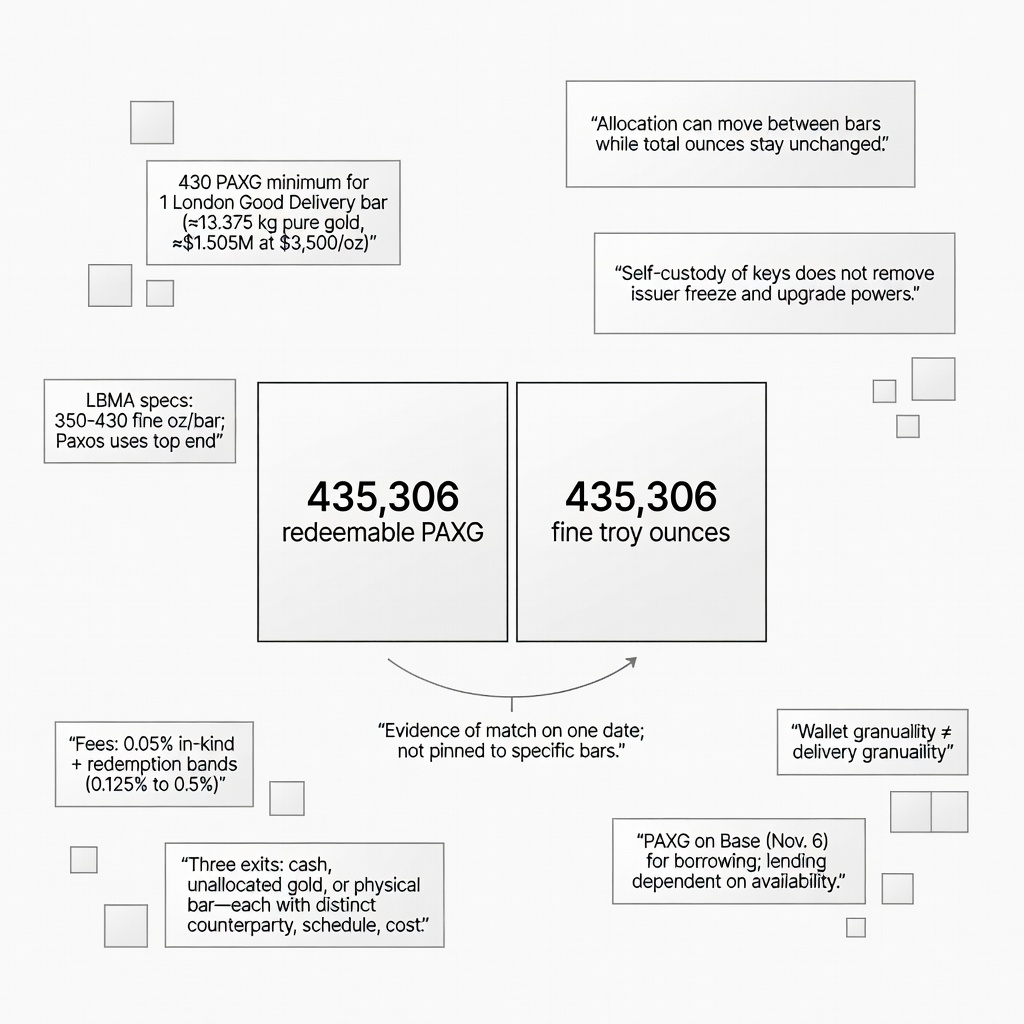
The latest linked monthly attestation in the report covers Sept. 30 and was issued by KPMG with an opinion dated Oct. 23. It reports 435,306 redeemable PAXG against 435,306 fine troy ounces of gold at 5 p.m. Eastern, with no surplus or deficit at that date. Ethereum accounts for 432,506 of those tokens, about 99.36%, with the remainder spread across other native issuances. The asset exhibit names Brink’s Global Services and ICBC Standard Bank as storage providers.
That is evidence of a one-to-one match between redeemable tokens and reported fine ounces on one measurement date. It is not evidence that a given wallet’s tokens are pinned to one bar. It also predates the native Base issuance below, so it cannot show whether the match still held after that deployment.
Borrowing does not bypass the bar rule
PAXG’s native deployment on Base on Nov. 6 was presented as a way for holders to retain gold exposure while borrowing against it. Lending integrations were described as dependent on product availability. A chain deployment is therefore not, by itself, confirmation that every lending venue is live.
On-chain lending service Arch accepts PAXG and XAUT as collateral through Anchorage Digital custody, with a disclosed starting loan-to-value ratio of up to 75%. In the report’s illustration, $100,000 of collateral and a 75% starting loan produce $75,000 of debt before interest. A 10% decline in collateral value leaves $90,000 against that debt, or roughly 83.3%. Starting loan-to-value is not automatically the liquidation threshold; each product’s contract supplies its own terms.
PAXGy, a gold-leasing token, inserts another conversion. It redeems into PAXG at an exchange rate affected by its reserve strategy, and only then do Paxos’s eligibility and bar-size rules apply. Paxos’s terms also reserve freeze and upgrade powers over the token, so self-custody of keys does not remove the issuer’s role in the asset.
What the minimum does and does not show
The 430-token bar minimum does not contradict the stated one-ounce backing of each token. Divisible ownership and transfer can sit alongside a professional custodian who stores whole bars. What the terms do establish is that wallet granularity and delivery granularity are different. Near an illustrative $3,500 an ounce, direct bar delivery is a seven-figure gold position, so most smaller holders are in practice choosing among an exchange sale, a cash conversion, and any partner-retailer route — three counterparties and three sets of charges. The partner-retailer fractional route is only referenced as having been described in January; this report does not restate its terms.
Open points
The next stated data point is the issuer’s next monthly reserve attestation, which would show whether the token count and reported fine ounces still match one-to-one after the Base launch. Holders weighing a direct exit would also need any later revision to the redemption fee bands or to that partner-retailer route. Delivery costs are not quantified here. None of the ounce prices above are live prints, and none of the redemption arithmetic is a recommendation to redeem, sell, or borrow.